
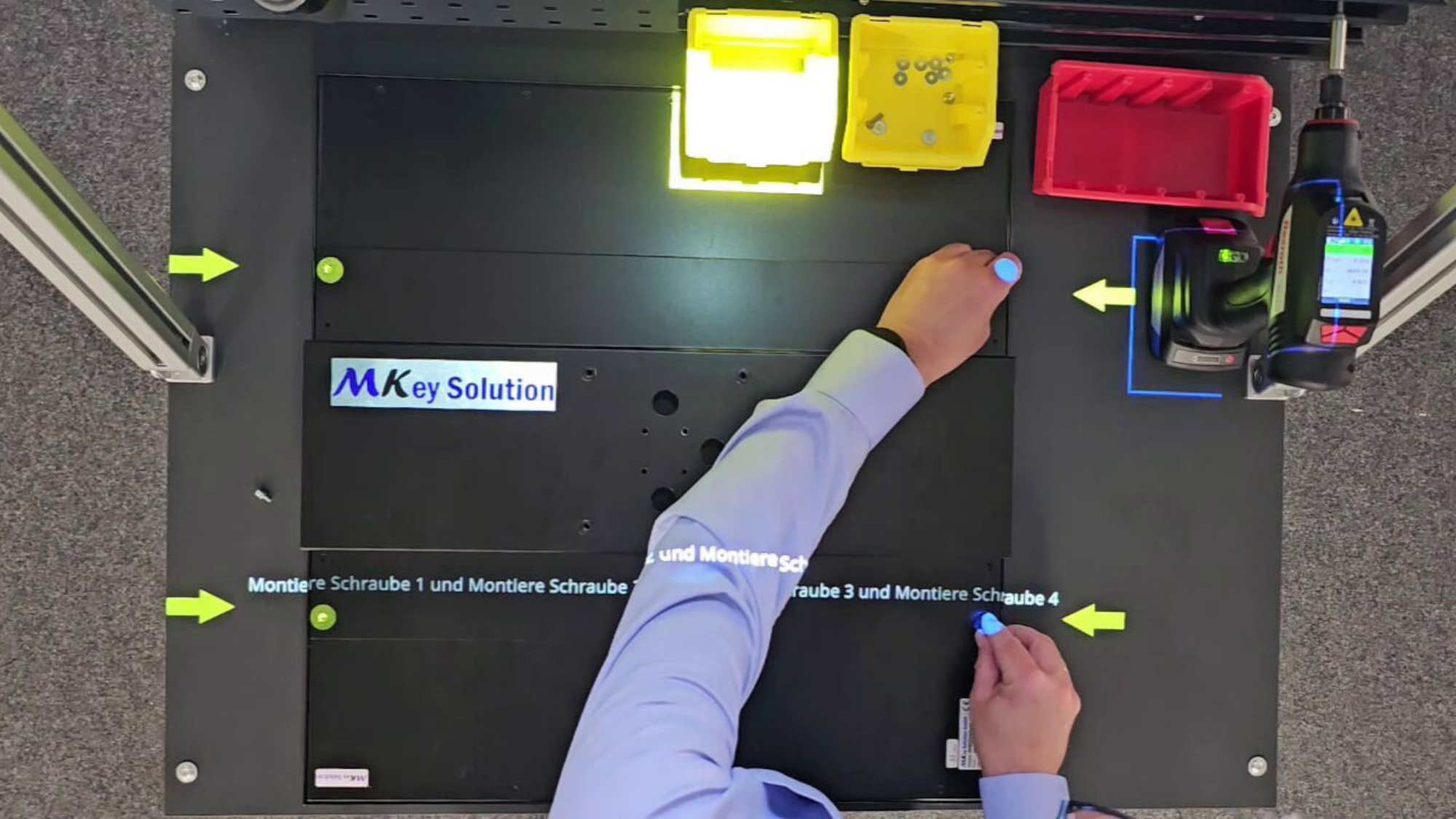
To help manufacturing executives uncover hidden productivity losses on the shop floor, German industrial digitalization exper,t MKey Solution GmbH, is redefining how worker assistance systems leverage operational data. While digital work instructions are traditionally viewed as real-time visual guides for complex manual assembly, their strategic value expands significantly when process telemetry is systematically analyzed across workstations, shifts, and individual cycle times.
Michael Kunze, Managing Director of MKey Solution GmbH and an expert in industrial digitalization, explains: “Worker assistance systems are often primarily understood as digital instructions that guide employees through complex assembly or manufacturing processes. However, their true strategic value only becomes apparent when the data generated during these processes is systematically utilized.
A particularly effective approach is to compare identical work steps across different workstations, employees, and shifts. This is precisely where differences emerge that often go unnoticed in day-to-day operations but can have a significant cumulative impact on productivity and quality.”
Interpret Data Instead of Simply Collecting It
Michael Kunze: In many production environments, it becomes apparent that a work step is completed more quickly in the morning than during the late shift, or that two workstations with identical equipment have different cycle times.
A worker assistance system can make such deviations precisely visible without disrupting the workflow. However, the key is not to look at this data in isolation. Only by linking it with contextual information such as material availability, ergonomic conditions, or employees’ qualification levels can a reliable picture be created.
This makes it possible to differentiate between causes rather than simply treating symptoms.
Identify and Transfer Best Practices
M.K: A key lever lies in systematically identifying particularly efficient processes and making them available as a reference. The goal is not to establish rigid specifications, but to make successful approaches transparent.
If, for example, one workstation consistently achieves shorter processing times, it is worth taking a closer look at the practices used there. Often, small adjustments to the sequence of manual operations or the positioning of components make the difference.
Worker assistance systems can document these findings and translate them into adapted, context-sensitive work instructions.
Involve Employees as a Source of Knowledge
M.K: The greatest strength of these systems lies not only in collecting data, but in combining data with practical experience and expertise.
Employees should therefore be actively involved in the analysis. They are best placed to explain why certain processes are more efficient or where obstacles arise.
When this knowledge is systematically captured and stored in the system, it creates a continuous improvement process driven from within rather than perceived as an externally imposed requirement.
Rapid ROI Through Targeted Optimization
M.K: The economic benefits often become apparent faster than expected. When bottlenecks are identified and eliminated by comparing workstations and shifts, cycle times can be reduced and error rates lowered.
Even small efficiency gains in frequently repeated work steps can add up to a measurable return on investment within just a few months.
The prerequisite, however, is that the insights gained are consistently implemented rather than simply remaining in reports.
From Tool to Operational Management Instrument
M.K: Worker assistance systems are therefore evolving from pure support tools into operational management instruments. They do not merely provide instructions; they create transparency regarding actual process differences and enable well-founded decisions in day-to-day operations.
Companies that systematically leverage comparisons between workstations, employees, and shifts can unlock optimization potential that often remains hidden when using conventional methods.