
Today’s food industry operates in a reality where hygiene is no longer merely a component of sanitary procedures, but one of the fundamental pillars of overall business safety. A single incident of microbiological contamination—even if it causes no direct harm to consumers—can lead to a sudden collapse in revenue and, within a few months, to the bankruptcy of an entire company. A telling example is the recent case of a German delicatessen chain specialising in fish products, which declared bankruptcy on 1 December this year. The company’s difficulties began in July 2025, when Listeria monocytogenes was detected in jellied herring produced in Norway. A company and brand built over decades disappeared from the market as a result of lost consumer trust.
The cleaning and disinfection procedures currently applied in food production facilities do not fully eliminate the risk of microbiological contamination. Continuously reducing this risk therefore remains a challenge for manufacturers of food-processing equipment, starting already at the design stage of installations. Traditional solutions—often described as “passive”—are limited to the use of construction materials, primarily stainless steel, that do not promote microbial growth, as well as to design features (such as geometry and surface finish) that enable efficient and effective cleaning of equipment and installations.
Further reduction of infection risk, while maintaining existing methods, should also include design solutions that actively inhibit the growth rate of microorganisms and, under favourable conditions, may even lead to a reduction in their numbers.
The concept of active hygiene, first developed in 2017, initiated research that resulted in AgATT® technology—an innovative, patented solution developed by ATT in cooperation with the scientific community of the Jagiellonian University in Kraków. It is a direct response to the real needs of modern food processing facilities, which increasingly seek solutions that go beyond the classical approach to infrastructure hygiene.
From passive protection to active hygiene support
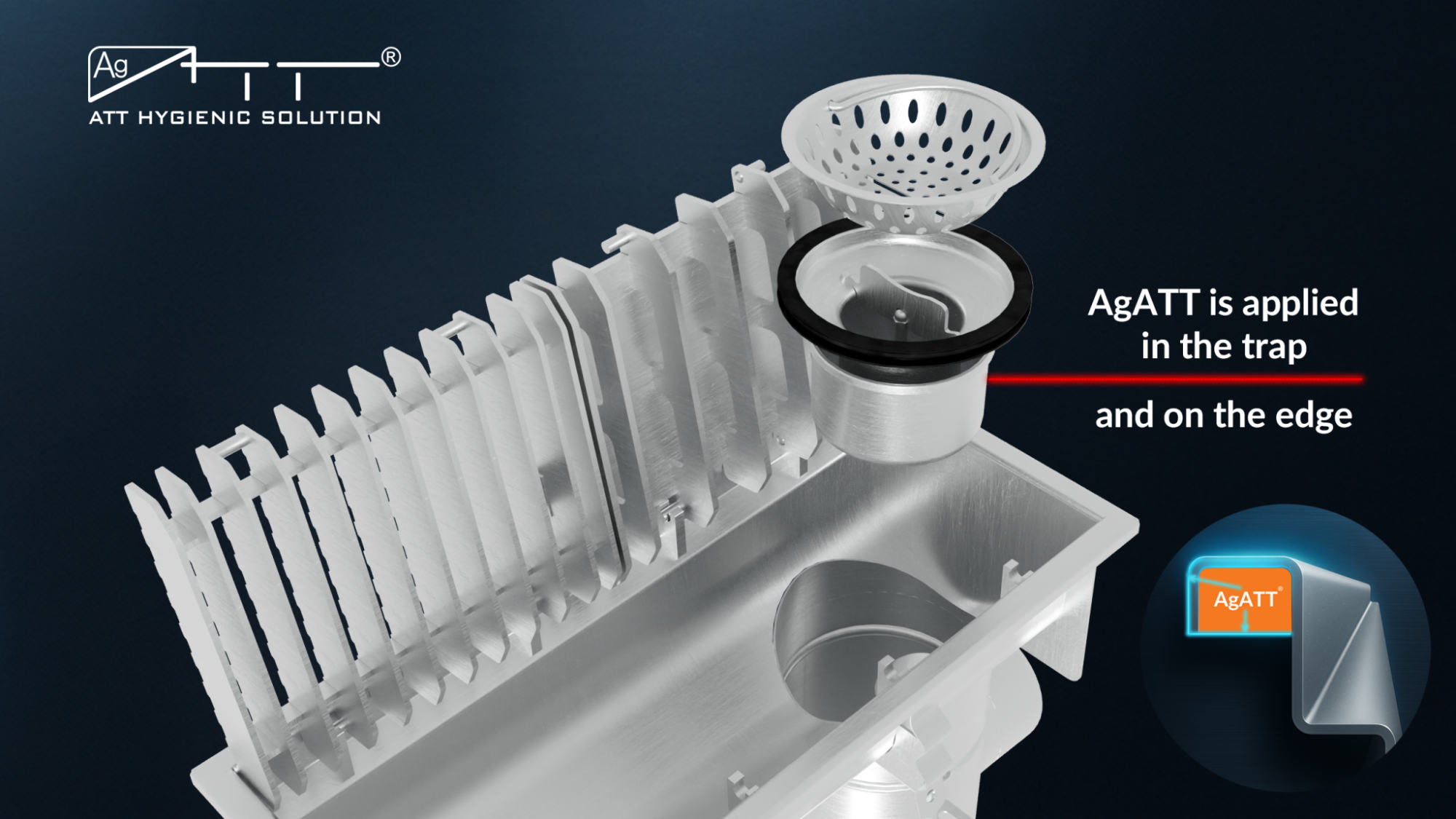
AgATT® is a durable coating applied to the surfaces of equipment in concealed structural elements. In humid environments, the coating—containing metallic silver—limits the growth rate of microorganisms. This is particularly relevant in hard-to-access areas exposed to prolonged contact with moisture and organic residues, or in locations inaccessible to traditional hygiene maintenance methods (such as expansion joints, or contact interfaces with floors or walls). It is also effective in components that, due to their design, are constantly exposed to contamination, for example sanitary drainage traps. These critical points often act as “reservoirs” of microorganisms and potential sources of contamination that cannot be fully eliminated through standard cleaning procedures.
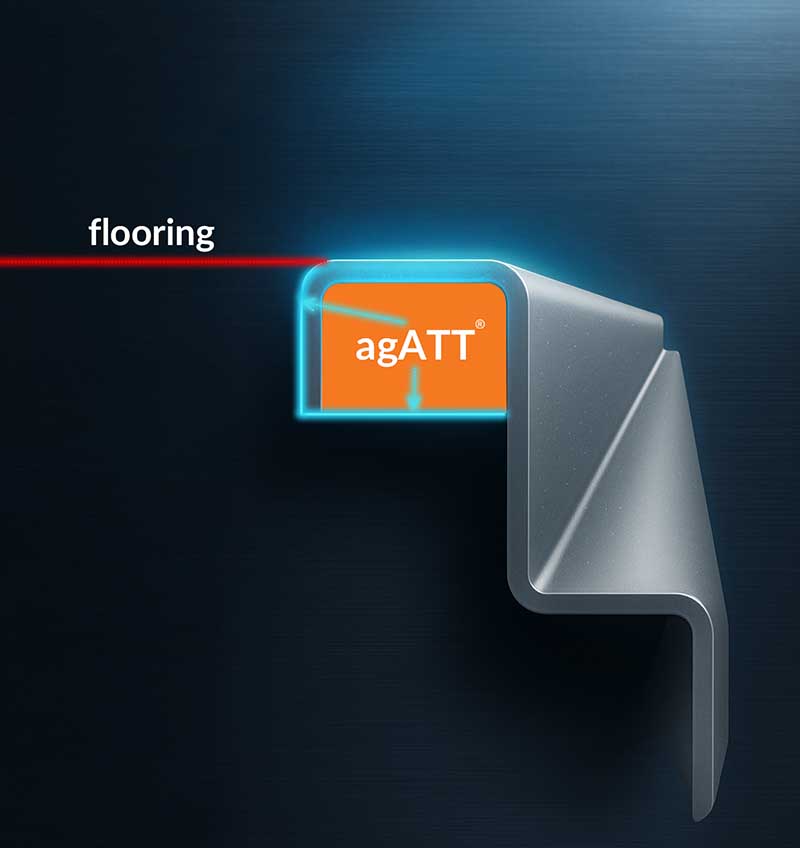
At the core of AgATT® technology are hybrid microparticles containing metallic silver, immobilised within a porous calcium carbonate matrix and permanently bonded to the substrate using an epoxy resin. This solution, developed in cooperation with the Faculty of Chemistry of the Jagiellonian University under the supervision of Prof. Maria Nowakowska, DSc, and Prof. Szczepan Zapotoczny, DSc, enables localised, long-term and controlled antimicrobial activity.
AgATT® does not require any changes to existing sanitary procedures. It does not replace them; instead, it passively and maintenance-free enhances sanitary safety, without generating additional operating costs.
AgATT® is a safe solution designed in accordance with the principles of sustainable development. It does not cause environmental emissions, either during the microparticle synthesis process or throughout the operational lifetime of the finished product.
Currently, AgATT® is being gradually implemented in selected floor drainage systems manufactured by ATT. This process is carried out in a controlled and consistent manner, with a strong focus on full compliance with the technological and hygiene requirements applicable to food processing facilities.
AgATT® is not a closed solution. It is a technological platform that can be further developed and adapted to additional areas of industrial infrastructure—wherever enhanced hygiene, workplace safety, and a responsible approach to technical design are a priority.
AgATT® represents another step towards the creation of intelligent, hygiene-aware infrastructure that responds to real customer needs while simultaneously setting new standards for the industry.