
Today, belt conveyor systems must adapt to a wide range of conditions – from freely configurable production lines to compact, highly integrated systems. This makes it all the more important to tailor the conveyor technology specifically to the respective integration and process requirements. Modular belt conveyors enable addressing diverse requirements and efficiently and sustainably designing material flows.
In state-of-the-art production environments, conveyor technology plays a central role as a link between individual process steps. It influences not only the material flow itself, but also the structure, expandability, and operational safety of complete systems. At the same time, the demands on conveyor technology are constantly increasing: System layouts are becoming more compact, processes are becoming more automated, and production systems are increasingly modular.
Suitable conveyor solutions for different system requirements
Against this background, it is crucial to select conveyor systems that can address both current requirements and future adaptations. Different design approaches each offer specific advantages – for example, in terms of integration capability, space requirements, or configurability. With the TB30 and TB40 belt conveyors, Montech provides two systems that focus on different technical areas and are specifically designed for different integration and application conditions. This Swiss technology company has specialized in the industrialization and standardization of advanced belt conveyors, transfer systems, and innovative aluminum framing technology for over 60 years.
TB30: High adaptability for flexible system concepts
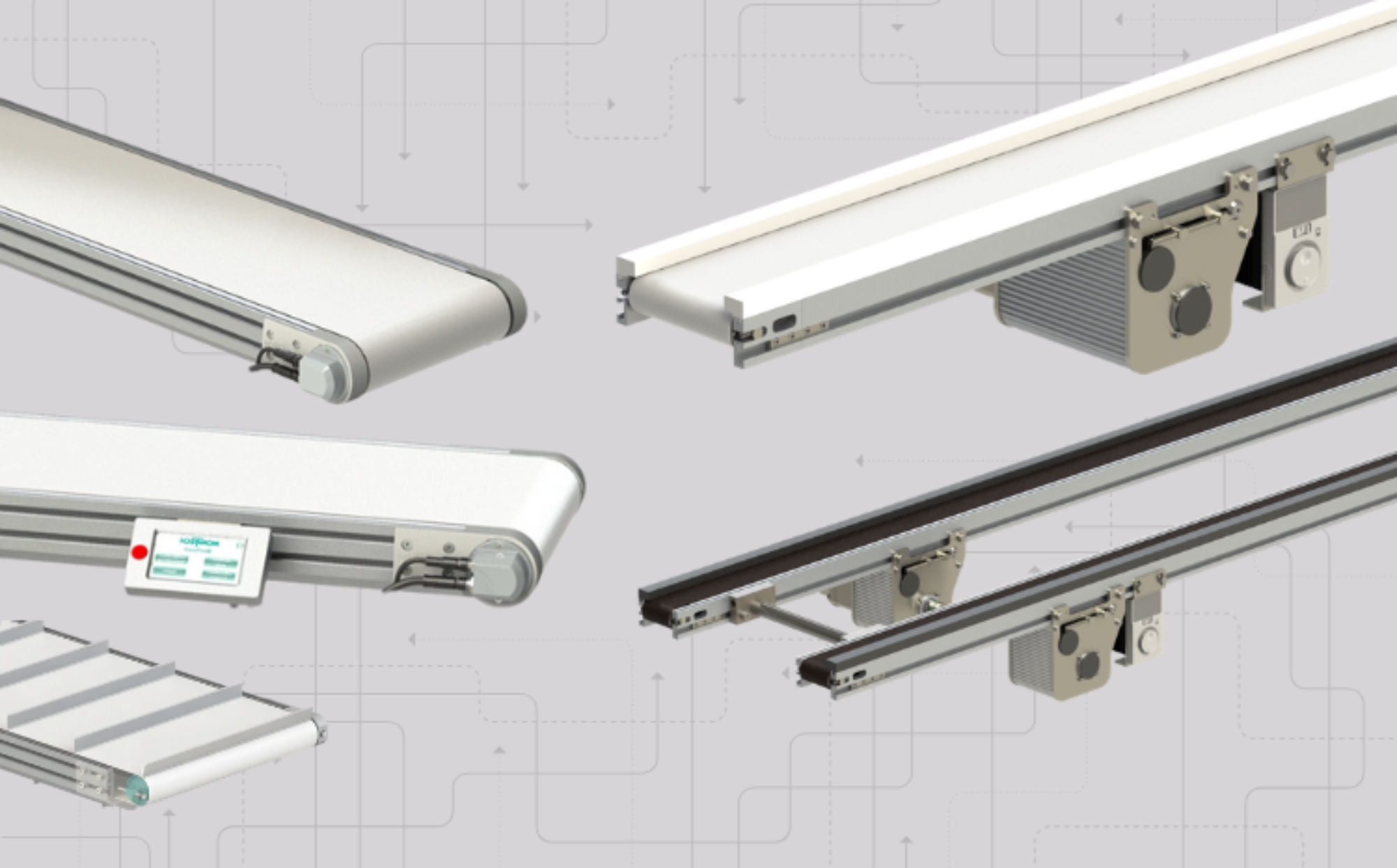
The TB30 belt conveyor is designed for applications that require a high degree of adaptability to the conveyor line. Different belt widths, conveyor lengths, and drive configurations allow precise adjustment to the specific task at hand. Depending on the integration requirements, a head or center drive is used, with the center drive positioned flexibly along the chassis. This facilitates the constructive integration into different system layouts. The modular design also supports use in existing systems and in modular production systems. Extensions and customizations can be implemented using standardized components without requiring fundamental changes to the design. This is particularly advantageous for systems with varying product formats, modular production lines, or frequent layout adjustments. This makes the TB30 belt conveyor particularly suitable for applications with individual layout requirements and variable system structures.
TB40: Integrated drive technology for compact system layouts
In contrast, the TB40 belt conveyor is based on an integrative design principle. The drive is fully integrated into the belt conveyor structure and is located directly in the drive roller. This solution reduces installation space requirements and simplifies mechanical integration. The elimination of external motor and gear units results in a compact and closed design with a mounting height of only 80 mm. This makes it easier to use in systems with limited installation space or in applications that require a particularly compact design. At the same time, the integrated drive concept simplifies the constructive integration into existing systems and reduces the effort required for installation and commissioning. The closed design also contributes to strong structural stability and low maintenance. The TB40 belt conveyor is therefore ideal for applications with clearly defined conveying tasks and stable process conditions, for example, in automated production lines or standardized material flow concepts.
Selection of conveyor technology according to design requirements
Both systems are modular, with standardized components, enabling efficient integration and high operational reliability. The choice between the TB30 and TB40 belt conveyors is based on the specific design and process-technical framework conditions. While flexibly configurable systems offer advantages for individual system layouts, integrated drive concepts enable particularly compact, integrated solutions. An application-oriented selection of the belt conveyor system optimally integrates the conveyor technology into the system structure and ensures stable, efficient material flows in the long term.