
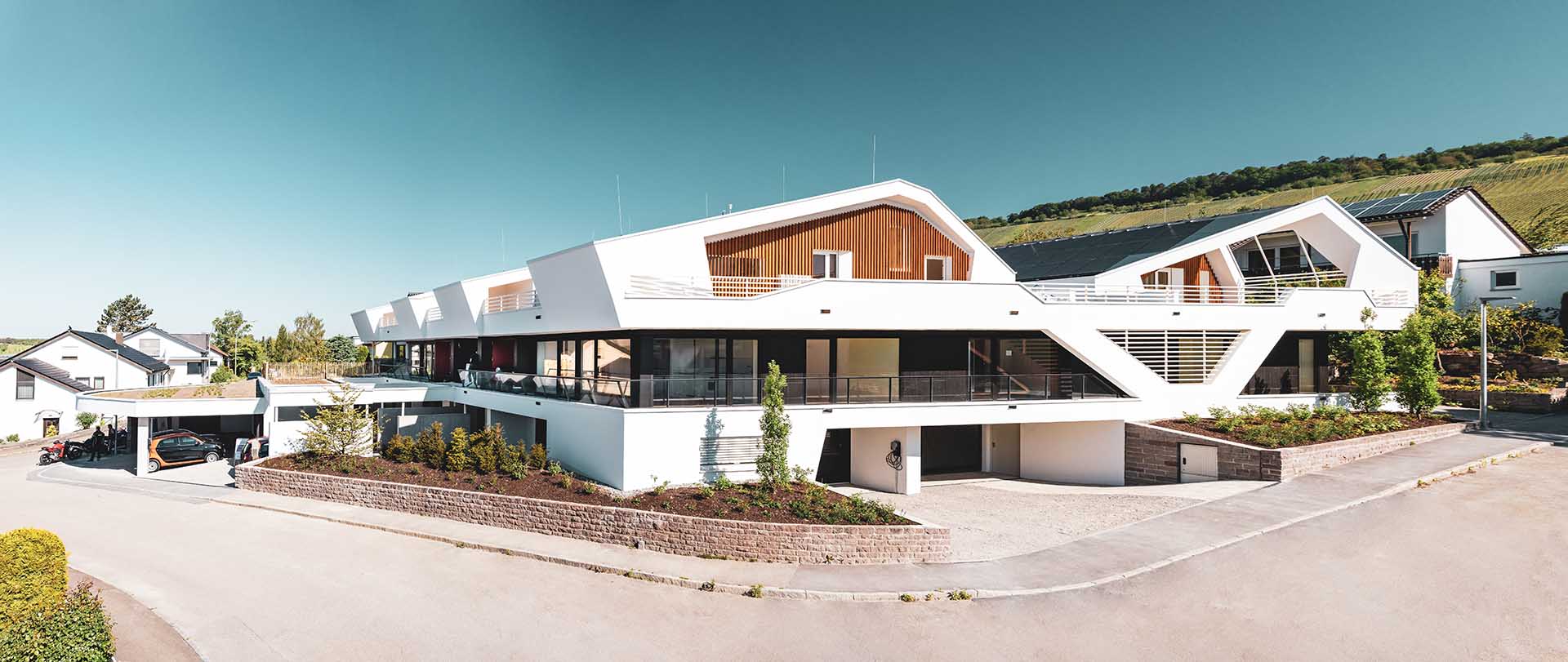
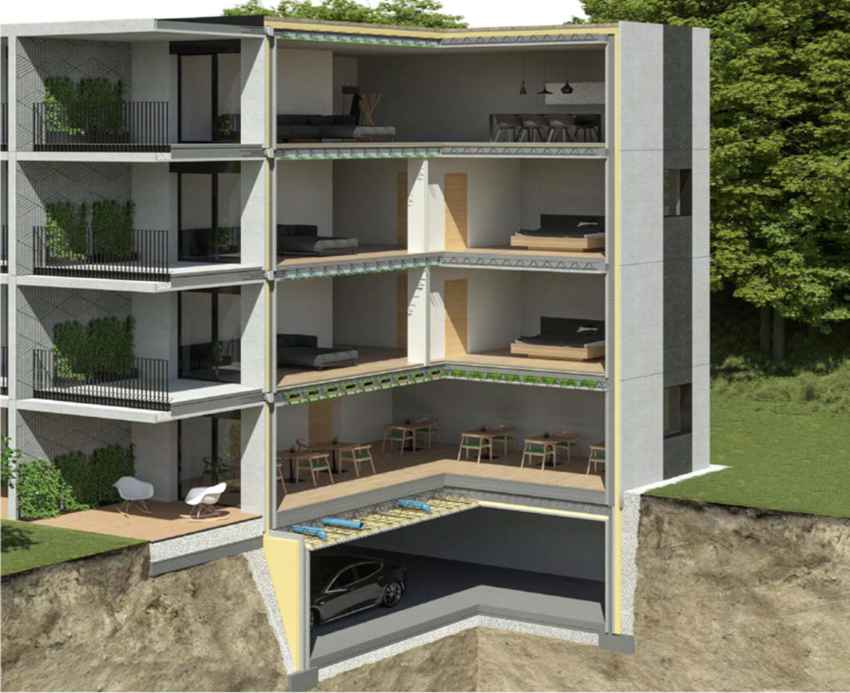
Green Code is an innovative construction system for individually planned, sustainable buildings made of concrete. System components are industrially manufactured precast concrete parts, activated with technical components: statics, insulation, climate, acoustics, light. Thanks to the possibilities of industrial prefabrication of the building elements, Green Code can equip the walls and ceilings with technical elements in a variety of ways. The system uses walls and ceilings far beyond their purely static function to increase the quality of living, comfort and optimize the energy balance.
The Green Code System was developed based on decades of construction expertise and know-how and guarantees an energy-optimized, building with feel good atmosphere.
Interview with Bernhard Leitner, Managing Director at Green Code.
How do your products or solutions contribute to greater operational efficiency for your clients or end-users?
Bernhard Leitner: At Green Code, efficiency is achieved through industrial prefabrication, standardization, and integrated building components. Green Code is an innovative building system for individually planned, sustainable buildings made with concrete. The system components are industrially manufactured precast concrete elements activated with technical features for: structural integrity, insulation, heating, cooling, ventilation, acoustics and lighting. Our system reduces planning complexity, compresses construction timelines, and ensures predictable quality. By embedding structural, thermal, and building-services functionality directly into our precast elements, we reduce interfaces and error sources. This results in streamlined workflows, leaner construction sites, and significantly lower lifecycle costs for our clients and residents. Once assembled on site and combined with in-situ concrete, the result is a structurally monolithic building.
Which key technologies or design principles have most improved the efficiency of your latest product generation?
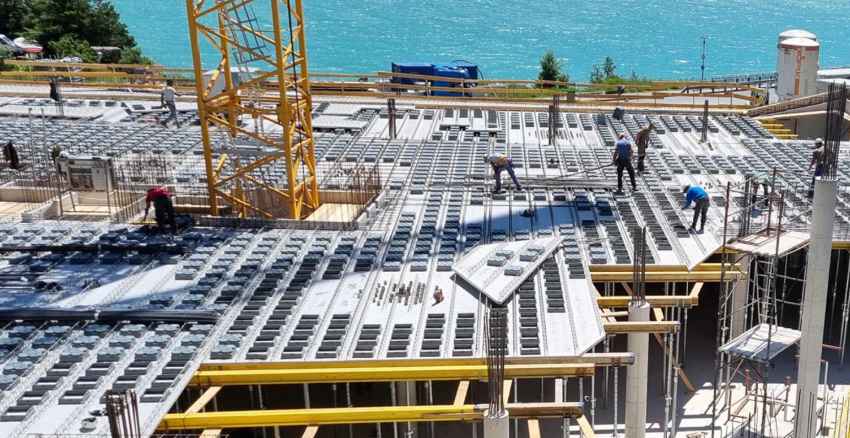
B.L: Our latest innovation, the Green Code Eco Slab® has achieved significant efficiency gains through a combination of advanced design principles and innovative production technologies. Central to these improvements is the use of void formers within precast concrete elements, which reduces the material volume while maintaining structural performance. This results in up to 25% less concrete, up to 15% less steel reinforcement, and consequently up to 25% lower CO₂ emissions, supported by optimized concrete mix designs in the automated precast plant. The system’s weight reduction of up to 25% allows for lighter overall building structures, enabling smaller foundations and columns without compromising stability. Integrated features such as lattice girders, customized panel widths, additional longitudinal and transverse reinforcement, punching shear reinforcement, and optional biaxial or single-axis tensioning ensure compliance with Eurocode 2 and broaden the system’s applicability. Automation and digitalization also play a key role: the Eco Slab is developed based on comprehensive digital planning up to the digital twin, enabling greater accuracy in scheduling and cost calculation. In practice, this approach shortens construction time by up to 40% and reduces required on-site manpower by up to 60%. Finally, the product’s circular design—including 100% recyclability at end-of-life, exposed concrete surface options, impact sound insulation comparable to solid slabs, and robust fire resistance—further strengthens its performance in terms of sustainability, safety, and long-term efficiency.
How do you define and measure “efficiency” within your organization or product portfolio?
B.L: We take a holistic perspective on efficiency, measuring:
- Construction efficiency through time savings, reduced interfaces, and predictable workflows.
- Material efficiency through minimized concrete volume, steel use, and embodied CO₂.
- Operational efficiency through energy consumption data and thermal comfort outcomes.
- Economic efficiency through lower planning costs, up to 40% reduced personnel on site, and minimized project risk.
In what ways has digitalization (IoT, data analytics, AI, etc.) influenced your approach to improving efficiency?
B.L: Digitalization is central to our approach. Our planning process is fully BIM-integrated, reducing planning loops and accelerating approvals. BIMpro, a plug-in for Autodesk Revit, thanks to its unique modular approach and mapping technology, aims to increase efficiency in the planning process. BIMpro increases the efficiency of converting an architectural or structural model into a precast concrete model by automating the creation of precast elements, reinforcement, inserts etc. Automated reinforcement layouts and data-driven prefabrication improve repeatability and reduce production errors. Data-based predictive operation further enhances comfort and reduces energy consumption. Manual work is reduced to an absolute minimum using automatisms, making detailing easier, faster and safer.
Can you share a recent project or case study where efficiency gains led to significant performance or sustainability benefits?
B.L: One standout example is the Hotel Das Gerstl Family Retreat in South Tyrol, a high-end hospitality project built entirely with Green Code components. Das Gerstl Family Retreat exemplifies how advanced precast technology, and efficient planning can drive significant sustainability and performance gains. By integrating large quantities of Green Code Eco Slab® elements—featuring recycled polypropylene void formers and cross-reinforced precast design—the project reduced concrete use by up to 25%, reinforcement by up to 15%, and overall structural weight by up to 25%, while accelerating construction by up to 40%. Despite the challenges of a hillside site and a technically demanding basement structure, precise digital planning and highly automated production ensured efficient workflows, consistent quality, and a minimized ecological footprint. Combined with durable concrete construction and complementary solid timber cladding, the hotel achieves long-term resilience, reduced environmental impact, and a harmonious architectural integration with its natural surroundings.

How do you balance efficiency improvements with other priorities, such as reliability, quality, or environmental impact?
B.L: We balance efficiency improvements with reliability, quality, and environmental performance by integrating these priorities directly into the design and production of the Green Code building system. Our system is based on strict standardization, ensuring that every component performs consistently across projects. Our precast concrete elements are engineered to reduce material use—saving up to 25% concrete and 15% steel—while maintaining long-term structural durability and resistance to fire, water, and extreme weather. At the same time, the components incorporate multiple functions within a single element, including thermal and acoustic optimization, surface-near activation for efficient heating and cooling, and integrated technical systems, ensuring high living quality and energy savings of up to 20%. Automated production processes enhance precision, minimize waste, and improve safety, while optimized cement and concrete formulations lower CO₂ emissions and enable full recyclability of all components. This holistic approach ensures that gains in efficiency never compromise reliability or quality; instead, they reinforce environmental sustainability and operational performance throughout the entire building lifecycle. All improvements are validated through structural tests, thermal simulations, and long-term performance criteria
What role do your suppliers or partners play in helping you achieve higher efficiency across your value chain?
B.L: Our suppliers and partners play a central role in achieving higher efficiency across our value chain. We collaborate with 11 certified Green Code partners across Europe, spanning Belgium, Germany, Austria, Poland, Italy, and Hungary, all of whom operate with highly efficient, standardized production processes. Their expertise in automated precast manufacturing, adherence to strict quality criteria, and ability to integrate technical components directly into the elements ensure consistent precision, reduced material use, and reliable delivery times. This network enables us to scale sustainably, shorten construction periods, and guarantee uniform performance standards across all markets. By aligning closely with our partners from planning to production, we create a streamlined, resilient, and resource-efficient value chain that supports both project quality and long-term sustainability.
How do you ensure that efficiency improvements are maintained over the full lifecycle of your product or solution?
B.L: We ensure that efficiency gains are preserved throughout the full lifecycle of our solutions by combining the inherent durability of concrete with circular design principles integrated into the Green Code Eco Slab®. Concrete maintains its structural performance for decades, offering high resistance to fire, water, and extreme weather, which minimizes maintenance needs and safeguards long-term efficiency. At the end of the lifecycle, the Eco Slab can be fully recycled, supporting a closed material loop. The system’s GC box void formers and built-in components, made from 100% recycled and fully recyclable polypropylene, further contribute to lifecycle efficiency. They are corrosion-resistant, structurally robust—withstanding point loads up to 2 kN—and available in multiple heights to accommodate integrated elements such as lighting, ventilation, and acoustic absorbers. This combination of long-lasting materials, multifunctional component integration, and complete recyclability ensures that efficiency is not only achieved during production and construction but consistently maintained through use, end-of-life, and material recovery.
BIM Pro Video:
What challenges or barriers do you face when implementing efficiency-driven innovations in your industry?
B.L: One key barrier is the coordination across multiple stakeholders, including architects, engineers, contractors, and suppliers, to ensure that advanced solutions like Green Code Eco Slabs® are fully understood and correctly integrated from design through installation. Another challenge lies in changing traditional workflows and mindsets, as contractors and workers must adapt to more automated, digitally planned processes while maintaining safety and quality standards. Additionally, skilled labor shortages make it harder to implement complex site-built solutions, which underlines the importance of our simple, prefabricated approach. By addressing these barriers through close collaboration, training, and rigorous planning, we are able to implement innovations.
Assembly Video Hotel Das Gerstl:
Looking ahead, which emerging technologies or trends do you believe will most unlock new levels of efficiency in your field?
B.L: Looking ahead, the technologies and trends that will unlock new efficiency levels in our field are advanced industrial prefabrication and automation. Highly automated production in the factory allows elements like Green Code Eco Slabs® to be manufactured faster, with less manpower, and with consistent high quality, something that traditional on-site methods cannot achieve. Integrated components and digital planning further streamline construction, reduce errors, and maintain cost-effectiveness—or even lower overall costs—while ensuring long-term durability. These trends enable projects to be completed more reliably, safely, and sustainably, combining speed, precision, and resilience in ways that conventional construction cannot match.
https://www.linkedin.com/company/green-code-sustainable-buildings
https://www.instagram.com/green_code_gmbh
https://www.linkedin.com/in/bernhard-leitner-green-code-managing-director
https://www.youtube.com/@progress-group
Green Code GmbH
Zeil 109
D-60313 Frankfurt am Main
Tel.: +39 0472 979 374