
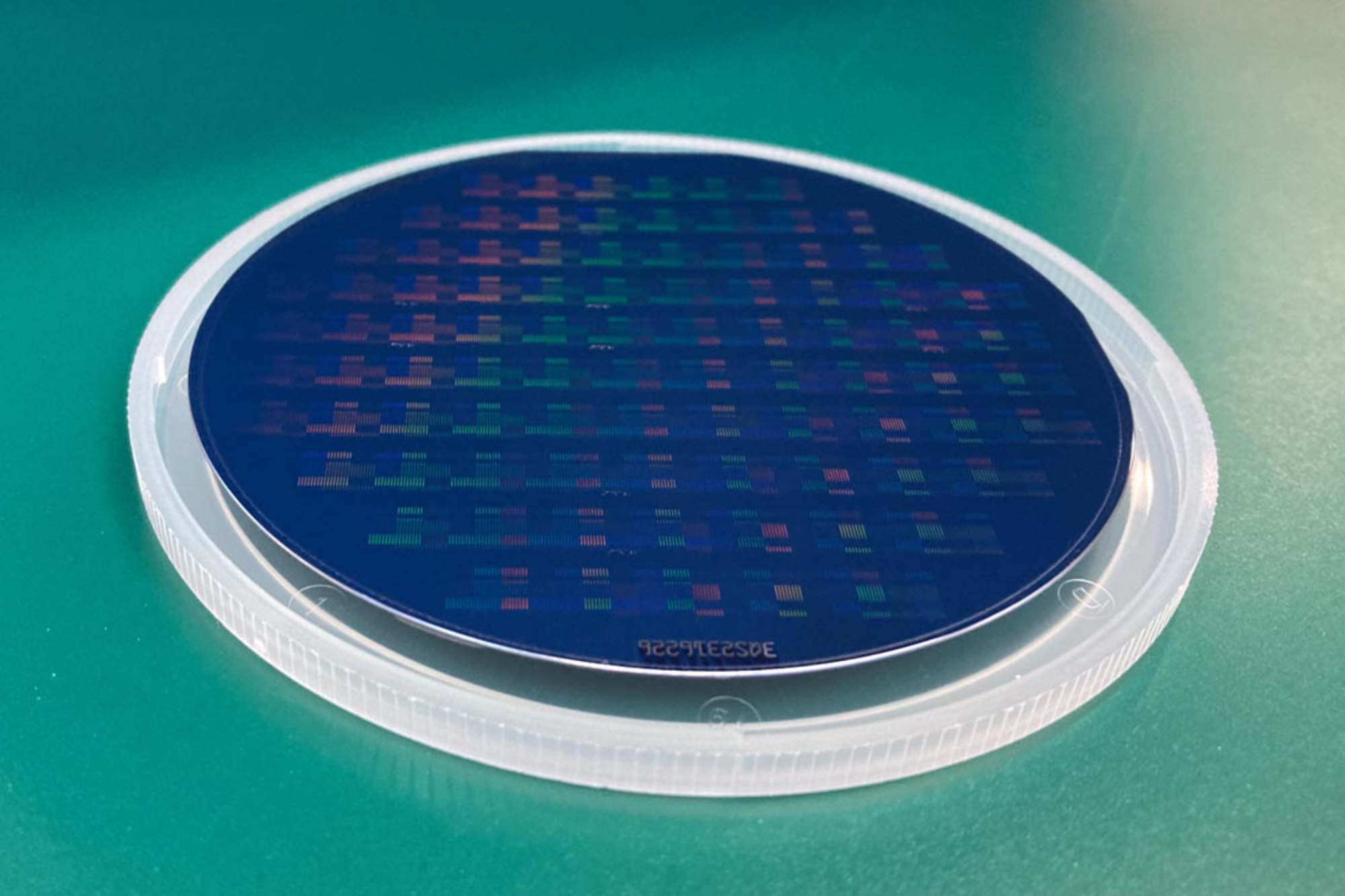
QD Laser, Inc. is a Japan-based company, offering cutting-edge technology in semiconductor lasers and epitaxial wafers. The company has been in the semiconductor laser market for nearly 20 years, and they succeeded in the commercialization of quantum dot laser for optical communications for the first time in the world. With core technologies of epitaxial growth, product design, and evaluation, QD Laser is focused on quality, innovation, and pushing the limits of what a semiconductor laser can achieve.
Interview with Yutaka Onishi, General Manager of Laser Device Division.
What are the main areas of activity of the company?
Yutaka Onishi: Our core activities span two main technological pillars:
- High-Performance Semiconductor Lasers: This includes the design, manufacturing, and global sales of various laser diodes, such as single-frequency DFB lasers, visible lasers, and quantum dot lasers. These products are engineered for superior spectral stability, low noise, and excellent beam quality, which are critical for precision applications.
- Epitaxial Wafers: With expertise in molecular beam epitaxy (MBE), we provide high-quality quantum dot epitaxial wafers to customers worldwide. This in-house capability ensures the high performance and consistent quality of our finished laser products and allows us to offer custom solutions to our customers.
What’s the news about new products/services?
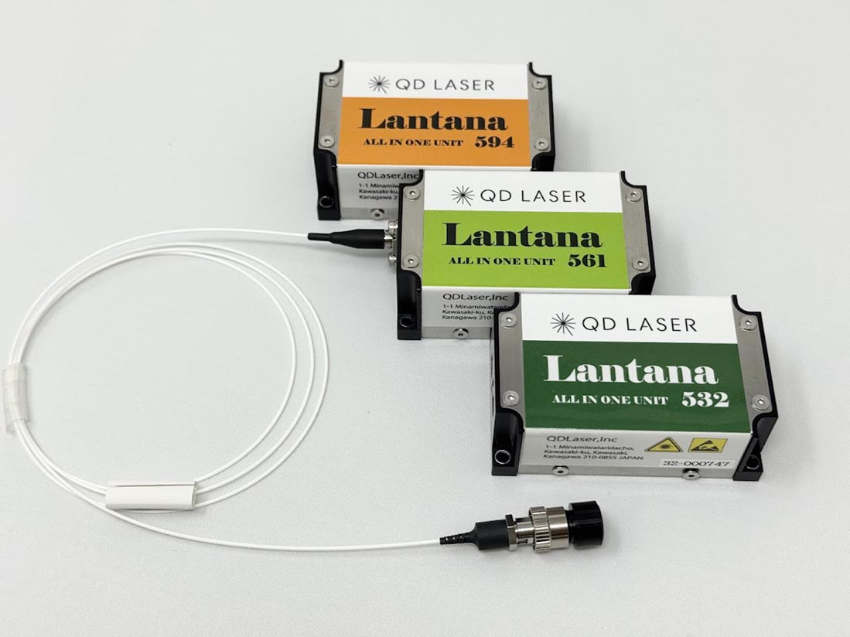
Y.O: In 2024, QD Laser proudly introduced “Lantana”, a game-changing addition to our visible laser portfolio. Lantana is an all-in-one (plug-and-play) yet ultra-compact, single-frequency laser unit with an integrated driver, realizing easy installation and miniaturization. The wavelengths are 532 nm (Green), 561 nm (Yellow-Green), and 594 nm (Orange). Lantana can be widely used in the area of biomedical (flow cytometry, laser microscopy, fluorescence imaging), Raman spectroscopy, holography, interferometry, and quantum sensing.
Furthermore, we are actively expanding the Lantana lineup. We are currently developing three important new wavelengths: 488 nm (Blue), 552 nm (Green), and 588 nm (Yellow). We anticipate these new light sources will become available for sample supply in Q3 of 2026.
What are the ranges of products/services?
Y.O: Our product lineup is:
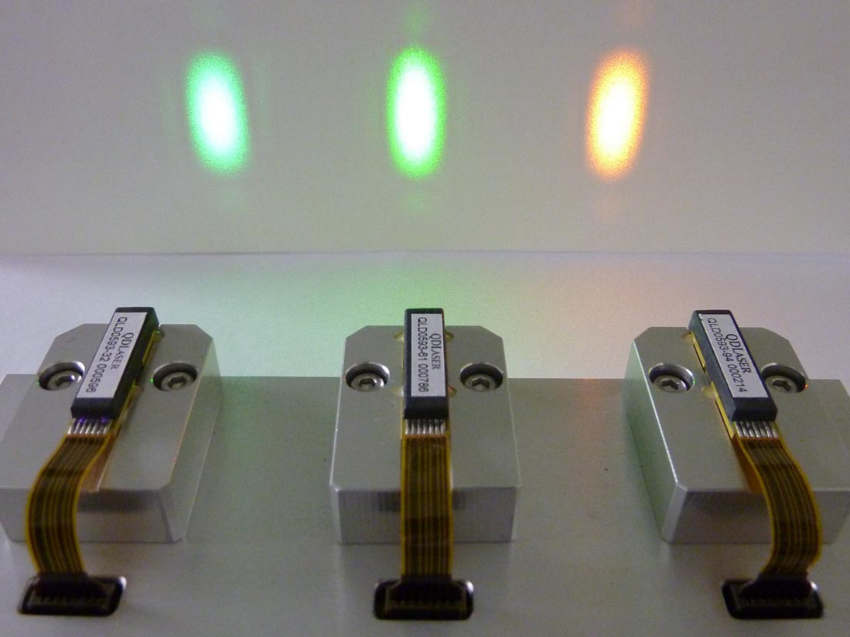
532, 561, 594 nm compact visible lasers: Ideal for biomedical applications such as flow cytometry, and Raman spectroscopy.
640, 660, 685, 785, 830, 850, 905 nm Fabry-Perot lasers: High-reliability, cost-effective lasers for various sensing and industrial applications.
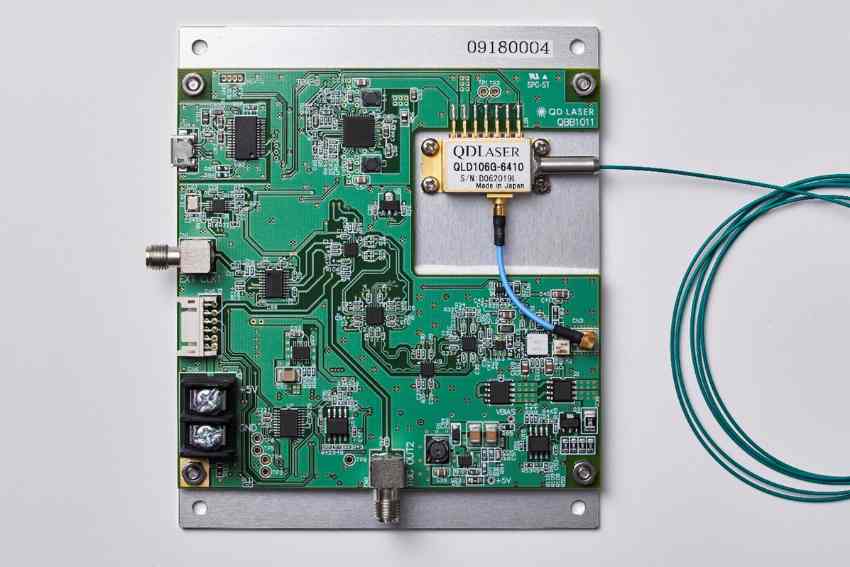
1 µm wavelength range single-frequency DFB lasers: Exceptional spectral stability and narrow linewidth. Perfect as a seeder for fiber lasers in LiDAR and Micromachining. Available in the ranges of 1018 nm-1122 nm and 1140 nm-1188 nm in 1-nm step.
1.3 µm quantum dot epitaxial wafers: Excellent reliability at high temperatures and high optical feedback tolerance, suitable as light source for optical communications and silicon photonics.
Detailed specifications and product documentation are available on our product website: www.qdl-laser.com/en.
What is the state of the market where you are currently active?
Y.O: The market landscape is highly specialized for our products:
Light Source for AI Data Center Market: AI data center market continues to be hot through 2026. A quantum dot laser is attracting much interest as a light source for Al data centers to save power consumption and production cost of optical components.
Visible Laser Market: The flow cytometry market is highly dynamic. The demand for increasingly compact, reliable, and high-power systems is driving innovation. Our 561 nm laser has a strong presence, as this specific wavelength is crucial for excitation in many fluorescent analysis techniques.
Single-Frequency DFB Laser Market: Our DFB lasers, covering a wide range from 1018 nm to 1188 nm (including key wavelengths like 1030 nm, 1053 nm, 1064 nm, and 1080 nm), are perfectly positioned as seeders for high-power fiber lasers. The growth of micromachining, semiconductor inspection, and next-generation LiDAR systems directly translates into increased demand for our spectrally stable DFB light sources.
What can you tell us about market trends?
Y.O: We observe several key trends shaping the future of photonics:
Low power consumption: Increasing power consumption of data center becomes a serious problem as scaling optical interconnects for AI. A challenge for light sources is to suppress power consumption while increasing bandwidth of data traffic.
Miniaturization and Integration: There is an overwhelming trend toward integrating more functions into smaller packages. This is not just about physical size, but also about integrating the driver and control electronics. Products like our Lantana are a direct response, offering plug-and-play simplicity and reducing the complexity for system integrators.
Increased Demand for Wavelength Flexibility: Applications in biomedical and quantum sensing constantly require new, non-standard wavelengths for enhanced differentiation and precision. Our commitment to offering a wide, high-resolution wavelength selection (like our 1 nm step DFB lineup) and developing new visible wavelengths (488, 552, 588 nm) is crucial to meeting this trend.
Low Noise and High Coherence for Quantum Sensing: Emerging fields, particularly Quantum Sensing and high-resolution metrology, demand lasers with extremely narrow linewidth and low intensity noise. This elevates the importance of high-quality Single-Frequency DFB Lasers that can maintain stability under various operating conditions.
What are the most innovative products/services marketed?
Y.O: Our most innovative and market-disrupting product is undoubtedly quantum dot epitaxial wafers. With more than 20years history of R&D, we support establishing a supply chain of next generation light sources for data center market as a world-leading quantum dot epitaxial wafer foundry.
Another innovative product is the Lantana, All-in-One Visible Laser Unit.
Lantana’s innovation lies in its exceptional combination of features that were previously unattainable in a single compact device:
- Ultra-Compact Form Factor (53 cc): Allowing designers unprecedented freedom to reduce system size.
- All-in-One Integration: Eliminating the need for a bulky, external driver, simplifying BOM (Bill of Materials) and reducing integration time.
- High Performance: Delivering the high spectral stability expected from laboratory-grade lasers.
On the infrared side, our family of single-frequency DFB lasers is highly innovative. By utilizing advanced design and epitaxy, we achieve world-class spectral purity across the difficult-to-achieve 1 µm band, making them irreplaceable as seeders for the next generation of high-power fiber lasers.
What estimations do you have for the first half of 2026?
Y.O: The first half of 2026 will be a period of significant growth and visibility for QD Laser.
Our focus will be connecting with new and existing customers at the industry’s most important event, Photonics West 2026.
- Event: Photonics West 2026
- Dates: January 20 – January 22, 2026
- Location: San Francisco, CA
We anticipate strong interest in our Lantana unit, especially from developers in the biomedical and analytical instrumentation sectors looking to start new design cycles. Furthermore, we expect increased demand for our 1 µm DFB lasers as LiDAR and micromachining continue their rapid adoption. We are excited to showcase our technological advances and engage in discussions about how our compact, high-performance lasers can contribute to our customers’ next breakthrough designs. We look forward to seeing many new faces at our booth.

QD Laser, Inc.