

Qualinx is a high-tech fabless semiconductor company specializing in ultra-low power wireless positioning, tracking and connectivity solutions for consumer products. Founded in 2015, the company pioneers Digital RF, a technology that enables their architecture to address frequency bands between the range of sub 100MHz to sub 8GHz.
A brief description of the company and its activities.
DRF is the key to transforming RF semiconductors from the analog domain to the digital domain, therefore bringing all the benefits of CMOS to the Qualinx technology platform. CMOS scaling results in our ability to deliver unprecedented scale in terms of power to performance to TCO ratios at the product level not only for Qualinx, but all the way downstream to our customers and their customers in turn – in fact all the way through the lifecycle of our customers’ end products.
Qualinx is bring technology to market that redefines the connected edge.
Headquartered in Delft, the Netherlands and with access to a centralized European supply chain with global capabilities, Qualinx is ideally positioned to provide the reassurances needed for resilient and de-risked supply chains.
What are the main areas of activity of the company?
Qualinx’s initial productization of our technology addresses the GNSS and IoT market segments. The intrinsic low power -to- performance characteristics of our DRF enabled GNSS hardware focus is on the design, production and sales of GNSS hardware and its embedded software solutions that deliver the optimal mix between low power consumption, performance and total cost of ownership. The first product rollouts from Qualinx are optimized for positioning, tracking and timing use cases, typified by vertical markets such as asset tracking, personal monitoring and ambient intelligence.

What’s the news about new products/services?
Early 2026 Qualinx is launching a flexible analog front-end (AFE) based on the patented digital RF technology (Dragonfly™,) that powers the GNSS receiver. It will bring the same advantages the GNSS receiver has; namely lower TCO, reconfigurability and agility over a wide range of frequencies. The AFE offers an optimal solution to applications that need to treat incoming signals with precision and enables the delivery of improved results.
Next to the AFE we’ll also introduce our evaluation kits, allowing a wider community to see the benefits with their own eyes and experience how easy embedding a Qualinx GNSS receiver in their products is.
What are the ranges of products/services?
Qualinx provides products for 3 main applications, Positioning, Tracking and Timing. Wearables are a good example of a positioning application where the true magic of wearable technology lies in their ability to operate continuously without charging. By using Dragonfly, these chips reduce energy consumption and allow devices such as fitness trackers and smartwatches to remain lightweight and dependable. The result is wearables that can deliver consistent performance without frequent recharging, making them more convenient for everyday use. Or if we focus on tracking, the Qualinx receiver can be used in logistics and agriculture to track vehicles, equipment, or even livestock. Consuming up to 10x less power than conventional solutions, which means sensors can operate for months or years without frequent battery changes with reliable world-wide coverage. The combination of small size, ultra‑low power, and reduced manufacturing complexity makes it possible to deploy tracking devices in places where traditional solutions would be too bulky or costly.

What is the state of the market where you are currently active?
The consumer GNSS market in 2026 and the near future is growing steadily, mostly driven by demand for location-based services in devices like wearables, and IoT devices. Integration with low-power, compact technologies and emerging LEO satellite systems is driving enhanced accuracy and coverage.
Multi-constellation support is now the standard, improving reliability across applications like navigation, fitness tracking, and asset management. Overall, GNSS is a cornerstone in connected consumer electronics with a lot of innovation ahead.
According to (360i Research, MMS, et al (2025) the total addressable market for radio-chip enabled IOT devices is about $900B in 2026. That includes GNSS receivers, wearables, asset tracking and devices for smart cities.
What can you tell us about market trends?
Integration is arguably the most dominant trend shaping the future of technology. We see it manifesting in multiple dimensions: the convergence of positioning and communication capabilities like 5G within IoT devices, the push toward increasingly compact form factors for products that demand both miniaturization and ultra-low power consumption, and the seamless incorporation of emerging LEO (Low Earth Orbit) satellite navigation systems into next-generation receivers.
A second important trend is the need for trusted positioning, where receivers can indicate how reliable the position is and help counter the effects of wrong, and unfortunately at times malicious, information being fed to the receiver.
These developments are not isolated—they reflect a broader industry movement toward smarter, more efficient, more robust and more connected solutions. In all these areas, Qualinx holds a strong and strategic position, thanks to its innovative use of digital RF technology, which enables high levels of integration without compromising performance or energy efficiency.
What are the most innovative products/services marketed?
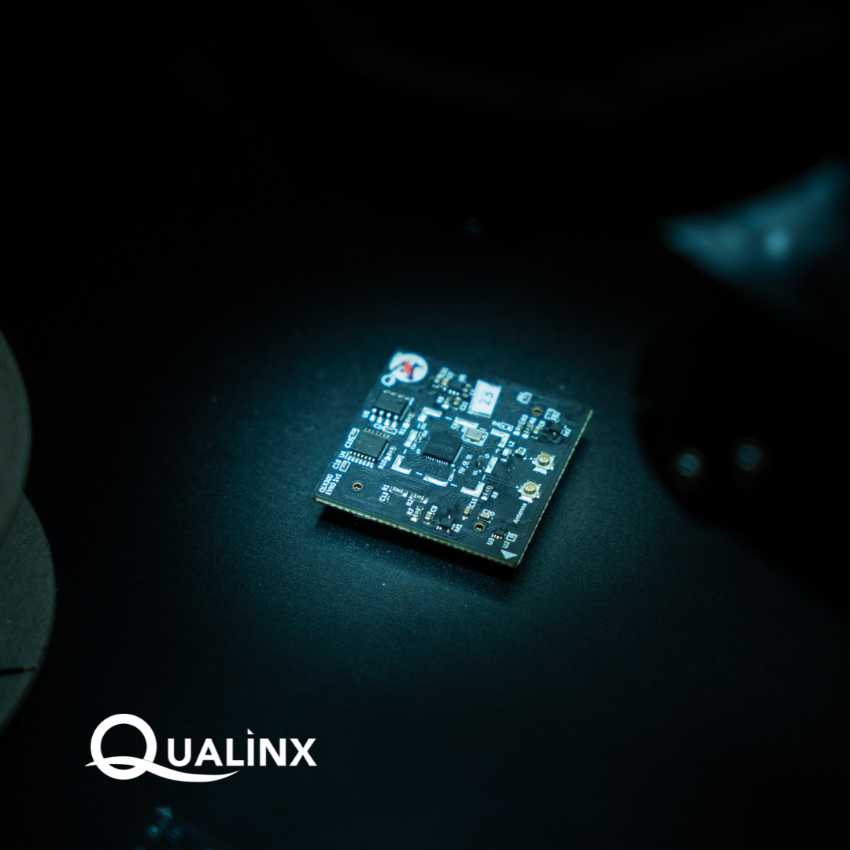
The innovative strength of Qualinx is in our people but ultimately embedded in our technology, like our patented Dragonfly™, which offers the base of our low-power and configurability. Ultimately, innovation is about creating value for users. At Qualinx, every customer we have engages in a close collaboration with our teams through the downstream process to ensure they fully comprehend the transformative nature of Dragonfly technology, thereby helping them to pass through real world benefits and value to their own customers – for example: longer product life, better precision , high accuracy services, security and resiliency, or authenticated services via OSNMA, particularly resulting from the work we do within the Galileo ecosystem. This gives them the flexibility to realize their own product / solution design ambitions and aspirations
What estimations do you have for 2026?
We see healthy growth in the markets for IOT and GNSS devices for the coming years with the total number of installed devices with GNSS growing to 8 billion units in 2033 according to (EUSPA EO and GNSS Market report 2024). We are also expanding our partnerships and relations throughout our very vibrant ecosystem. We are investing heavily in our presence at CES, Mobile World Congress, and Embedded World, where customers and partners can experience the transformational performance of our AFE and GNSS solutions.
We recently stepped up our digital media presence by launching our new website, creating stronger brand awareness, visibility and engagement. This enhanced presence is driving broader awareness of Dragonfly technology and aligning our 2026 mass production ramp with new product introductions throughout our partner and customer value chains.