
Electronics manufacturing has changed significantly in recent years. Product life cycles are becoming short and shorter, and product variants are on the rise. At the same time, the demands on quality and traceability are constantly increasing. Additional pressure is exerted by external factors such as fragile supply chains and the persistent shortage of skilled labor.
At the same time, the technological complexity of the circuit boards being produced is rising. The main drivers of this trend are modern applications for servers, IT infrastructure, and communication. Ever more parts in limited areas, more powerful components and ever finer structures place greater demands on the performance and balance of SMT lines. At the same time, miniaturized components such as 016008M chips must be processed with the same reliability and efficiency as large, heavy odd-shaped components (OSCs) and demanding ball grid arrays (BGAs) – all while the pressure keeps rising on the cost side as well.
It is becoming apparent in SMT manufacturing that individual improvements like increasing a machine’s performance or shortening its cycle times are no longer sufficient for achieving the efficiency and process stability needed for today’s applications. As a result, we are seeing a paradigm shift in the industry – away from the selective optimization of individual processes towards a connected production that is supported by data.
From focusing on the machine to integrated manufacturing
Looking back, the performance of an SMT line was for a long time defined by the performance of individual machines, with solder paste printers, placement machines and inspection solutions being optimized separately from each other. While this principle supported technological development for many years, it falls short for today’s requirements. In practice, it is becoming increasingly clear that the overall performance of a line depends predominantly on the interaction of all its processes. Uneven cycle times along the SMT line, unsynchronized material flows or delayed responses to process deviations can noticeably reduce its efficiency even if the individual machines perform on a high level. Against this backdrop, ASMPT has for some time pursued a different approach by linking people, machines, software, materials and processes in such a way that a consistent overall picture is created: the intelligent factory.
The basis for this concept is the data that is generated along the entire SMT line: from solder paste printing parameters to placement data to the results being generated by the SPI and AOI systems. But the full benefit of this data can unfold only if it is systematically consolidated and combined. Integrated software solutions in the WORKS Software Suite and the Factory Solutions of ASMPT bundle this information, process it, and make it usable for analytical purposes.
On this basis, optimization steps can not only be derived with precision, they can also be automatically implemented in many cases. Closed control loops use process data in real time to adjust parameters instantly, as happens in the feedback loop between the solder paste inspection and printing process or in the control of cleaning cycles. In addition, AI-based assistants help to identify patterns in the placement process data, detect deviations at an early stage, and point out potential improvements. As a result, the manufacturing process gets viewed in its entirety and becomes transparent and controllable. Production data can be compared against targets, bottlenecks can be identified with clarity, and quality deviations can be traced to their origin in detail. At the same time, decisions are made faster and based on better information than in classic, isolated system landscapes.
Maintenance operations also benefit from this integrated approach because rigid intervals give way to condition-based concepts that are based on the continuous analysis of machine and process data.
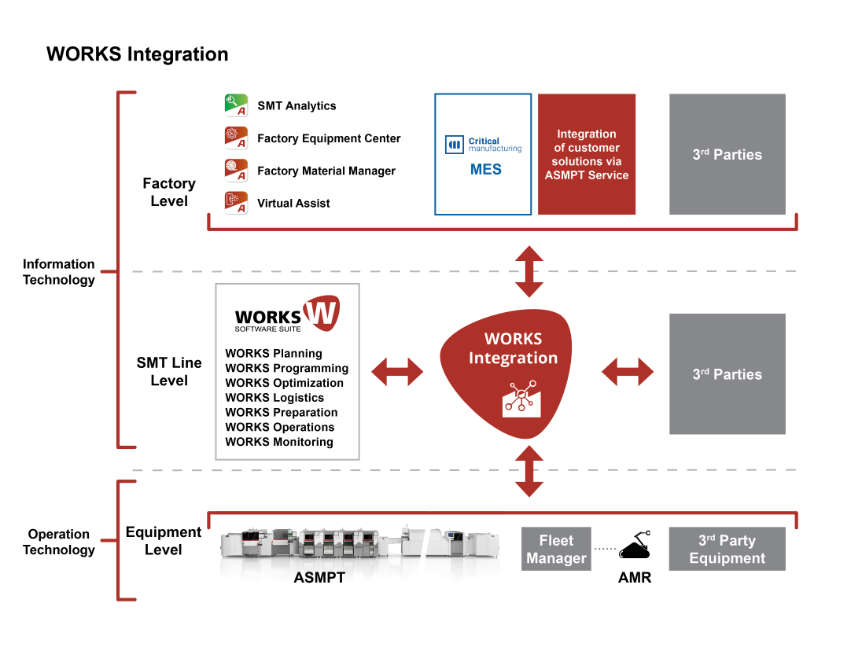
Image credit: ASMPT
Integrated platforms as the logical consequence
The increasing integration of data and processes is also reflected in the development of modern manufacturing platforms. What customers need are high-performance solutions that fit seamlessly into connected manufacturing concepts.
A typical example of this holistic product philosophy is the SIPLACE V assembly platform from ASMPT. It was newly developed from the ground up and combines up t 30 percent more real performance with precision and flexibility – even under demanding high-mix conditions. To ensure maximum output quality, it features seamless process controls thanks to optimized placement heads and vision systems. Components are recorded and checked from the moment they get picked to the moment they get placed on the circuit board. Functions like individually controllable nozzle segments and closed-loop sensor technology ensure that position, height and placement force are continuously adjusted and any deviations are immediately detected and compensated for.
The platform is designed for data availability and integration from the ground up. Switching to Ethernet-based communication makes it possible to process large data volumes and transmit them to higher-level systems in real time. With features like these, the SIPLACE V creates the foundation for further automation steps and the use of data-based and/or AI-supported manufacturing concepts. In addition, its platform architecture was designed for end-to-end investment protection. This allows the machine to fit seamlessly into existing SMT lines while offering performance and data reserves for future placement head generations and advances in automation. The SIPLACE V thus exemplifies that modern placement platforms are no longer mere manufacturing systems but have become central components of fully networked and scalable electronics production.
Intelligent material flow control
The flow of materials is another significant factor for efficiency that is often underestimated. Many factories continue to struggle with system breaks between planning, production and logistics. This leads to excess inventories and “material tourism”, increased coordination activities, and delays. At the same time, making sure that the right material is available in the right place at the right time is becoming increasingly complex due to distributed storage locations, fluctuating consumption and additional requirements resulting from factors like use-by dates and/or moisture sensitivity – processes that can be optimized by considering the appropriate data.
By taking inventory and consumption data into account in real time, intelligent software solutions create end-to-end transparency regarding material availability and material requirements. Two questions are crucial in this context: Which material is located where, and what is needed on the line when and in what quantities?
Based on the findings, the system performs a digital reconciliation between storage and production that makes it possible to supply the material in accordance with demand and in concert with the respective process. Integrated solutions for a holistically optimized material flow from ASMPT combine real-time inventory data with forecast-based demand analyses and use them to automatically control replenishment and transport processes.
Especially for larger production orders, a purely static provision of material is not sufficient. Instead, the software continuously analyzes the demand and makes time-slice-based forecasts in order to ensure a steady supply of materials without building up unnecessary “just-in-case” along the SMT line. The interaction of these functions creates an automated in-house logistics system that consistently implements the 4R principle: the right material in the right place at the right time and in the right quantity. The result is a significantly improved flow of materials and less capital being tied up in the warehouse. Production interruptions are avoided, and excess inventories and unnecessary material movements are reduced.
Efficient staff deployment through transparency
In addition to the factory’s technical aspects, the way the work is organized is also changing. Above all, the ongoing shortage of skilled labor forced companies to deploy their existing resources as efficiently as possible and to break up rigid structures. Having access to current production data allows them to organize tasks in a much more dynamic fashion. With the help of software, employees can be deployed across multiple lines based on their qualifications and be organized in so-called smart operator pools. Tasks can be automatically prioritized and transmitted directly to mobile devices along with all relevant information. This shortens response time and reduces downtimes.
In addition, AI-supported assistance systems are increasingly providing support for service, maintenance and analytical tasks. Virtual assistants provide context-based knowledge from documentations, service cases and historical values, making it possible to identify and resolve problems much faster. Finding information becomes much easier while in-house expertise stays available and is being continuously added to. This makes the employees’ everyday work easier and increases the factory’s productivity without having to add more personnel.
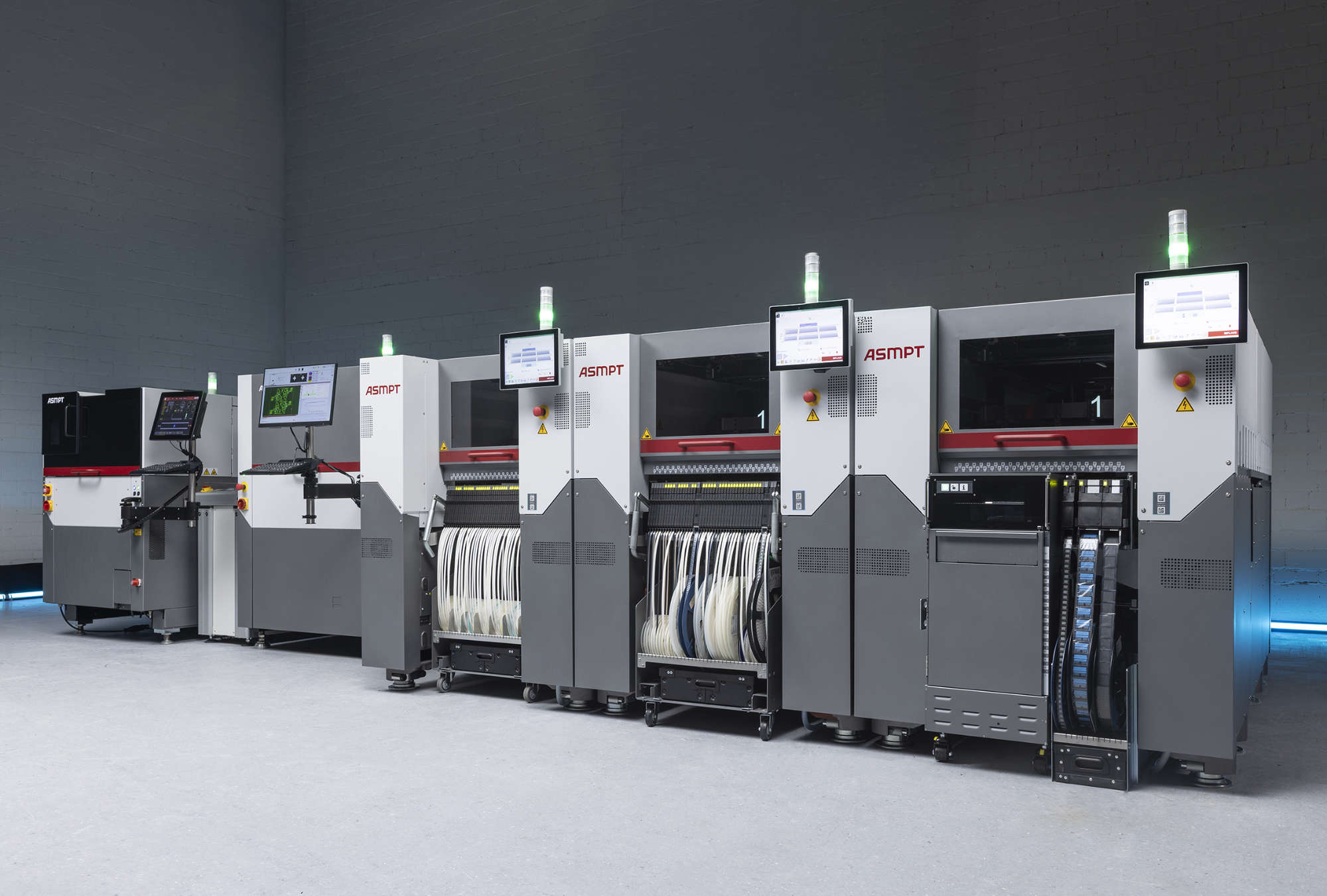
Image credit: ASMPT
Integration as the basis for intelligent manufacturing
All these advances would be impossible without open and standardized interfaces. Only when machines, transport systems and IT solutions communicate seamlessly with each other can data be used across the board and lead to concrete process improvements. Standards such as IPC-HERMES-9852 and IPC-2591 (CFX) enable cross-vendor integration and create the basis for consistent data structures. They ensure that information is available along the entire line and can be processed independently of individual systems.
In practice, however, integration extends far beyond the actual interfaces. The decisive factor is having a central database through which all systems are linked with each other. Platform approaches such as WORKS Integration from ASMPT pool data from machines, autonomous mobile robots (AMRs), software applications and higher-level IT systems in a non-proprietary manner. A major advantage of this approach is that the systems are being decoupled – machines and applications communicate no longer directly with each other, but via a central integration layer. This reduces complexity, avoids redundant data streams, and simplifies the scaling and integration of new systems considerably. The aim is to create a stable and secure database that can also be used for further applications such as automation, analytics, and AI-supported improvements. In this way, integration advances from being a technical requirement to becoming a competitive factor and the foundation of a flexible, scalable and future-proof electronics production.
Conclusion: Integration as a foundation for the future
SMT manufacturing is developing into a networked, data-driven system. Decisive competitive advantages are no longer brought about by individual technologies, but by their interaction with each other. Integrated hardware and software solutions like those from ASMPT show how data can be used along the entire value chain to make processes more transparent, stable and efficient. Companies that implement this approach throughout their operations secure their competitiveness and prepare for a dynamic industry segment whose demands will undoubtedly continue to grow.