

Milan-based software startup Vertalis S.r.l is bridging the execution gap in European manufacturing by serving as a unified digital backbone across legacy ERP, MES, and SCADA systems.
Beatrice Bigoni, Co-founder & COO of Vertalis, outlines the company’s non-invasive architecture that orchestrates AI agents over a proprietary “Golden Schema” industrial ontology. Operating without replacing floor-level hardware, Vertalis automates production scheduling, dynamic margin pricing, and material management, reducing setup changeovers while delivering 5–10% OEE gains and 7–9% OTIF improvements.
With self-serve onboarding, 2-day integration capability, and new modules launching in H2 2026, Vertalis provides a queryable, human-governed data layer for smart factory decision-making.
A brief description of the company and its activities
Beatrice Bigoni: Vertalis is a Milan-based software company. We build what we call a digital backbone for manufacturers: a layer that connects all your data and your knowledge systems into one governed data structure, and then puts AI agents on top of it that support operational decisions.
The company was founded in 2025 by three co-founders, Beatrice Bigoni, Stefano Giancristofaro and João Cunha.
Our starting observation is simple. European manufacturers are not short of data, they are short of a connected, queryable structure to act on it. Systems were implemented one at a time over fifteen years, each solving a local problem, none designed to talk to the others. The consequence is that people become the integration layer: supervisors reconciling figures by hand between systems that disagree, planners rebuilding the schedule after every disruption, buyers working from a spreadsheet that was already out of date when it was shared.
We do not ask anyone to replace what runs their plant. We sit above it and make it work as one picture.
What are the main areas of activity of the company?
B.B: We are built for European manufacturers: companies with real production complexity, multiple lines and sites, and a planning team, but without the internal data engineering capacity of a large group. That profile matters more than the sector does. Once the data layer is right, the same logic runs in consumer goods, in furniture, in tooling and in automotive accessories.
Functionally we concentrate on the decisions that move plant profitability: production scheduling, material management, and pricing. Underneath all of them sits the integration work, which is where every deployment actually starts.
We are not an ERP, not an MES, and not a BI tool, and we do not put hardware on the shop floor. Machine and sensor data (vibration, energy, piece counts) reaches us through the MES, SCADA, IoT and retrofit vendors who already live on the plant floor. We own the integration and intelligence layer in the middle and partner below us for machine data. For a good number of the companies reading this, we are a partner rather than a competitor.
What’s the news about new products/services?
B.B: The most significant recent step has been moving Production Scheduling into daily production use at the end of July.
The problem it addresses is one every plant manager will recognise. In a plant running hundreds of products a day, every order has to fit packaging and bulk availability, line capacity, changeover and sequencing constraints, and commercial priority, all at the same time. Planning typically runs across ERP screens, spreadsheets and whiteboards that are never current simultaneously.
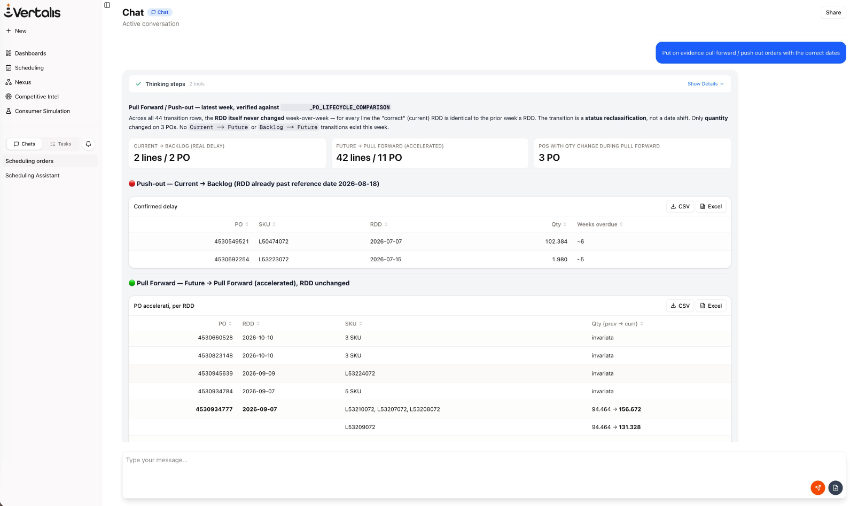
We centralise orders, BOMs, machine calendars, changeover matrices and material constraints on one backbone. An orchestrator then coordinates specialised agents: one sequences each line, one groups compatible jobs to reduce changeovers, one validates material and capacity before a plan is confirmed. A last-minute change is simulated across the whole flow in seconds, showing which orders move and which slots or lines are alternatives. The changeover matrix is calculated automatically from historical data.
In production deployment the module has delivered an OEE improvement of 5 to 10%, an OTIF improvement of 7 to 9%, and a 20% reduction in overtime.
The approved sequence writes back into the ERP, but only after a planner has seen the trade-offs and approved it. Nothing we build changes a source system on its own.
What are the ranges of products/services?
B.B: The platform is modular, and a manufacturer typically starts with one module and adds others as the data foundation proves itself.
The foundation is the building of the digital backbone auto-connecting the existing systems into one governed layer and holds the context the agents need: vocabulary, metrics, roles, documents, and the graph of how everything relates. This becomes queryable through consultation in natural language. Ask questions of your own data in plain language and get a grounded answer in seconds, with exportable charts and reports.
On top of this basis, we run our modules:
Production Scheduling — AI-assisted optimisation of the sequence against real constraints, with human-approved write-back.
Dynamic Pricing — maps the full bill of resources, from raw material through labour, energy and machine time, in a graph that handles the deeply nested structures relational databases struggle with. When an input cost moves, exact margin impact is recomputed in seconds. In production this has improved operating margin by 3 to 5% and raised quote pricing accuracy to 80%.
Material Management — monitors stock by product and by plant, flags a material at risk before it blocks a production order, and derives reorder quantities from real demand and actual supplier lead times rather than thresholds set years ago.
Underneath all of it sits Integration as a Product, which is how a manufacturer’s systems get mapped into our standardised schema; it happens automatically in days rather than months.
What is the state of the market where you are currently active?
B.B: There is a gap between intent and execution that has become impossible to ignore. AI adoption among EU enterprises reached roughly 20% in 2025, but manufacturing sits below that average at about 17%, and the adoption there is concentrated in sales and administration. It has barely touched production planning, scheduling and inventory. The hardest and most valuable part of manufacturing AI is still largely untouched.
At the same time, more than 87% of AI projects never reach meaningful production, roughly twice the failure rate of IT projects that do not involve AI. When you look at why, the causes are not model quality or computation. They are inadequate data and underinvestment in deployment infrastructure. Companies have the intent and often the budget, and they still cannot deploy, because the connective layer between their systems does not exist.
That is what the market has learned the expensive way over the last two years, and it has changed the conversation. Manufacturers now ask about integration effort, about who owns the data, and about what happens on day ninety — not about model architecture. It is a more demanding market than it was, and a healthier one.
What can you tell us about market trends?
B.B: Many things stand out when we look at the market trends.
The first is that the machines got digital before the systems running them got connected. Sensors, ERPs and MES platforms were deployed plant by plant through the years. Each investment was rational on its own, and each created a new island of data. Digitisation happened but integration did not.
Furthermore, the ERP estate itself is about to move. Mainstream maintenance for SAP ECC 6.0 ends on 31 December 2027. Every manufacturer still running it has to open up its core system within the next two years, and adjacent software gets evaluated in the same budget cycle.
Finally, the shift from dashboards to decisions. A decade of Industry 4.0 investment produced excellent visibility, and manufacturers can now see their operations in considerable detail. But visibility is no longer the bottleneck. The bottleneck is what to do at eight o’clock on a Monday morning, with a machine down and three urgent orders.
What are the most innovative products/services marketed?
B.B: Three things, and the first two are not the parts people expect.
Integration as a Product. Everyone else does integration as a consulting engagement: months of a field team hand-mapping one manufacturer’s tables into whatever the software expects, slow and expensive, and it resets to zero with the next one. We do it with a combination of agentic AI and proprietary algorithms. The system collects metadata, samples the data, infers the relationships across structured and unstructured sources, and auto-maps into our schema. Our current time to integrate a new manufacturer is two days.
The Golden Schema. A proprietary industrial ontology: a standard model of production orders, stock, machines, plants and the relationships between them. Because everyone maps onto the same schema, the same agents run in one plant and the next without rewriting their logic. Every deployment makes the schema richer and the agents more portable.
The trust engine. A manufacturer will not act on a number it cannot trust, and most AI vendors cannot honestly promise the number is right. Every figure, table and chart in our product comes from an executed query, the model reads values, it does not write them. When something cannot be verified, the system abstains and says so rather than returning a confident wrong answer, and every result carries a trust band showing whether it is certified or exploratory. A definition becomes certified only after passing a test written by the manufacturer, not by us. We do not grade our own homework.
What estimations do you have for the second half of 2026?
B.B: The second half of the year runs on two tracks, and we are pushing hard on both.
On product, the platform widens considerably. Three new modules enter pilot: Demand Forecasting, Competitive Intelligence and Energy Management. Material Management gains intelligent reorder logic that proposes and executes replenishment automatically, always behind a human approval step. We are releasing a control centre that lets each organisation manage its own people, permissions and approvals and browse its certified knowledge directly. And we are expanding the connector library across the systems manufacturers already run, alongside the next generation of self-serve onboarding — which is the piece that matters most, because it means a company can map its own operations onto the backbone without our engineers in the room. Onboarding measured in days becomes something a plant simply does for itself.
On the commercial side we are widening both the sectors and the geographies we operate in, moving beyond our Italian base into the wider European market. A large part of that growth comes through partnership rather than direct sales: the software vendors, integrators and technology partners already working inside these plants bring the customer relationship and the machine-level data, and we bring the intelligence layer above it. That model scales far faster than a field team ever will, and it is where we are putting our energy.
The ambition has not changed since day one. We want to be the digital backbone of European manufacturing: the layer a manufacturer runs its operational decisions on, whatever sits underneath it. Everything we ship between now and December points at that.