
As Europe’s wind energy sector approaches a massive surge in decommissioned components, with annual blade waste projected to hit 55,000 tonnes by 2030, the industry faces strict self-imposed landfill bans. While traditional EOL strategies focus on low-value shredding or energy-intensive composite recycling, Blade-Made treats old turbine blades and nacelles as high-integrity structural assets. By extending the functional life of composite materials by 25 to 50 years, the company turns decommissioned components into modular highway noise barriers, urban furniture, and tiny housing shells.
Jos de Krieger, Co-Founder of Blade-Made, outlines the performance monitoring of the Blade Barrier trial on the A58 highway, the launch of the Nacelle Micro Home, and strategies for scaling structural repurposing into late 2026 and beyond.
Can you briefly describe your company and its activities?
Jos de Krieger: Blade-Made repurposes decommissioned wind turbine components, blades and more recently nacelles, into durable products for infrastructure and public space, instead of sending them to landfill or shredding them for low-value recycling. Rather than treating an old blade as waste, we treat it as a structural element with decades of technical life left in it, and design a second function around that.
What are the main areas of activity of the company?
J.d.K: We operate between two worlds: the wind industry, which supplies the material as turbines are decommissioned or repowered, and public space and infrastructure, where that material gets a new functional life: noise barriers, bridges, playgrounds, urban furniture, and even micro homes.
What’s the news about new products/services?
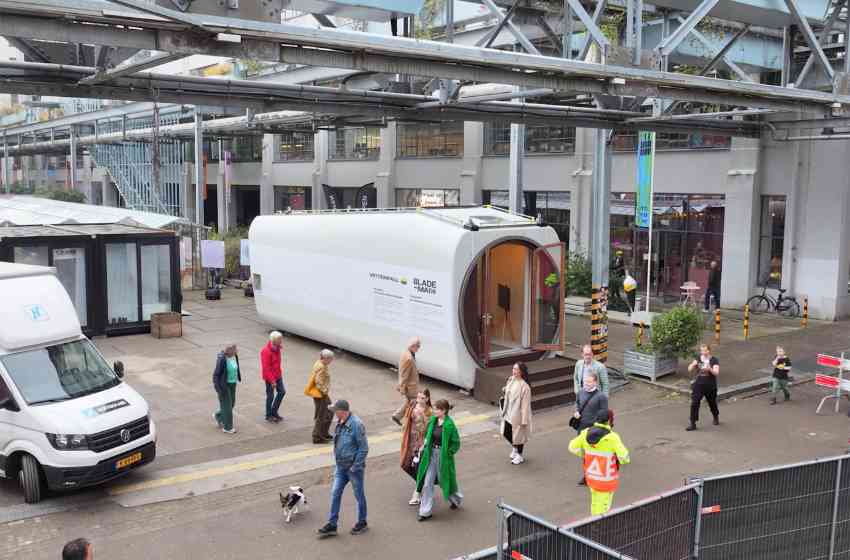
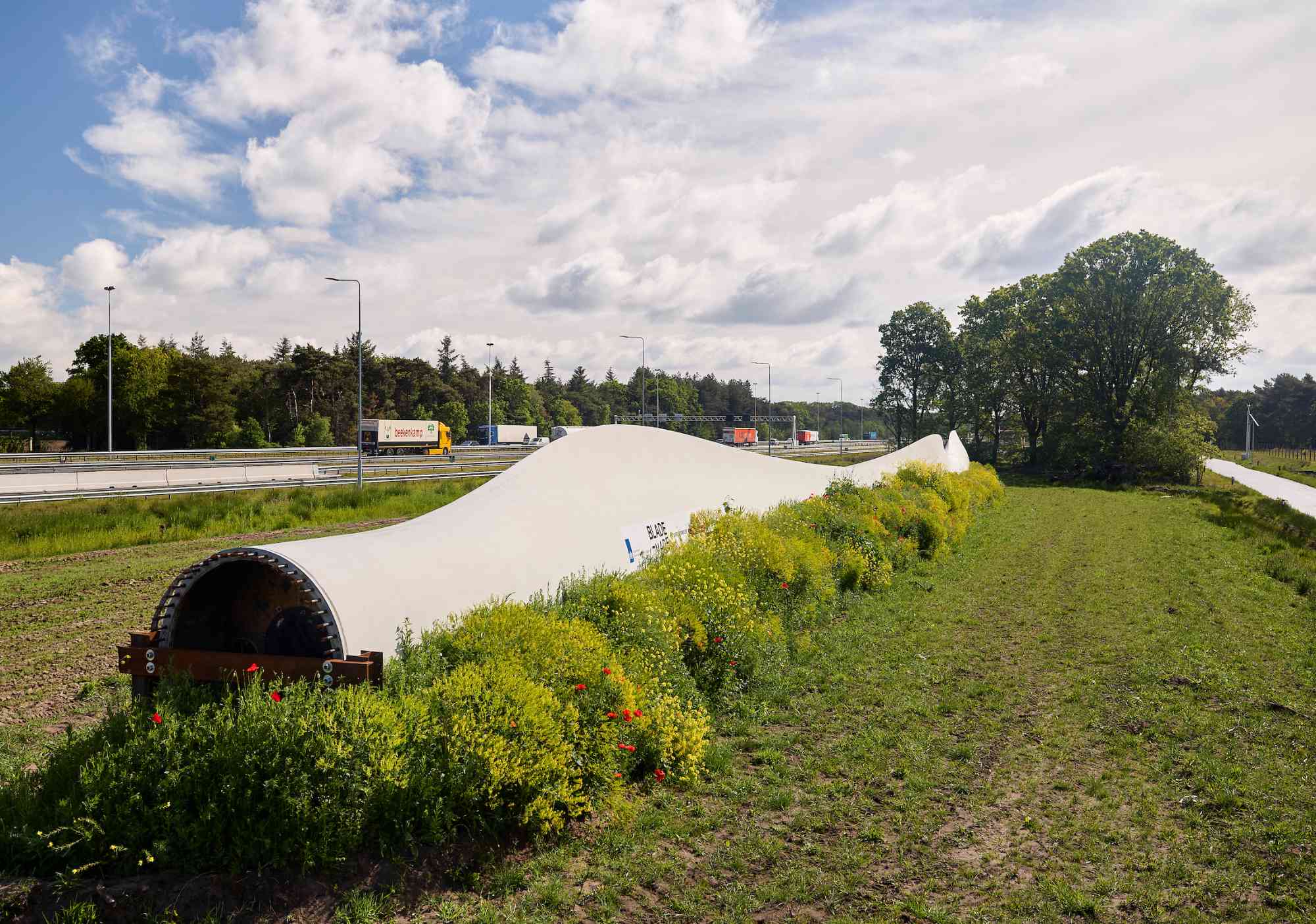
J.d.K: Two projects are currently central to our work, and both are designed to scale rather than stay one-off demonstrations. The Blade Barrier is a noise barrier built from repurposed turbine blades: a 60-metre trial installation made of two 37-metre blades and a sawn section, unveiled on the Rijkswaterstaat Innovation Strip along the A58 near Oirschot. It’s a modular design intended to be replicated at other locations once performance is proven. And the Nacelle Micro Home is a tiny home built from the nacelle of a decommissioned V80 2MW turbine: the housing shell that once contained the generator. We’re the first to put a house inside a nacelle, no doubt about that, and we designed the conversion process so it can be repeated with other nacelle types as they come off decommissioned turbines.
What is the range of your products and services?
J.d.K: Our core range covers blade-based infrastructure elements (barriers, bridges, urban furniture, playgrounds) and nacelle-based housing units. Beyond that, custom repurposing is possible, and no two projects start from the same point: each one begins by identifying either the material a client already has available, or the specific turbine material that needs to be sourced to meet a given demand.
What is the state of the market where you are currently active?
J.d.K: We’re active in the Netherlands, across Europe, and increasingly in global conversations. The scale of the underlying problem is large and about to become urgent: WindEurope estimates the annual volume of decommissioned blade material in Europe will rise to 55,000 tonnes a year by 2030, up from around 20,000 tonnes in 2025. The European wind industry has also committed to a self-imposed landfill ban for wind turbine blades, effective 1 January 2026, an industry commitment rather than EU law so far, but a clear signal of where regulation is heading.
What can you tell us about market trends?
J.d.K: Interest in repurposing solutions is rising fast, driven partly by that looming volume and partly by the landfill ban. I’d add one nuance: most of the market attention and investment currently goes to recycling (grinding blades down into fibre for cement or composites), which is a different, lower-value activity than what we do. Repurposing extends the material’s life instead of ending it: it keeps the material intact and functional for another full service life, and recycling only becomes a real need much further down the line, realistically 25 to 50 years out, once that extended life is used up. We also support reuse of the full wind turbine itself, not just its components, wherever a functional life extension of ten or more years is possible.
What are the most innovative products or services you market?
J.d.K: The Blade Barrier is by far the most ingenious idea, since it seems simple, but there are actually a lot of hurdles to take to make it happen. Six months after it was unveiled, the first measurements show it achieves noise reduction comparable to a standard concrete barrier: a genuinely encouraging early result, though it’s still one test site, one climate and one traffic load, and we’re careful not to over-claim from a single trial. We also expect it to become cost-competitive once production scales up, and current estimates put its carbon emissions at around 50% of a conventional concrete barrier.
What are your estimations for the second half of 2026?
J.d.K: The Blade Barrier’s monitoring programme runs until the end of 2027, but we expect a report on its functional performance already in Q4 2026. Another estimate for the second half of the year: we hope to sign the first projects that can lead towards really scaling our results. So if you have a problem with end-of-life turbines and/or noise complaints that can be solved with a Blade Barrier, let’s get in touch.