
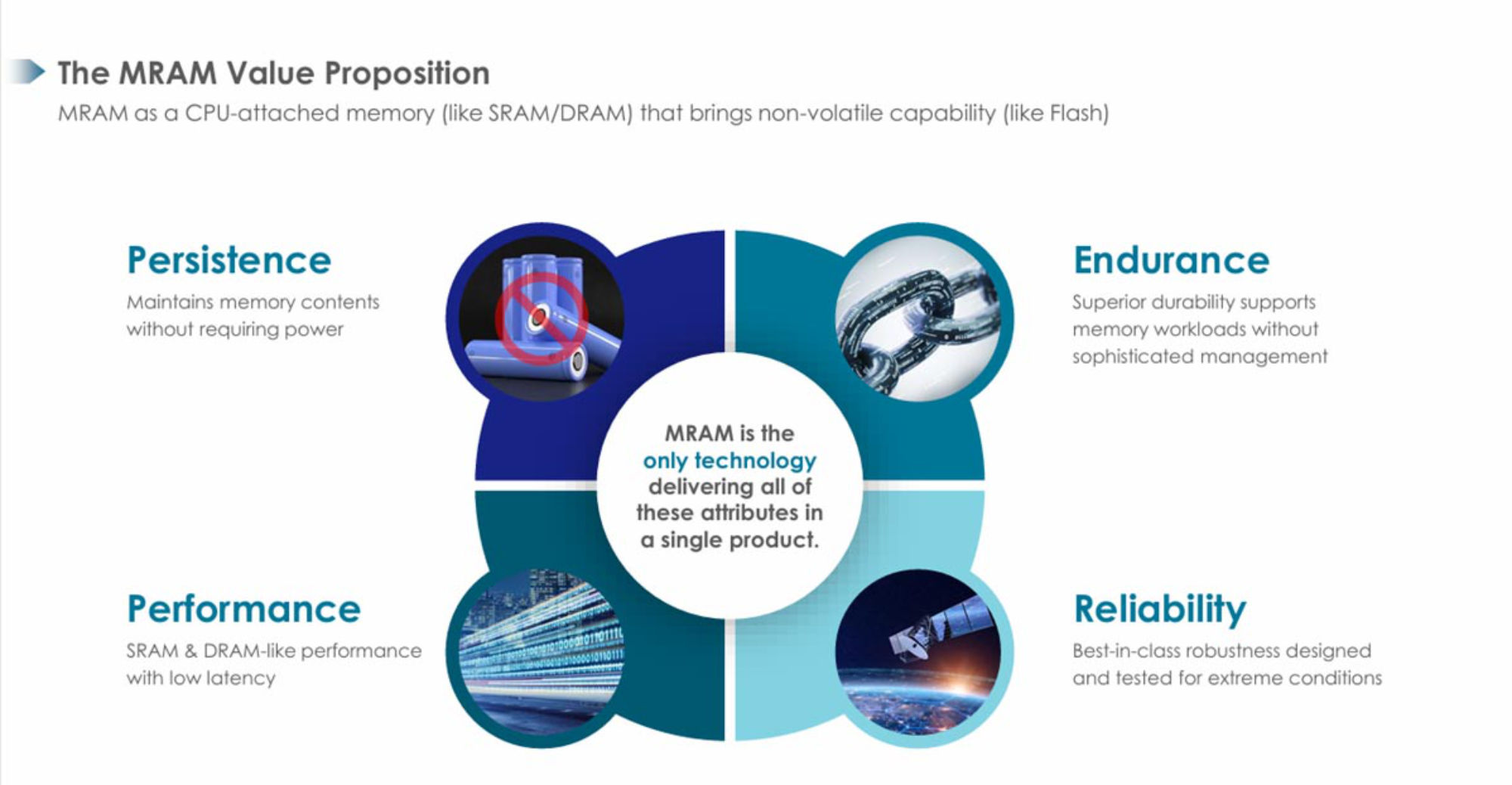
As artificial intelligence infrastructure consumes the bulk of global high-bandwidth memory (HBM) and DRAM manufacturing capacity, tier-one industrial, aerospace, and defense OEMs face severe supply allocation pressures and long-term component obsolescence. Mission-critical systems, such as satellite boot recovery, sub-zero industrial controllers, and AI server write-buffering, demand instant power-loss persistence, high write endurance, and immunity to radiation-induced soft errors without relying on battery backups. By replacing separate NOR flash and SRAM/DRAM chips with Magnetoresistive Random Access Memory (MRAM), Everspin Technologies delivers unified, non-volatile memory architectures that eliminate wear-leveling overhead and erase-before-write delays.
Sean Dougherty, Vice President of Worldwide Sales at Everspin, outlines the rollout of the high-density UNISYST™ product family, Astro Digital’s deployment on the Raven GEO satellite bus, and Everspin’s US manufacturing agreement with Microchip Technology.
A brief description of the company and its activities.
Sean Dougherty: Everspin Technologies is the world’s leading developer and manufacturer of Magnetoresistive Random Access Memory, or MRAM, solutions. The company designs, manufactures and commercializes MRAM products for systems where data must be retained and available through power loss, reset or interruption.
Everspin MRAM is used in industrial, automotive, aerospace, defense, data center and other mission-critical systems where endurance, reliability and long product lifecycles matter.
What are the main areas of activity of the company?
S.D: Everspin has been the world’s leading developer and manufacturer of MRAM solutions for more than two decades. The company provides non-volatile memory solutions with fast read and write performance, high endurance and data persistence.
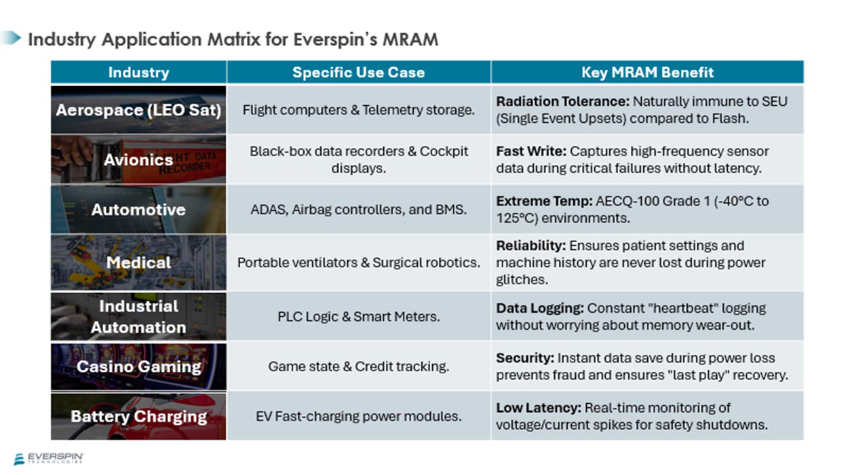
For example, in aerospace and defense, MRAM supports functions such as boot, recovery, telemetry, loggingand data retention in systems built for long program lifecycles. These systems benefit from MRAM’s inherent radiation tolerance as well. In industrial automation and energy systems, the SRAM-like behavior with high endurance and data retention helps controllers, meters and other equipment recover cleanly after power loss and remain supportable in the field for years. In data centers and AI infrastructure, persistent memory supports metadata, log data, write buffering and cache functions. In automotive and transportation, MRAM can support configuration storage, instant restore and high-endurance logging.
The need for MRAM is growing as systems become more complex, retain more data, requiring faster recovery and stays in service longer. Traditional memory approaches can create tradeoffs around endurance, power-loss protection, long-term support and radiation environments. In those environments, memory behavior can affect reliability, restart time, data integrity and product support over many years. Depending on the design, Everspin MRAM can replace or complement SRAM, DRAM and NOR flash, giving engineers a non-volatile memory option for systems where critical data must be written quickly, retained safely and be available when the system restarts markets.
What’s the news about new products/services?
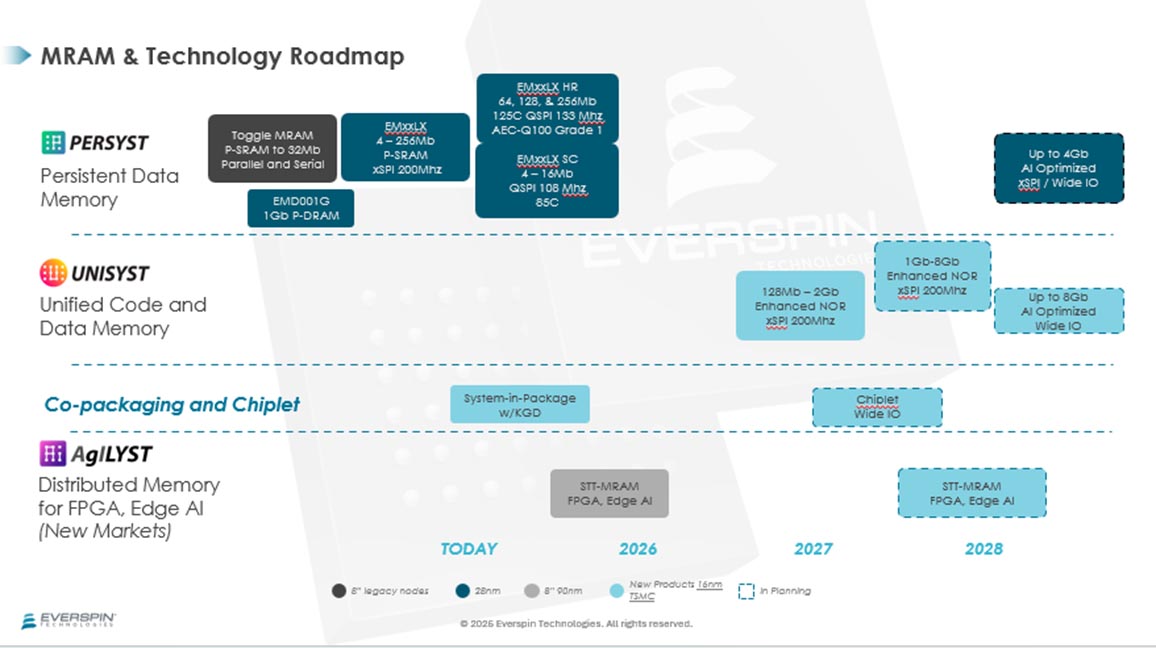
S.D: There have been several product, customer and manufacturing announcements in 2026. We introduced UNISYST, a unified MRAM family for embedded systems. UNISYST combines code storage and data memory in a high-density, non-volatile architecture and is designed as an extension of Everspin’s PERSYST MRAM platform.
Everspin also continues to advance PERSYST MRAM for high-reliability applications. Astro Digital selected Everspin’s PERSYST 64Mb STT-MRAM as primary fail-safe memory for the boot process on a Raven bus GEO satellite mission, showing how MRAM is used for boot, recovery and data retention in satellite systems.
In AI infrastructure, Everspin and MaxLinear announced a collaboration focused on memory efficiency in AI servers, including persistent MRAM for metadata management, log data, write buffering and cache functions.
Everspin also announced a manufacturing agreement with Microchip Technology to expand U.S.-based MRAM production capacity and support long-term supply.
What are the ranges of products/services?
S.D: To highlight a few product lines, PERSYST is Everspin’s core MRAM product family. It includes Toggle MRAM and STT-MRAM products across serial, parallel, xSPI and DDR-class interfaces. The portfolio gives engineers options based on density, interface, bandwidth, endurance, operating temperature and lifecycle requirements.
Then we have UNISYST, Everspin’s newest MRAM product family for embedded systems. It combines code storage and data memory in one non-volatile device. For designs that rely on separate NOR flash and SRAM/DRAM, UNISYST provides a replacement option with fast access and data retention through power loss.
What is the state of the market where you are currently active?
S.D: The memory market is being pulled in different directions. AI is driving strong demand for high-bandwidth and high-density memory, and suppliers are prioritizing the highest-volume opportunities.
For industrial, automotive, aerospace and defense customers, the concern is less about chasing the newest memory trend and more about whether they can count on the parts they qualify today. These customers are looking at lead times, pricing, lifecycle support and whether a memory supplier can support a design once it is in production and in the field for years.
That is where MRAM has a clear role. It is not a replacement for every memory type, but it is relevant in systems where persistence, endurance, fast writes and long-term availability are part of the design decision.
What can you tell us about market trends?
S.D: Memory allocation is one trend we are watching closely. AI demand is pushing suppliers toward high-volume, high-margin opportunities, which can create pressure for customers outside the AI market, especially those designing systems with long qualification cycles and long service lives.
That is pushing memory planning earlier in the design cycle. More customers are asking about lead times, second-source options, lifecycle support and what happens if a qualified memory option becomes constrained later.
At the system level, embedded designs are also writing more logs, configuration data, state information, security data and calibration data over longer product lifecycles. That puts pressure on memory approaches that rely on erase-before-write operations, limited endurance or backup power.
What are the most innovative products/services marketed?
S.D: UNISYST is our newest MRAM solution and it changes the conversation by bringing code storage and data memory into one non-volatile architecture. It is designed to work with the NOR-like interfaces embedded designers already know, but without the erase-before-write operations, write delays and endurance limits associated with traditional flash. That gives customers high-performance read and write access with a practical path from separate NOR flash and SRAM or DRAM devices to a single persistent memory architecture that can support code, working data and frequent updates.
The advantage becomes more important as embedded systems handle larger FPGA/MCU bitstreams, AI models and other data that must be updated quickly. Storing information is only part of the problem. The system also has to write it, update it and make it available again after a power interruption. UNISYST is designed to address that full workload. Engineering samples are expected in the fourth quarter of 2026.
PERSYST combines RAM-like access with non-volatility and the endurance required for active memory workloads. Unlike NOR flash, MRAM does not need an erase cycle before a write. Engineers can update individual data locations without managing page erase operations or building the same wear-management structure around the memory. These are not write-once applications. The memory may be updated repeatedly, and the information has to remain available if power is interrupted. PERSYST gives designers a way to handle those functions using a single persistent memory technology, rather than automatically separating working memory from non-volatile storage.
What estimations do you have for the second half of 2026?
S.D: From an operating standpoint, the second half of 2026 is focused on product qualification, customer design activity, manufacturing readiness and support for programs that require persistent memory and long-term supply confidence. This includes growing with our customers to ensure consistent supply chains, manageable lead times, and long product life cycles.
We expect memory architecture to remain part of the design conversation across datacenter and AI infrastructure, industrial automation, aerospace and defense, energy and automotive systems. These markets are putting more pressure on recovery time, logging, data movement and lifecycle support. Everspin’s priority is to keep advancing PERSYST and UNISYST, support customer programs as they move through qualification, and strengthen the manufacturing base needed for long-term MRAM adoption.