

In high-stress industrial environments, ranging from semiconductor etching chambers to jet engine turbine blades, technical ceramics offer unparalleled thermal shock resistance, compressive strength, and chemical inertness. However, traditional ceramic manufacturing methods like slip casting and injection molding introduce severe geometric limitations and expensive, long-lead tooling. Austrian additive manufacturing pioneer Lithoz is overcoming these barriers with its proprietary Lithography-based Ceramic Manufacturing (LCM) technology. By combining vat polymerization slurry processing, ISO 13485-certified quality management, and real-time CeraControl software networking, Lithoz enables zero-tolerance, high-density 3D printing of alumina, silicon nitride, and zirconia.
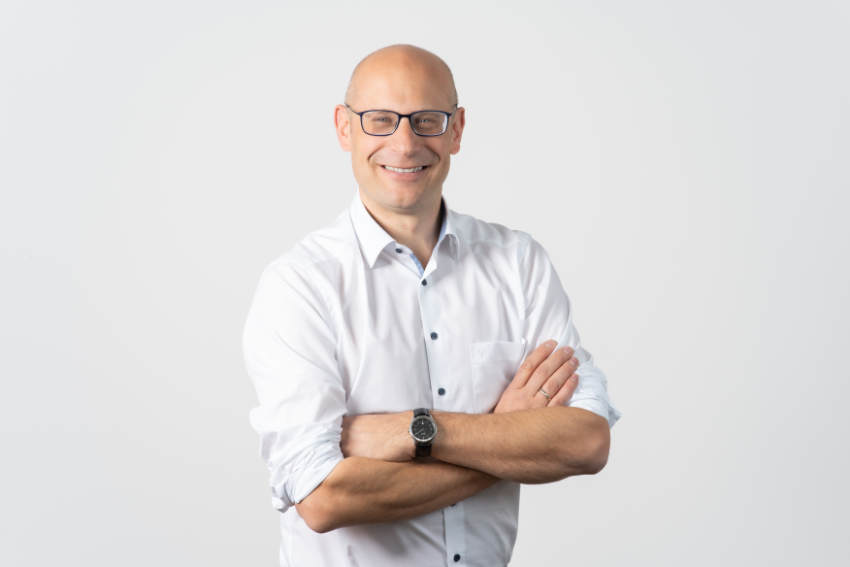
In an exclusive interview, Dr. Johannes Homa, CEO and Founder of Lithoz, outlines how LCM achieves lateral resolutions down to 25 µm, multi-material ceramic-metal integration, and high-volume serial production across aerospace, medical, and semiconductor applications.
How do you design your solutions to deliver reliable performance over the long term, particularly in demanding industrial environments?
Johannes Homa: A 3D-printed ceramic part’s long-term performance starts way before it is finished – longevity is engineered into the entire process chain: it is rooted in the material’s formulation, in the scalable accuracy of our LCM (Lithography-based Ceramic Manufacturing) printing process, in the fine-tuning of a component’s design to make it work for technical ceramics, in mastering thermal processing from debinding to sintering. Every single step is crucial to create a perfectly dense functional part, as ceramics is always about zero tolerance. And LCM is a DLP-based process perfectly adapted to these specific challenges of ceramics. It uses a ceramic-loaded photopolymer slurry processed through vat polymerization, which lets us achieve ultra-precise lateral resolution down to 25 µm. Then, after all, it’s one thing to print a “green part” of this precision — but the real magic about LCM is to safely transfer these impressive dimensions through cleaning and thermal processing. Only then, a high-performance part made from technical ceramics unfolds its impressive strengths. That precision of the entire system and only the perfect density is what separates a decorative prototype from a part that will perform years in an underwater sensor, as an electrolyte in solid oxide fuell cells or a nozzle into a semiconductor etching chamber.
What are the key factors that determine the durability and service life of your products or solutions?
J.H: In durability all comes down to three interdependent variables: powder purity, achievable sintered density, and microstructural consistency batch to batch. Our high-purity alumina employs 99.99% powder purity and reaches 99.4% relative density after sintering, with a three-point bending strength of 450 MPa. Our silicon nitride pushes past 99.8% relative density with biaxial flexural strength around 760 MPa and hardness of HV10 1500 — figures that matter directly for anything load-bearing or wear-exposed, like cutting tools or orthopedic components. Another great example how we master a part’s performance with pinpoint accuracy are silica-based casting cores for investment casting in the construction of aircraft engine turbine blades: Here, requirements are practically inverse: we deliberately engineer porosity (around 72% relative density) into our silica-based LithaCore material. The ceramic core must survive the casting window, its durability can be defined as survival under transient thermomechanical loads. Then, the part is being leached out of the blade, so to say, a controlled destruction every time. This narrow sweet spot is not easy to achieve and be aware that we do this job for each and every customer.
How do you ensure that your solutions can withstand challenging operating conditions such as heavy loads, continuous operation, temperature variations or other demanding factors?
J.H: There is a clear answer to this question: for each single ceramic we offer for LCM printing, all parameters have to be under absolute control. Bottom line, what defines the quality and thus performance of a technical ceramic part is its absolute physical immaculacy. Absolute zero tolerance to cracks or contamination, as even the tiniest deviation would mean that a component must be scrapped. The only way to get to this level of processing ceramics is actually to master the material, and this means testing, testing, testing. Don’t forget that also shelf life, transportation, storage conditions or other factors strongly influence a slurry’s usability. We take all these factors into account, nothing “just happens”, it is controlled. But it’s this devoted accuracy in each detail where our material-specific engineering really shows. On the side of structural temperature-shock enduring parts, Lithoz silicon-nitride grades are rated for continuous use up to 1200°C, with compressive strengths in the 2000–2500 MPa range. Undergoing bending-strength testing, HIPped alumia-toughened zirconia (ATZ) bars have reached values of up to 1,200 MPa. To make this challenge more tangible, let’s maybe come back to the ceramic core example: In investment casting of single crystal turbine blades, a core faces sudden thermal shock and extreme metal pressure. Our silica-based core material features ultra-low thermal dilatation (<0.2% at 1000°C and <0.4% at 1530°C) and tight phase-composition control. This prevents premature cristobalite transformation and high-temperature sag. Seeing how narrow this sweet spot is, you can well imagine that each parameter, from powder purity to storage condition, is under control..
How do your engineering and development processes contribute to improving the long-term reliability of your solutions?
J.H: This has been largely covered in my previous point. But there is an important element to add: quality management stays in the centre of the entire engineering and development process. Two years ago, we achieved ISO 13485 for our quality management, which to have or not to have for some industries like MedTech or Aerospace is a hard knock-out criterium. In the 3D printing of technical ceramics, nothing less than an absolute zero failure policy is the only way to build functional parts comparable to those from legacy processes like slip casting. We treat reliability as a qualification problem, not just a performance problem. That’s why at some points we’ve worked with external organizations specifically on process reliability for ceramic additive manufacturing — because for aerospace and medical customers, a part isn’t usable until it’s repeatable and certifiable, not just strong once in a lab test.
What role do material selection, component quality and manufacturing standards play in ensuring durability?
J.H: Being subject to ISO 13485 conformity, every batch of material we ship comes with a full set of technical data, spec sheets and if requested CoC. Of course, this starts when we select our vendors for the basic powder, but the heart of it all is our certified quality management. Each single part printed by a user fo our LCM printing system could then be tracked down to its origin, this is what our customers in MedTech, Dental or Aerospace can expect when working with our technology. Every material parameter, from purity, theoretical and relative density over strength, hardness to thermal conductivity, alongside its mechanical properties, is precisely listed. That level of documentation exists because our customers need to qualify materials against their own industry’s standard. This consistency is also why we’ve continued upgrading rather than replacing our core materials — our newest LithaLox and LithaCon zirconia variants, including a medical-grade ATZ, are direct upgrades to already-proven, main-selling formulations, which of course stay in the portfolio, to not force customers to change their “sweet-spotted” setup.
How do you approach maintenance and serviceability to help customers extend the operational life of your solutions?
J.H: A central part of our DNA has always been to stay by our customers’ side after selling a printer system. This approachability, especially via application engineering, certainly is a unique strength. There is no point in selling a machine without aftercare – users would often be overwhelmed by the many parameters to master. So we strongly support them in bringing their application to the market. There are several stages of service contracts available, defining the depth of constant support. And where serviceability really matters is upstream, in production consistency. That’s the role of our CeraControl software, which can network up to 100 CeraFab S65 systems globally, giving both us and our production partners the process data to catch drift before it becomes a defect. As our product is the printing system, including printer, software and materials, our part here is to make sure that these three elements are flawlessly working at our customers’ premises. This is the ultimate condition that their product – using the parts produced with our technology – perform at the maximum level possible.
How do you balance initial investment with long-term value, reliability and total cost of ownership for your customers?
J.H: Tool-free additive manufacturing removes the mold and tooling cost that traditional ceramic processing requires, along with the long changeover cycles — which fundamentally shifts the economics toward design freedom and speed. One of our partners, Alumina Systems, found that switching to LCM for their ALD ring significantly reduced production costs while achieving lighter, thinner-walled structures that actually improved performance — a design that conventional methods couldn’t produce efficiently at that precision. That’s the pattern we see repeatedly: yes, the per-part material cost of technical ceramics is higher, but when tooling elimination, faster time-to-market, and improved in-service performance are factored in, the total cost of ownership case is strong. That’s the thinking behind our manifesto for serial production — we want to be judged on real components scaled to industrial volume, not just impressive one-off demonstrators.
What technologies or innovations are you implementing to improve durability, reliability or lifecycle performance of your solutions?
J.H: The basis of durability is consistency! A few threads here. First, continuous material upgrades instead of replacements — our newest alumina, zirconia or medical-grade ATZ variants for instance, launched at ceramitec 2026, are built to extend both processability and in-service performance of our best-proven chemistries. Take zirconia for instance, meanwhile we have launched not less than ten variants, each exactly streamlined to a specific property or application, from dental implants over PT sensors to watch bezels. Second, equipment: the LCM’s ultra-precise printing principle meanwhile can serve various requirements. While the CeraFab S65 with its lateral resolution of 40 µm focuses on scaling industrial production at highest complexity level, the CeraFab S320 offers a fivefold increase of the S65’s build volume with just a minor sacrifice in precision. But for less complex parts it scales the technology to 150 layers/hour and 60 µm of resolution, which matters for durability because larger batch consistency reduces part-to-part variation at scale. Third, and most exciting to me personally, is multi-material printing. I myself was one of the biggest sceptics of it — first I thought it was playing around of some of our engineers. But now we’ve seen, the globally unique combining of technical ceramics with metals, or different ceramics or porosities in a single part, is opening up durability dimensions — a multi-material part printed in one piece is just superior to something bonded together — that we simply couldn’t engineer as separate components before.
How do you gather feedback from customers and real-world applications to continuously improve the long-term performance of your products?
J.H: First, we regularly conduct surveys with our customers. Our team tries to stand by our customers’ side as closely as possible. And of course, the tight contact and persistent exchange of knowledge between our application engineers and the customers makes sure, that our materials will benefit from improvements found for a specific customer challenge. Our largest customer is producing seven million parts a year in the medical field — that’s genuine real-time mass-production feedback we get on a daily basis, and you can trust that we’ve learned a lot from this, to make all customers benefit from these steps.
Can you share an example of how one of your solutions has delivered long-term value or reliability in a particularly demanding industrial application?
J.H: There are many examples of how LCM printing has created added value to industrial applications. And mostly, it’s either about miniaturization or about multi-features built in one part. One customer created a 18” dual-channel ALD ring for high-speed PEALD and ALE in the very same chamber, which is a “first” even for the fast-moving semiconductor industry. Another contract manufacturer operating a CeraFab print farm realized a gas injection nozzle with two inlets and 62 outlets, which formally was assembled from two parts. KLS Martin, leading surgical implant manufacturer from Germany, produces fully-individualized bioresorbable ceramic implants for maxillofacial surgery, in this case of course, patients benefit from these calcium phosphates’ excellent biocompatibility. Or let’s close with casting cores: Safran Aircraft Engines acquired three CeraFab S65 printers specifically for developing casting cores used in single-crystal turbine blades and defined LCM technology as a key element to step to the next level of turbine inlet temperatures necessary for the next-gen aircraft. These and many more applications are examples where durability, process control and precision directly boost the long-term performance of the entire system it’s part of.