
In high-precision industrial manufacturing, curing complex three-dimensional components with ultraviolet light has historically required mechanical rotation or robot-mounted lamps, introducing cycle time delays and uneven angular exposure. Danish engineering specialist EFSEN UV & EB TECHNOLOGY is addressing these limitations through its industrial 3D-UV reflected curing systems. Founded in 1986 in Holte, Denmark, by Karin Efsen, the company manufactures custom curing platforms while distributing selective radiation systems across Scandinavian, European, and global markets. EFSEN’s 3D-UV technology utilizes reflective chamber interiors to direct UV light onto all surfaces of stationary parts, operating either as batch curing chambers or inline continuous tunnels. To satisfy stringent process validation demands in medical devices, electronics, automotive parts, and wood finishing, EFSEN integrates its proprietary ICAD® (Inline Continuous Automated Dynamic) monitoring technology across systems like W-LED and P-LED, delivering real-time output regulation, full traceability, and reduced energy consumption per component.
A brief description of the company and its activities.
Curing a door panel, a medical device housing or a moulded component with UV light has traditionally required one of two compromises: rotating the part in front of the lamps or mounting the lamps on a robot that moves around it. Both add mechanics and cycle time, and both risk uneven exposure on surfaces the light only reaches at an angle. EFSEN has developed an industrial alternative: a 3D-UV system in which reflected light reaches every surface while the part stands still.
EFSEN UV & EB TECHNOLOGY is a Danish engineering company based in Holte, north of Copenhagen. It was founded in 1986 by Karin Efsen to introduce electron beam (EB) curing to the Nordic market and today works across radiation curing as a whole: UV, UV-LED and low-energy EB. EFSEN designs and manufactures its own curing systems and is also the exclusive distributor of selected UV, UV-LED and EB equipment in several European markets. This allows the company to take responsibility for the complete curing process, from specification and construction to installation, measurement and service, rather than supplying a single component.
What are the main areas of activity of the company?
EFSEN works in three technology areas: conventional UV curing with mercury and doped-arc lamps, UV-LED curing, and low-energy electron beam (EB) curing, complemented by process-control instrumentation and UVC disinfection solutions. Besides equipment, EFSEN provides application engineering, on-site commissioning, process optimisation, service and preventive maintenance, and calibration of radiometers and UV measurement devices. Customers work in printing, packaging and converting, wood and furniture finishing, electronics and optical fibre, medical devices and automotive components, mainly in Scandinavia, the Baltic region, Germany and Poland, as well as in wider European and international markets.
What’s the news about new products/services?
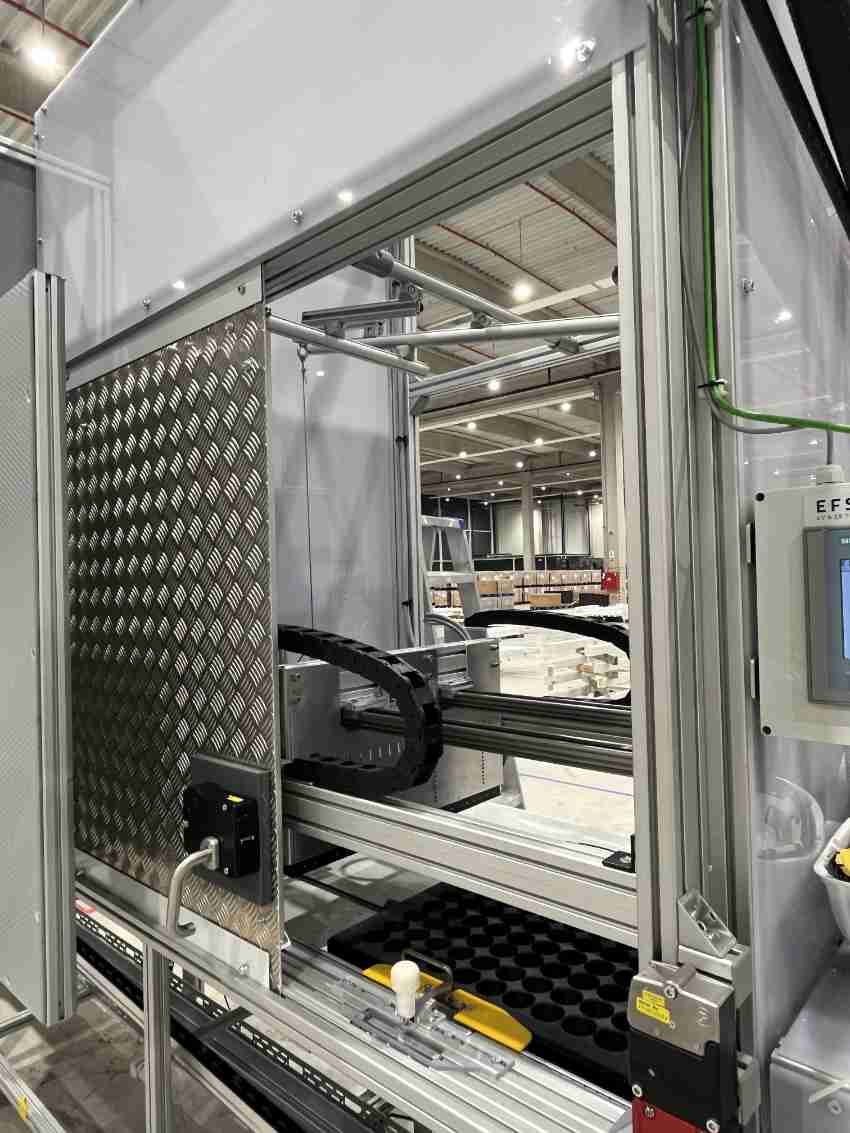
The main news is EFSEN’s industrial 3D-UV technology. It builds on around 20 years of experience with small 3D-UV chambers for curing medical products, now scaled up for industrial production. The interior of the booth is designed so that UV light reflects from its walls and irradiates all surfaces of the product evenly, without moving either the product or the lamps.
The system can be built as a chamber, where products are placed inside and cured while standing still, or as a tunnel, where they are cured on the move. Because several products can be cured in the same cycle, a whole batch is processed at once. Compared with curing parts one by one, this shortens production time and reduces the energy used per part.
What are the ranges of products/services?
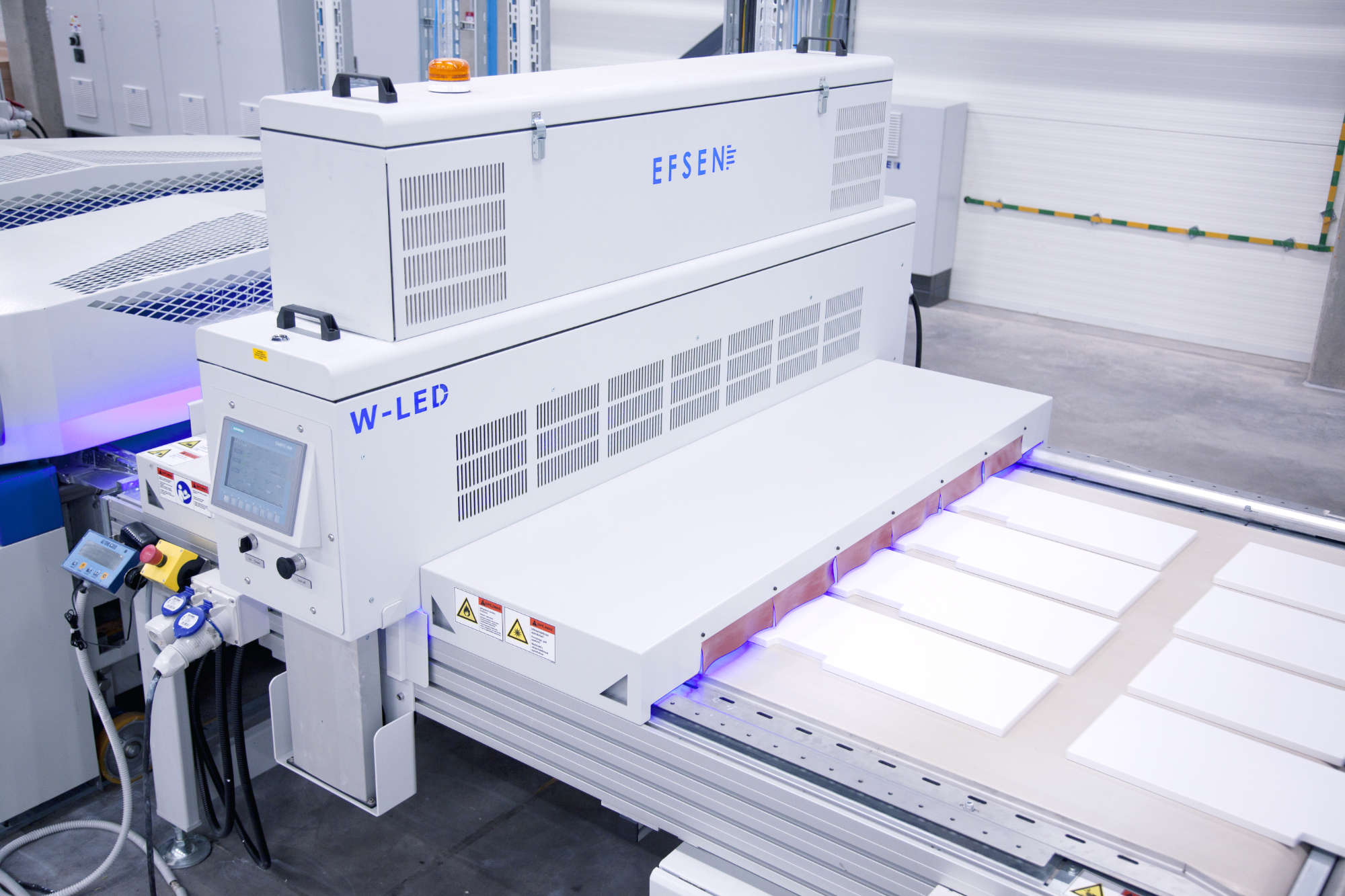
The range covers the main UV sources in industrial use, namely arc lamps, UV-LED, microwave systems and spot curing, as well as dedicated systems for specific industries. For wood and flooring there are the WoodCure and W-LED families, with W-LED 3-D for complex wood products such as doors. M-LED is designed for curing small, high-precision components, and the EFSEN Wing and Star systems cure long, continuous products such as cables and tubes.
Supporting equipment includes LT lab conveyors with UV lamps for testing and development, Bucket-Cure for curing residual coating in empty buckets, and EIT 2.0 radiometers for process measurement. EFSEN also operates a European calibration centre for EIT radiometers. On the service side, EFSEN supports customers through the full introduction of UV curing: process assessment, technology selection, system design and integration, commissioning and ongoing optimisation.
What is the state of the market where you are currently active?
Competition has increased in recent years, mainly from low-cost LED module suppliers. As a result, the light source itself no longer separates one supplier from another. What matters is whether the supplier can show that the process performs as specified and continues to do so over years of production.
Conditions differ between industries. Wood and furniture remain sensitive to investment cycles, but conversion to LED continues because the energy and maintenance savings are easy to calculate. Graphics, printing and converting are consolidating when a group acquires a plant, it often introduces the technology already used at its other sites. This standardisation opens the door for suppliers already established in the group and largely closes it to others.
What can you tell us about market trends?
The clearest trend is the shift from mercury lamps to UV-LED, driven by energy efficiency, longer lifetime, lower maintenance and regulatory pressure. Curing is also becoming more automated and more closely integrated into production lines. For three-dimensional parts, this shows as a move away from robot-based systems with moving lamps towards dedicated 3D-UV solutions, which puts more weight on repeatability, uniform exposure and cycle time.
At the same time, customers in electronics, medical devices and optical fibre increasingly require process validation, traceability and real-time monitoring of UV irradiance and dose. Measurement is therefore becoming a built-in part of the curing system rather than an optional add-on.
What are the most innovative products/services marketed?
EFSEN’s own ICAD® technology addresses exactly this need. ICAD® continuously measures the actual UV output during production and regulates the light source accordingly. Operators therefore have documented evidence that the correct dose was delivered, instead of relying on an estimate based on lamp operating hours. ICAD® is integrated in the W-LED system for wood and furniture and in the P-LED system for graphics, printing and converting, and it can be combined with 3D-UV so that every measurement is recorded.
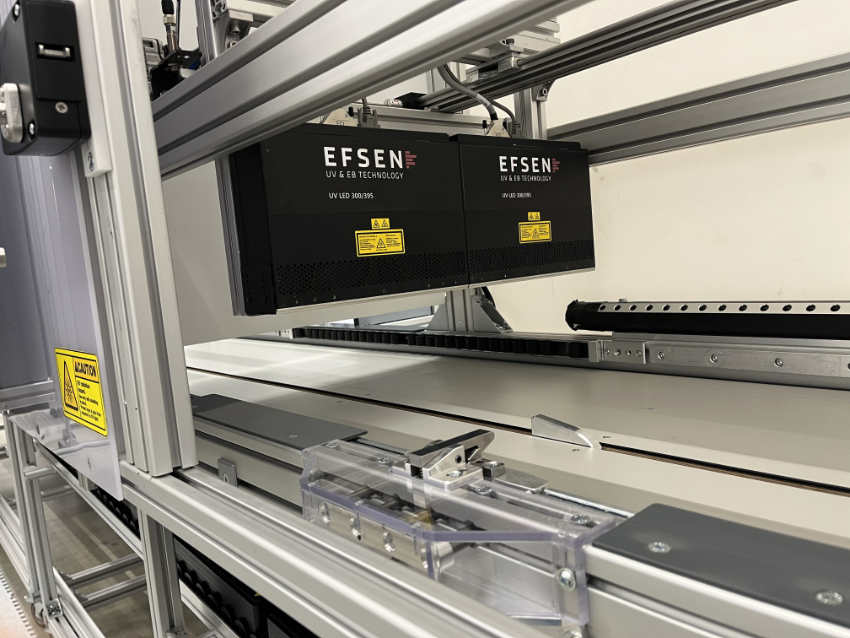
3D-UV systems are also designed to run without operator intervention. When integrated with the production line controls, as EFSEN recommends, the operator selects a recipe, and the system runs automatically in communication with the line. Maintenance consists essentially of the recommended annual service and replacement of lamps or light sources in case of failure.
What estimations do you have for the second half of 2026?
EFSEN expects the second half of 2026 to continue the pattern of the first: steady, project-driven growth rather than a sudden upturn. Demand for UV-LED conversion remains healthy, with the strongest activity expected in wood and furniture retrofits, in medical device and electronics assembly, and in measurement and calibration services, which depend less on the capital investment cycle.
The main uncertainties are the general European industrial investment climate, the time taken to decide on larger capital projects, and continued price pressure from commodity LED suppliers. EFSEN’s response is to compete on documented process performance, engineering capability and long-term service rather than on unit price.