
To accelerate inline defect detection and reduce hardware costs across fastener, automotive, and medical manufacturing, QuaVis Technologies is expanding its embedded smart camera and surface inspection portfolio. Founded in 2007 in Germany, QuaVis specializes in high-speed sorting machines, retrofits, custom optics, and AI algorithms built around its proprietary QuaVision software platform, which inspects up to 1,500 parts per minute with 1 µm repeatability.
In the interview, Managing Director Sebastian Reinelt, highlighted two major launches: the QuaSolo PC-less smart camera (offering 1 to 24 MP frame resolutions and line-scan variants with built-in GPU acceleration, OPC UA, and MQTT support) and a 2D Shape from Shading surface inspection module. By combining on-device AI training with legacy sorting machine retrofits, QuaVis enables quality engineers to deploy edge-based defect detection without external vision PCs or cloud infrastructure.
A brief description of the company and its activities.
Sebastian Reinelt: QuaVis Technologies GmbH is an industrial machine vision company based in the south of Munich, Germany, founded in 2007. We develop image processing systems for quality assurance and industrial control, with a focus on high-speed sorting machines for screws, fasteners, pins and other small parts. Our expertise covers image hardware, computer vision, AI algorithms and custom hardware design. All products are built around our proprietary QuaVision software, which inspects up to 1,500 parts per minute with a repeatability up to 1 µm. Customers are manufacturers in the automotive, fastener, electronics, aerospace and medical industries.
What are the main areas of activity of the company?
S.R: Four areas. First, complete inspection systems: vision systems and sorting machines, built together with our partners, that detect defects at production speed. Second, retrofits: we bring current cameras, optics and AI-based image processing into existing sorting machines, so the mechanics, PLC and control cabinet stay in place. Third, engineering services: screw inspection, geometric feature inspection, surface defect detection, convex surface inspection, AI and machine learning inspections, and custom hardware development such as lighting modules, optics, trigger systems and sensor integration. Fourth, development of standard systems: our QuaSolo smart camera for area and line-scan cameras, and our own PLC, the QuaC controller. We also offer consulting for system design and special sorting tasks.
What’s the news about new products/services?
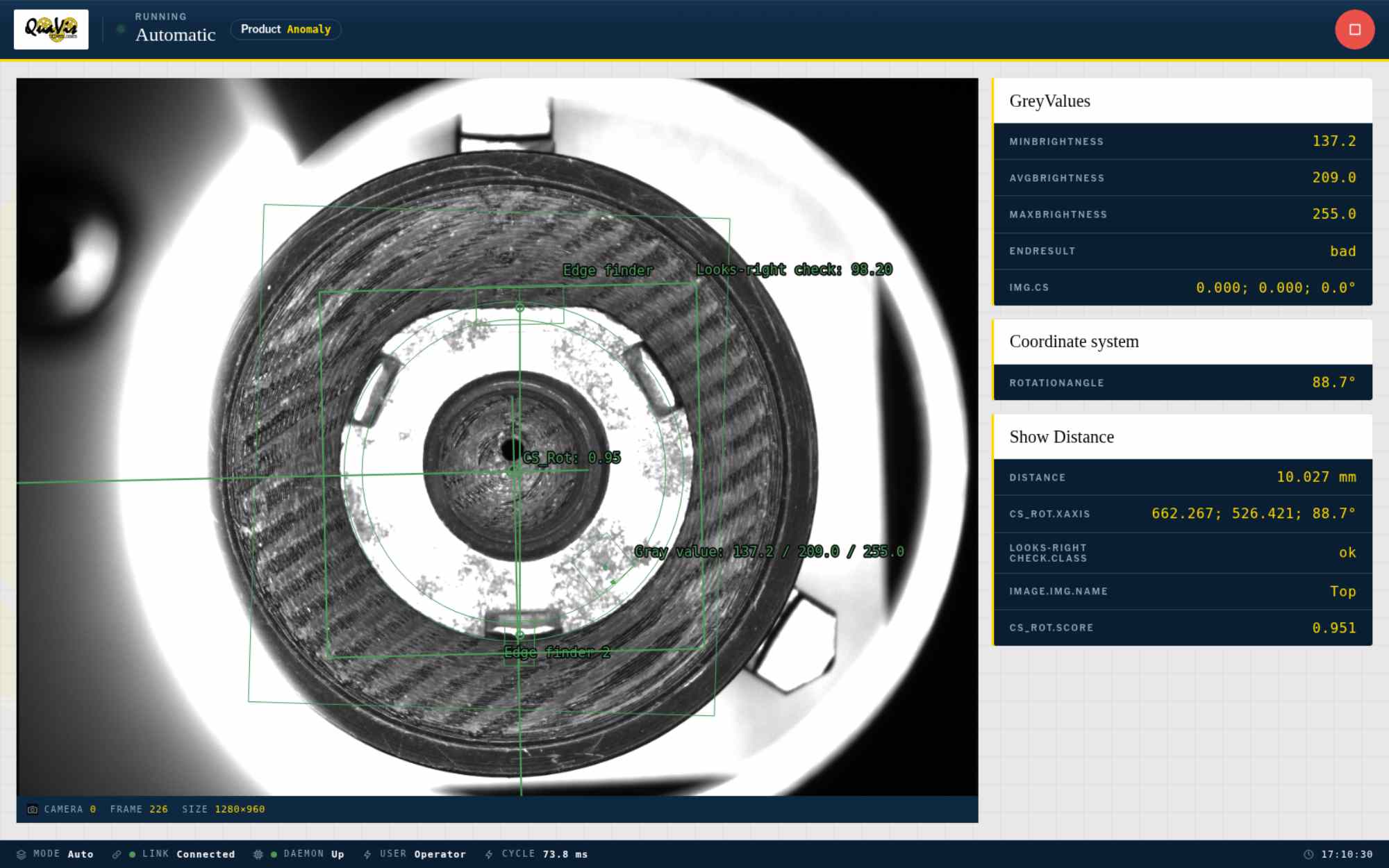
S.R: Two launches this autumn. In October we introduced QuaSolo, our smart camera for inline inspection. It is available as a frame camera with resolutions from 1 to 24 megapixels and as a line-scan camera. Camera head, passively cooled compute unit, AI accelerator, line interfaces and configuration software are in one device; it needs no PC, no seat licence and no vision library. Inspections are built as a flow of tools by drag and drop in a browser. QuaSolo measures edges, lines, circles, angles and grey values, reads barcodes, DataMatrix, QR codes and OCR, and reports results over OPC UA (OPC 40100-1), MQTT and digital I/O. AI tools such as part finders and similarity check run on a built-in dedicated GPU.
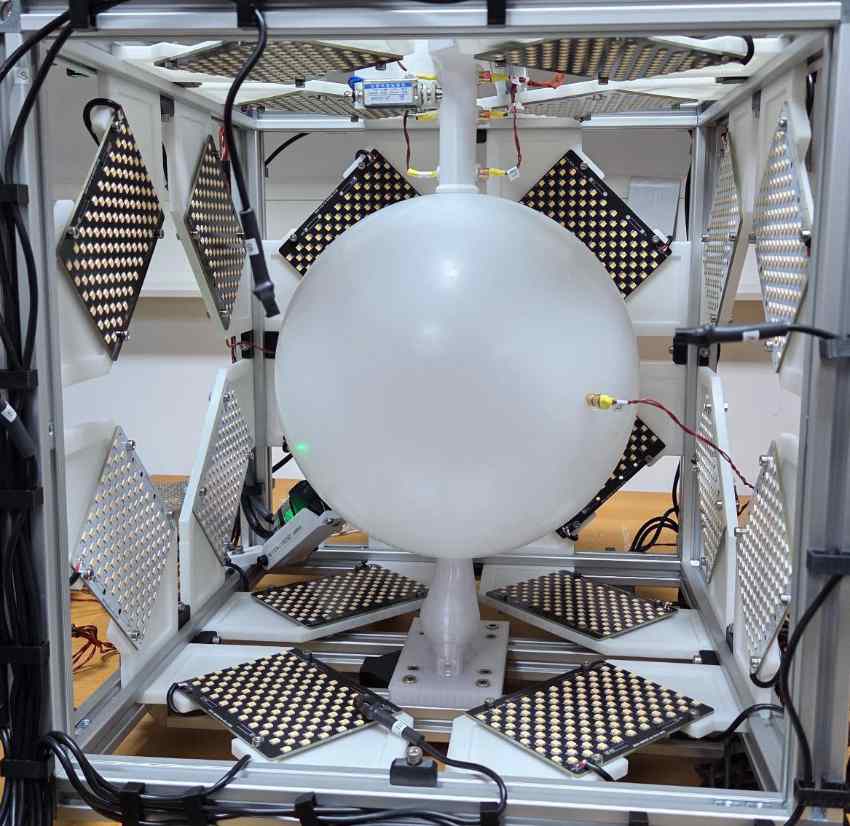
Shortly after, we added Shape from Shading to our surface inspection portfolio. One camera and three to eight switched lights produce a relief image in which embossing, stamped marks, dents, scratches and creases stand out while print, colour and stains drop away, without a 3D sensor, laser line or second camera. Earlier in the year we showed at All About Automation Heilbronn how quality engineers train and deploy AI inspection models in QuaVision without a data science team and without cloud services.
What are the ranges of products/services?
S.R: Vision systems on the QuaVision platform: hardware-independent, compatible with area and line-scan cameras, infrared and 3D sensors, touchscreen operation without programming, 16 languages, lot management, SQL-based logging and automatic reports. Sorting machines with metal plate, glass plate, chute and belt handling; the KPM 600 inspects up to 800 parts per minute standing and up to 2,500 parts per minute hanging. The QuaSolo smart camera as a frame camera from 1 to 24 megapixels or as a line-scan camera. The Integration Kit around our QuaC PLC controller: Linux on a 64-bit quad-core ARM, about 5 W, passive cooling, up to 128 digital inputs and 128 outputs, visual drag-and-drop programming with optional Lua. Shape from Shading. Retrofits of legacy systems. Consulting and custom hardware development.
What is the state of the market where you are currently active?
S.R: Our core market is small-part and fastener production in Germany and Europe. Demand for 100 percent inspection is stable because customers in automotive, aerospace and medical technology require documented zero-defect delivery. At the same time capital budgets are tight, so many manufacturers want to extend the life of existing sorting machines rather than buy new ones. That is why retrofits have become a large share of our work. We also see strong interest in compact inspection stations that go into a line quickly, without a dedicated vision PC and without an integrator.
What can you tell us about market trends?
S.R: AI-based inspection is moving from pilot projects to the shop floor, but only where quality engineers can use it themselves and where the data stays on the premises. Second, the inspection task decides the method: area cameras, line-scan cameras, scanners, 3D and now Shape from Shading are combined per application instead of one method for everything. Third, open interfaces: OPC UA and MQTT are becoming standard expectations so that inspection results feed directly into MES and quality systems. Fourth, edge computing in the camera itself replaces the PC for many tasks.
What are the most innovative products/services marketed?
S.R: Our AI workflow in QuaVision: mark defects in images, train several models at the push of a button, select the best one and deploy it with one click, with no programming and no cloud. QuaSolo’s on-device AI, which learns a new part in about a minute from good parts alone. Shape from Shading, which turns a camera and a few switched lights into a relief sensor without 3D hardware. And our retrofit approach: this spring we moved a 30-year-old sorting machine from Windows 3.11 and analogue cameras to AI-based image processing in two days, with no retraining of the operators.
What estimations do you have for the last part of 2026?
S.R: We expect the first QuaSolo installations to go live at customers, and their feedback will shape the next tool releases. Shape from Shading goes into pilot applications for stamped marks and surface defects on fasteners. Retrofit projects remain a focus into the winter, since many plants schedule machine downtime around the turn of the year. Overall, we expect moderate growth, driven by the replacement of ageing inspection technology rather than by new capacity.