
To safeguard the competitiveness of European graphics manufacturers amidst shifting regulatory frameworks and digital transformation, Brussels-based trade federation Intergraf is expanding its policy advocacy and technical standardization initiatives. Founded in 1930, Intergraf represents 22 national printing federations and 17 associate members across 26 European countries, serving an industry that generates €70 billion across 100,000 predominantly SME businesses. In an interview with Secretary General Beatrice Klose, the federation highlighted key market dynamics, including the structural expansion of packaging and labels – which account for 60% of sector turnover – and compliance challenges driven by the EU Deforestation Regulation (EUDR) and the Packaging and Packaging Waste Regulation (PPWR). To support digital integration, Intergraf collaborated with the German Printing and Media Industries Federation (bvdm) and Initiative Online Print (IOP) to establish a print-specific vertical for Google’s Universal Commerce Protocol (UCP), ensuring customized print products integrate into emerging AI-driven agentic commerce systems.
Interview with Beatrice Klose, Secretary General of Intergraf,
A brief description of the company and its activities.
Beatrice Klose: Intergraf is the European federation for print and digital communication, representing the interests of the European printing industry at EU level. Established in 1930 and based in Brussels, Intergraf brings together 22 national printing federations and 17 associate members from 26 European countries.
As the voice of the European printing industry, our mission is to strengthen the sector’s competitiveness, promote its economic and societal importance, and ensure that its interests are adequately represented in European policymaking.
We work closely with European institutions, national printing associations, industry stakeholders and social partners to address the challenges and opportunities facing the sector.
What are the main areas of activity of the company?
B.K: Intergraf’s activities encompass a broad range of areas aimed at strengthening the European printing industry’s competitiveness, sustainability and long-term development.
Advocacy and European affairs are central to our work. We represent the industry’s interests before European institutions, monitor legislative developments and advocate for a regulatory environment that supports printing companies, particularly SMEs. We also promote the importance of print in society and advocate for fair treatment of printed and digital communication.
Sustainability is another key priority. We support the industry’s environmental transition through policy advocacy, practical guidance and initiatives such as our recommendations for calculating and reducing the carbon footprint of printing companies and products.
Market research and economic intelligence are equally important. Through our annual Economic Report and cooperation with research partners such as Smithers, we provide comprehensive industry statistics, market analyses and forecasts.
As the recognised European social partner representing employers in the graphical sector, we engage in social dialogue with UNI Europa Graphical & Packaging, addressing employment, skills, health and safety, and other workforce-related challenges. We also work to attract younger generations to the industry through initiatives such as Print Your Future and the Intergraf Young Talent Award.
Intergraf is also actively involved in security printing and certification, managing international certification schemes for security printers and their suppliers, including ISO 14298 and Intergraf 15374.
Finally, we facilitate international cooperation, networking and knowledge-sharing through our membership network, partnerships, publications and international conferences, including Print Matters, Shaping the Future with Print and Intergraf Currency+Identity. Through these activities, we bring together industry representatives, policymakers and technology experts to exchange knowledge, address common challenges and explore opportunities for innovation.
What’s the news about new products/services?
B.K: As a European trade association, Intergraf does not manufacture or market printing products. Instead, we continuously develop initiatives, publications and services to support the industry’s development. We provide in depth information on current legislative initiatives to our members so that printing companies are prepared for these developments.
What are the ranges of products/services?
B.K: Intergraf offers a wide range of services to its members and the wider printing industry, including European policy representation, regulatory guidance, economic research, market intelligence, professional networking, conferences, webinars and industry publications.
We also support the security printing sector through international certification schemes, notably ISO 14298 and Intergraf 15374, which establish security requirements for security printers and their suppliers.
The industry we represent encompasses a broad spectrum of printed products, including books, newspapers, magazines, commercial printing, advertising materials, packaging, labels, pharmaceutical information, security documents and numerous other applications.
This diversity demonstrates the continuing relevance of printing technologies across virtually every sector of the European economy.
What is the state of the market where you are currently active?
B.K: The European printing industry remains a substantial manufacturing sector, although it is undergoing significant structural transformation.
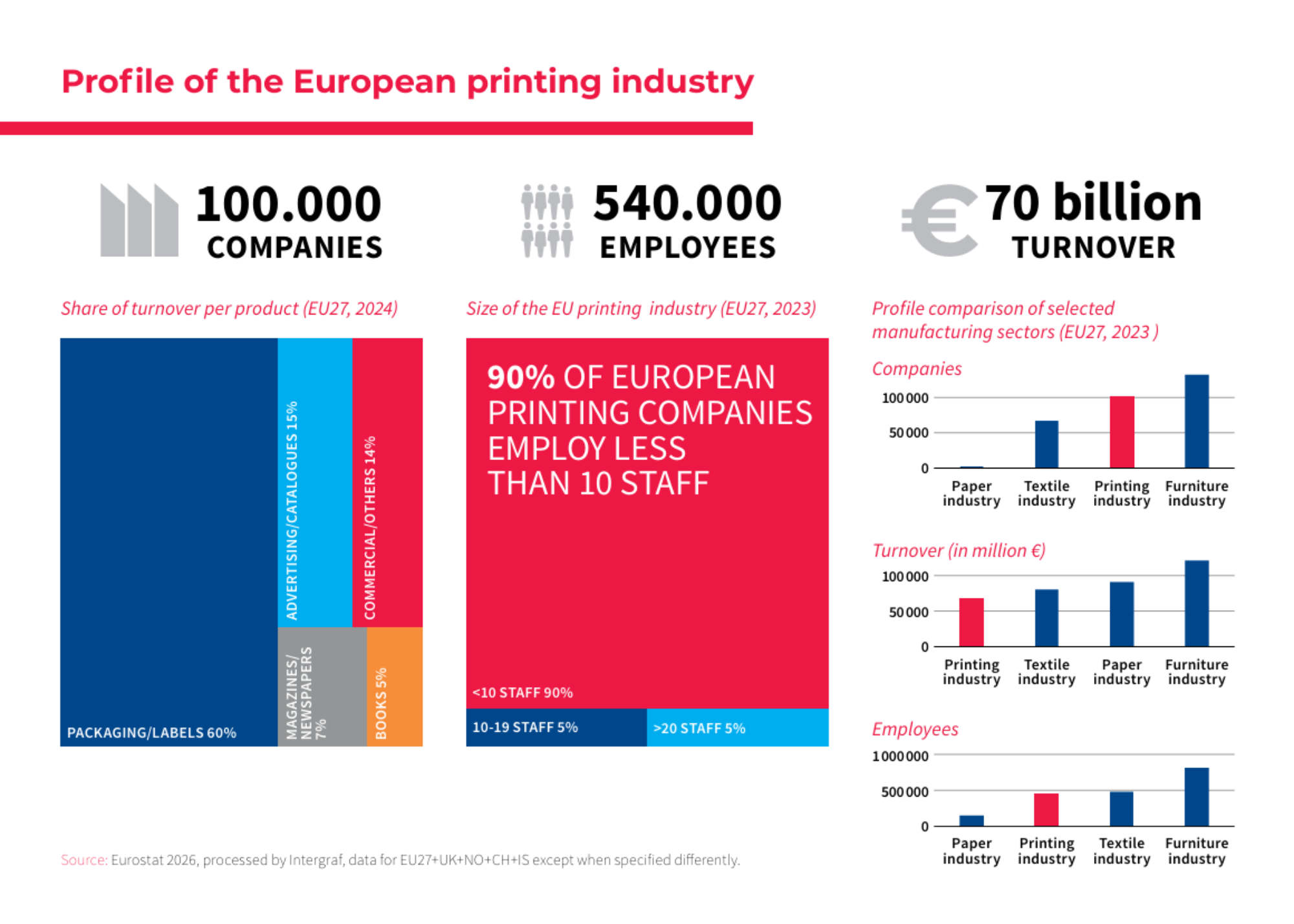
The European printing industry comprises approximately 100,000 companies, employs around 540,000 people and generates an annual turnover of approximately €70 billion. The sector is predominantly composed of small and medium-sized enterprises, with 95% of printing companies employing fewer than 20 people.
The market is characterised by considerable differences between its various segments. Traditional publication and commercial printing continue to face pressure from changing consumer behaviour, digital communication and declining demand in certain product categories. Conversely, packaging and labels represent an increasingly important part of the market. In 2024, packaging and labels accounted for approximately 60% of printing industry turnover in the EU.

European printing companies must also navigate rising operating costs, labour shortages, international competition and an increasingly complex regulatory environment.
Despite these challenges, the sector continues to adapt by investing in new technologies, diversifying its activities and developing higher-value printing applications.
What can you tell us about market trends?
B.K: Several important trends are shaping the future of the European printing industry.
Digitalisation and automation continue to transform production processes. Digital printing technologies enable shorter production runs, greater flexibility, personalisation and more efficient workflows. Artificial intelligence and automation are also creating new opportunities to optimise production, improve resource efficiency and develop innovative business models.
Packaging and labels remain a particularly important market segment. Growing demand for sustainable packaging solutions, improved recyclability and more efficient material use is encouraging technological innovation throughout the packaging value chain.
Environmental sustainability and regulatory compliance are becoming increasingly important. European legislation, particularly the Packaging and Packaging Waste Regulation (PPWR) and the EU Deforestation Regulation (EUDR), is influencing business practices, material sourcing and production requirements.
Workforce development represents another major challenge. Many European printing companies face difficulties attracting qualified workers, particularly younger professionals. Addressing skills shortages and improving the industry’s attractiveness are therefore essential priorities.
Finally, we see increasing opportunities for print to complement digital communication. From education and publishing to packaging and personalised marketing, physical printed products continue to offer distinctive qualities that digital channels cannot always replicate.
What are the most innovative products/services marketed?
B.K: Although Intergraf does not directly commercialise printing technologies, we actively support and promote innovation throughout the European printing industry.
One particularly interesting development is the integration of artificial intelligence into printing and online commerce. In 2026, Intergraf joined forces with the German Printing and Media Industries Federation (bvdm) and Initiative Online Print to contribute to the development of a printing industry-specific standard for Google’s Universal Commerce Protocol. This initiative seeks to ensure that the specific requirements of customised printing products are considered in emerging AI-driven commerce systems.
More broadly, innovation is taking place across numerous areas of printing, including advanced digital printing technologies, automated production workflows, personalised printing, sustainable packaging solutions and sophisticated security printing applications.
Through our conferences, publications and partnerships, we aim to facilitate the exchange of knowledge and encourage the adoption of technologies that improve competitiveness, efficiency and sustainability.
What estimations do you have for the second half of 2026?
B.K: The outlook for the European printing industry for the remainder of 2026 remains mixed, reflecting the different economic conditions affecting individual market segments.
Traditional printing applications are expected to continue facing structural challenges associated with digitalisation and changing demand. At the same time, packaging, labels and digital printing offer opportunities for companies investing in technological innovation, production efficiency and specialised services.
Economic uncertainty, operating costs, regulatory requirements and access to skilled labour will remain important factors influencing business decisions and investment.
The implementation of European environmental legislation is also a significant priority for the industry. Intergraf continues to support printing companies in understanding and complying with new regulatory requirements while advocating for proportionate and workable rules that reflect the operational realities of the sector, particularly its many SMEs.
Looking beyond 2026, we believe the long-term competitiveness of Europe’s printing industry will increasingly depend on its ability to innovate, attract qualified professionals, improve resource efficiency and adapt to changing customer expectations.
Intergraf will continue working to ensure that Europe’s printing companies have the regulatory framework, knowledge and support they need to remain competitive, innovative and environmentally responsible.