
Sensitive components in electronics manufacturing require precise, clean, and ESD-proof production processes. Montech’s cleanroom belt conveyors and transfer systems support controlled material flows between assembly, testing, and processing stations – from individual components to complete assemblies.
In the electronics industry, products are often produced in tightly timed and highly automated manufacturing environments. Printed circuit boards, sensors, semiconductor components, and precision mechanical assemblies undergo several assembly, testing, and processing steps before further processing or installation. At the same time, production lines must accommodate high quantities, short cycle times, and changing product variants. In addition to processing, controlled material flow between process steps is also a focus. Conveyor technology reliably delivers and transfers sensitive components, helping keep processes stable and reproducible.
Cleanliness and ESD protection are key requirements
Even the smallest impurities or electrostatic discharges can affect the quality of sensitive components in electronics manufacturing. Particles on component surfaces, uncontrolled charging, or mechanical loads can cause faults that only become apparent in later testing or use phases. Therefore, all components of a production line must be adapted to the environment’s requirements – including the conveyor technology. Montech offers conveyor technology for sensitive electronics processes; technology that features a cleanroom-suitable or ESD-proof design depending on the application. This Swiss technology company has specialized in the industrialization and standardization of advanced belt conveyors, transfer systems, and aluminum framing technology for over 60 years.
Montech cleanroom belt conveyors
Montech’s TB30R and TB40R cleanroom belt conveyors transport sensitive components cleanly, safely, and in a process-oriented manner through controlled production areas. Their cleanroom-compatible design supports a low-particle material flow, for example, when feeding sensitive components, connecting assembly and test stations, or transporting them through cleanroom-critical production areas.
The TB30R cleanroom belt conveyor is particularly suitable for compact conveyor lines and lighter components. The TB40R is wider and more robust and is ideal for larger components or applications with more conveying area. Both belt conveyors can be integrated into controlled production areas as a transport, feed, or buffer line.
Defined processes in assembly and testing
In addition to belt conveyors, transfer systems play an important role in the electronics industry. They guide components or assemblies through several stations and support precise assembly, testing, and processing. In electronics production, it is particularly important to keep workpieces in a fixed position and ensure precise transfers between stations. Workpiece carriers reproducibly pick up the components and create the basis for controlled flows across several process steps.
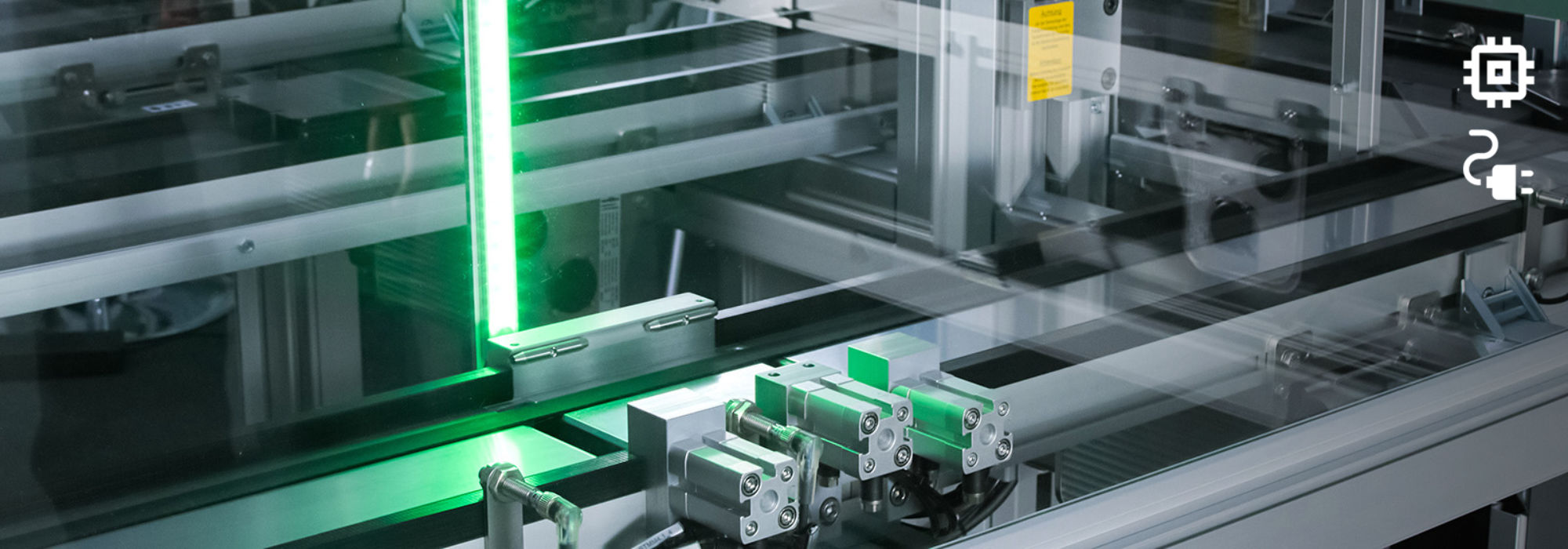
Montech’s transfer systems:
With the LT40 and LTE transfer systems, Montech offers solutions for a range of assembly, testing, and processing steps. The LT40 transfer system suits applications where workpiece carriers are reliably guided through process stations and precisely transferred to assembly stations, test units, or handling systems. The LTE transfer system complements this range as a single-track, asynchronous transfer system for compact workpiece carriers and flexible process layouts. Both transfer systems can be combined with buffer areas, ejectors, or bypass solutions. This lets components move through the process in a targeted way, be removed from the main flow for additional tests, or be fed evenly to downstream stations.
Modularity for short product cycles and a wide range of variants
In addition to cleanroom compatibility, ESD protection, and precise process control, Montech belt conveyors and transfer systems offer another advantage: They are modular and can be adapted to different products, process steps, and system layouts. This is particularly relevant in the electronics industry, which is characterized by short innovation cycles, small component geometries, and a wide range of variants. New products, modified test requirements, or additional stations can thus be integrated more easily into existing lines. Conveyor widths, lengths, drive variants, workpiece carriers, buffer areas, ejectors, and accessories can be designed to match the system layout. This results in compact transport lines and interlinked assembly, testing, and process steps that combine technical cleanliness, ESD protection, precise handling, and flexible system concepts.