
As industrial OEMs and automation engineers seek to bridge the gap between deterministic PLC field control and open IT architectures, Munich-based software provider embedded ocean GmbH is commercializing its Xentara software-defined automation platform. Co-founded by CEO Michael Schwarz and CTO Robert Schachner, embedded ocean developed Xentara to eliminate the latency, high engineering costs, and maintenance friction associated with traditional OT/IT gateways. The platform unifies hard real-time control, a global semantic model, and deterministic local AI inference within a single runtime executable across standard embedded boards, edge controllers, and servers. Supporting real-time fieldbuses like EtherCAT, Profinet, and Modbus alongside cloud protocols such as MQTT and OPC UA, Xentara enables local machine intelligence directly inside the control loop. With the release of the Xentara Workbench no-code editor and upcoming version 2.1 features including AI machine vision and Smart Machine Agents, embedded ocean provides a hardware-independent foundation for Physical AI in brownfield and greenfield industrial applications.
A brief description of the company and its activities.
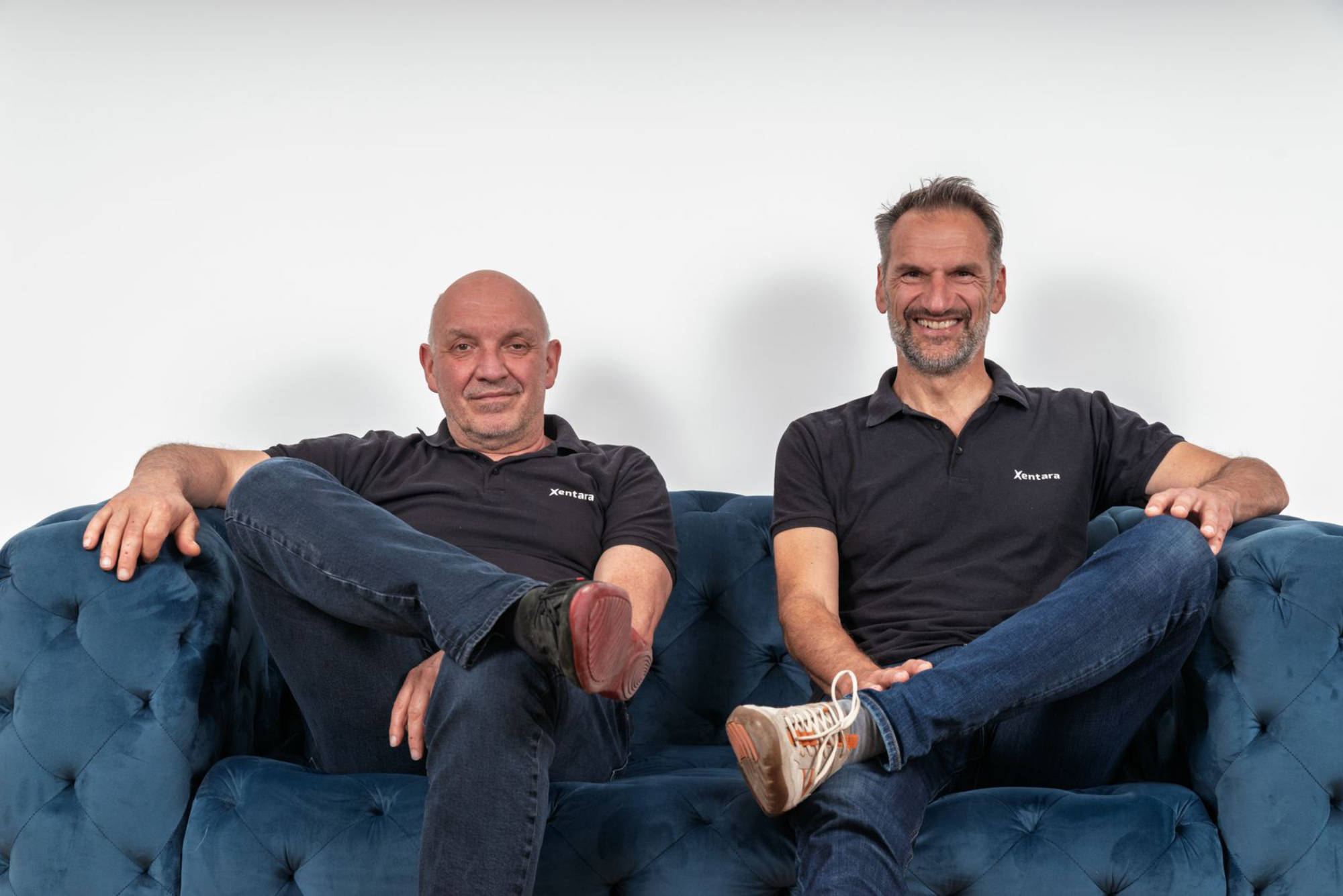
Michael Schwarz: embedded ocean is a Munich-based software company, founded by me and our CTO Robert Schachner. Our diverse team currently brings together nine nationalities, with more than 150 years of automation, embedded and industrial software experience between us. We also have a steadily growing ecosystem of Skill developers and partners.
Our main product is Xentara, a software-defined automation platform. The idea for Xentara came about because we kept seeing the same scenario: a PLC gives you determinism and almost no openness, whereas the IT stack gives you openness but no notion of timing. The usual remedy is a gateway between the two, and you pay for it in latency, engineering hours and a bespoke architecture that becomes harder to maintain the more systems you integrate. Xentara solves this by running hard real-time control and machine intelligence in one runtime on standard hardware. Having no installed base to protect meant we could design for the machines being built now.
What are the main areas of activity of the company?
M.S: Real-time control is the foundation. Soft-PLC, motion and robotics control, and more demanding approaches like model predictive control and adaptive control. What these have in common is they ask for absolute precision; jitter is not an option.
The second area is getting data out of machines without losing context. Semantics and timestamps have to survive the trip into MQTT, OPC UA, InfluxDB, a historian, an MES or a cloud service, and plenty of products move the values but not the meaning. Xentara’s global semantic model solves this.
Third, AI inference inside the control loop rather than alongside it. If the output of a model reaches an actuator, that model has to meet the same timing constraints the controller does.
The combination of these three factors makes Xentara the ultimate Physical AI enabler.
What’s the news about new products/services?
M.S: The Xentara Workbench was released in January. It is a graphical no-code editor for our data model files. It validates as you go, covers the timing model and security configuration, and imports for example TwinCAT TMC and Siemens S7 DB files, so an existing project is a starting point rather than a retyping exercise.
Also, in January we completed the DashSet integration for time-series machine learning. In February we announced a partnership with ValueMiner to put knowledge graphs on top of real-time data, so correlations between data points become visible rather than every tag sitting on its own.
In July, Andreas Geiss joined us as Chief AI Officer, underlining the importance of deterministic local inference and Physical AI on our roadmap.
The same month saw the first annual Xentara Connection Day tech conference, with around 120 guests and speakers from WAGO, Advantech, Omdia, Roland Berger and Benthor. The proceedings are now public.
Later this year we will release Xentara 2.1, an update introducing support for AI machine vision and inspection plus Smart Machine Agents as well as unveiling the Xentara Inspector, a new runtime user interface.
What are the ranges of products/services?
M.S: We provide a real-time execution platform in the form of the Xentara runtime. It is deployable onto embedded boards, edge controllers or network servers, natively or containerized. Inside it, the Semantic Model puts data from every source into one hierarchy, with multilingual ontologies where you need them. The Timing Model mixes event-driven state changes with deterministic cyclic execution, resolved to nanoseconds. The integrated Xentara Security Services provide role-based access applied per data point rather than per device.
Everything else is modular and can be extended with currently more than forty connectors and skills, including EtherCAT, Modbus, OPC UA client, Siemens S7, Beckhoff ADS, Profinet / Profibus and EtherNet/IP, SPI and PXI as well as MQTT, InfluxDB, Clarify, REST, WebSocket, an OPC UA server and Python or C++ interfaces. AI and simulation Skills include ONNX, MCP, PyTorch, TensorFlow Lite, and FMI.
On the tooling side there is the Xentara Workbench for modelling and the upcoming Xentara Inspector for watching a running system over WebSocket. Logic can be written in IEC 61131, IEC 61499, C++ or Rust, whatever the customer prefers.
A free trial license is available through our website.
What is the state of the market where you are currently active?
M.S: CAPEX on classic automation is careful. Nobody replaces a running line because a vendor issued new firmware, and they are right not to. Meanwhile automation software is one of the few budget lines still growing, because most OEMs have been told to deliver a machine that produces usable data and runs models, but cannot get there with the architecture they have.
So, market queries are shifting from controllers towards solutions that combine sensor data, control logic and a model into one system without having to run three integration projects in parallel. Most legacy vendors do not have an answer for that, partly because answering it properly would mean competing with their own hardware.
This is also a brownfield industry. Most of what runs today will still run in ten years, so a platform has to be able to run on and talk to existing hardware. So we connect to S7, TwinCAT, Codesys, EtherCAT and more as they are already laid out in the Brownfield and add our own interfaces and functionality instead of replacing them.
What can you tell us about market trends?
M.S: Physical AI has moved off keynote stages and onto real floors, but the money still goes to chips, models and robots. The runtime that carries a perception result into a real-time action is comparatively unowned, and it decides whether the rest of it does anything useful. Lock-in, meanwhile, has become a board-level question, and hardware independence now appears as a written requirement in tenders.
Simulation-driven engineering has quietly become normal. Commissioning against an FMU model before the machine physically exists is now simply how you compress a schedule. In our projects it does more for time-to-market than anything else we offer.
The trend I am least convinced by is the idea that more cloud will fix latency. It will not, and no architecture diagram shortens a propagation delay.
What are the most innovative products/services marketed?
M.S: The part I would point at is deterministic inference. We run ONNX models inside the real-time context, so vision inspection comes in under 20 ms per frame at 60 FPS, with lighter models finishing under 10 ms, and vibration analysis works on signals sampled at 40 kHz and above. The result reaches the actuator on the same cycle instead of arriving in a report somebody reads at end of shift.
What matters here is that inference, fieldbus cycle and control task share one timing model, so you can state a worst case and defend it. That is what makes it deployable in a validated quality control line.
The Semantic Model is less interesting to talk about, but invaluable. Data that arrives already carrying its meaning is much easier to use not just immediately but also years later, when whoever built the machine has left.
What estimations do you have for the second half of 2026?
M.S: Pilots will start turning into production installations and some of them will fail. My expectation is that most of those failures will get blamed on the model when the actual problem sits in the runtime underneath it.
For us, I expect the Skill partner ecosystem to keep growing, and more OEM machines to ship with Xentara inside, the way BenThor did with the BENTHORcube. The strongest pull will come from the change to Physical AI, especially process industries that have to prove inference is bounded in time.More generally, software-defined automation stops being discussed as a category and starts appearing as a procurement requirement. We are already seeing it in the tenders that cross our des