

Complex high-voltage battery architectures, stringent Euro 7 durability standards, and upcoming EU Battery Passport regulations require advanced, highly integrated validation frameworks across the entire e-mobility lifecycle. To maintain safety and repeatability during high-voltage cycling, modern test benches combine bidirectional power hardware, early outgassing detection, cell emulation, and real-time battery management system (BMS) diagnostics. By bridging automated laboratory diagnostics with in-vehicle road testing, engineers can track battery health from initial R&D through production, second-life assessment, and recycling.
A brief description of the company and its activities.
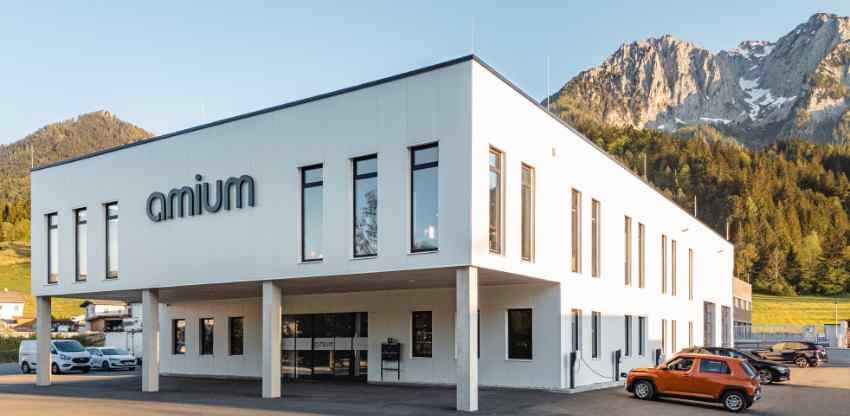
Amium GmbH is an Austrian technology company based in Walchsee, Tyrol. Since 2007, we have been developing measurement, testing and control technology for tasks where dependable data and safe processes matter.
What customers value most is our ability to look beyond an individual instrument. We bring electronics, measurement technology and software together, then adapt the system to the customer’s test process. Keeping development and manufacturing close together in Austria also helps us respond quickly when an application does not fit a standard solution.
What are the main areas of activity of the company?
Much of our current work is driven by electrification. Vehicle manufacturers, battery developers and test laboratories need to charge and discharge batteries under controlled conditions, communicate with battery management systems and reproduce faults without putting a real battery at unnecessary risk. We support that process from cell and sensor simulation through battery cycling and diagnostics to safety and environmental monitoring. Drawing on many years of experience in automotive emissions analysis, we now apply this expertise to gas analysis and measurement challenges across a wider range of industries, combining precise measurement with process automation.
What’s the news about new products/services?
When battery systems grow in voltage and capacity, a cycler has to do more than move energy in and out. It must make the process controllable, repeatable and safe. That is the idea behind our new SBC A2723.
The system provides bidirectional charging and discharging at voltages of up to 1,000 V. More importantly, it can become the centre of a wider Amium test environment: the BMC A2717 brings battery management system data directly into the test, while early outgassing detection, temperature probes and infrared fire sensors extend safety monitoring around the battery.
This modular approach allows customers to start with controlled battery cycling and add diagnostics, data acquisition and safety functions as their test programme develops. It makes the SBC relevant across development, end-of-line testing, service and second-life assessment.
What are the ranges of products/services?
Our portfolio starts with the battery itself. We provide systems for controlled cycling and discharging, access to battery management systems, and the simulation of cells and sensors. These technologies support development, validation, production and end-of-life applications. Safety monitoring is an integral part of this work, from the early detection of cell outgassing to the measurement of temperature and other environmental conditions.
Beyond e-mobility, we develop equipment for gas analysis and emissions measurement, together with sensors, controllers and interface technology. What connects these areas is our ability to combine measurement hardware with data acquisition, visualisation and process automation. Where a standard product is not enough, we adapt individual components or develop a complete system around the customer’s application.
What is the state of the market where you are currently active?
The market remains demanding but technically active. European vehicle and battery manufacturers face intense cost and time pressure as battery architectures become more complex. This increases the need for adaptable test equipment that delivers reliable data and fits into existing laboratories.
Euro 7 remains primarily an emissions regulation, but it also sets durability requirements for traction batteries in plug-in hybrid and battery-electric vehicles. It applies to new M1 and N1 vehicle types from 29 November 2026.
This brings battery validation and Amium’s long-standing emissions expertise closer together. Customers increasingly need both within the same development process.
What can you tell us about market trends?
One important trend is that battery testing no longer ends when development is complete. Data is needed during production and service, and later when a battery is assessed for reuse, repurposing or recycling. Engineers therefore need methods that make different stages of battery life comparable.
This also changes the test environment: shorter development cycles and more automated sequences require coordinated diagnostics and safety monitoring.
From 18 February 2027, the EU Battery Regulation requires a battery passport for electric-vehicle batteries, light-means-of-transport batteries and industrial batteries above 2 kWh that are placed on the market or put into service. Reliable lifecycle data is becoming essential for informed engineering decisions and regulatory compliance.
What are the most innovative products/services marketed?
The BMC A2717 gives engineers a detailed view of what is happening inside a battery during testing. It provides direct access to cell voltages, balancing functions and diagnostic data instead of limiting the test to pack-level values. This makes it easier to investigate abnormal behaviour and automate repeatable test sequences.
The controller can operate independently for balancing, sensing and control, or be integrated into an Amium battery cycler or automated validation system. Up to 32 units can be connected in series, allowing the same approach to scale from module to pack level.
Alongside it, the SBE A2725 can reproduce cell voltages and resistive temperature sensors without a real battery, while the AGI A3251 monitors atmospheric changes associated with early cell outgassing. The CAN-based Universal Device Link (UDL) connects the devices and their data to the test bench. Customers can use these components individually or combine them for a specific test without being tied to a closed platform.
What estimations do you have for the second half of 2026?
In the second half of 2026, we will continue to expand our battery-testing activities. We are broadening our portfolio to cover more testing driven by regulatory requirements and safety considerations. This includes thermal propagation testing, for which we now offer solutions.
At the same time, we are increasingly developing test systems for use directly in vehicles under real driving conditions. These projects bring battery diagnostics, safety monitoring and reliable data acquisition beyond the laboratory and into the vehicle’s actual operating environment.