
Precise product transfers are one of the central challenges for modern conveyor technology – especially for small, sensitive, or lightweight products. Montech’s knife edge features a ball bearing design and has the smallest radius on the market. It is also the only cleanroom-certified solution of its kind. This allows conveying processes to be designed more precisely, so they are more stable and cleaner.
In automated production lines, transfer areas between belt conveyors significantly influence process stability. The larger the deflection radius of a belt conveyor, the greater the transfer gap between two conveyor sections. This increases the risk of unstable transfers, product loss, or unplanned process interruptions, especially for small or sensitive products.
Knife edges reduce this transfer area to a minimum. However, the decisive factor is not only the basic design, but especially the size of the knife edge radius.
Minimum deflection radius for precise conveying processes
Montech’s knife edge features a ball bearing design and has the smallest radius on the market. This Swiss technology company has specialized in the industrialization and standardization of advanced belt conveyors, transfer systems, and aluminum framing technology for over 60 years. With a diameter of just 8 mm (radius 4 mm) for the TB30 belt conveyor and 16 mm (radius 8 mm) for the TB40 and GTB belt conveyors, especially small transfer areas are created between two belt conveyors. Products can be transported from one conveyor line to the next with a very small transfer gap. Especially for small or sensitive components or lightweight products, the use of knife edges with diameters of 8 mm or 16 mm increases the stability of the entire conveying process. At the same time, challenges such as tilting, position changes, and product loss can be significantly reduced.
Ball bearing design reduces friction and wear
In addition to the minimal knife-edge radius, the overall geometry of the knife edge itself plays a central role. The ball-bearing design of Montech’s knife edge reduces friction within the system to a minimum, ensuring particularly smooth running of the belt conveyors. Reduced friction directly affects component wear. There is less load on belt conveyors and mechanical components, extending their service life and reducing maintenance costs. At the same time, the low-friction design supports stable and reproducible conveying processes. For production environments with high requirements for process reliability, this means higher system availability and more economical operating conditions in the long term.
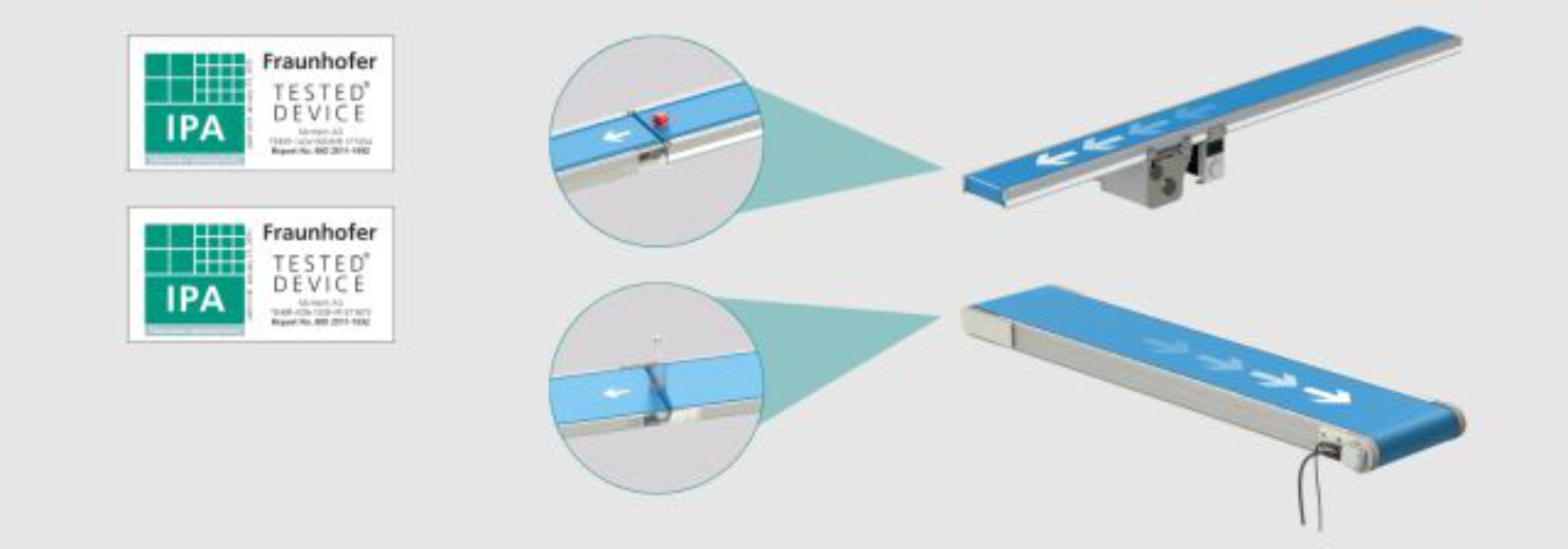
The only cleanroom-certified knife edge on the market
Montech has qualified its knife edge for cleanroom use. It is currently the only knife edge on the market with cleanroom suitability certification. The test was carried out by the Fraunhofer Institute for Production Technology and Automation IPA under cleanroom conditions according to ISO 14644-1; -14. The certification proved that the knife edge meets the requirements of the ISO 5 air purity class.
Precise conveyor technology for sensitive production environments
Montech’s knife edge is particularly suitable for applications in which small or sensitive products need to be transferred precisely between belt conveyors. These include automated assembly processes, pick-and-place applications, packaging lines, and production environments in the pharmaceutical, medical, electronics, and semiconductor industries. Wherever precise conveying and transfer processes, minimal particle emissions, and high process stability are required, the combination of the smallest knife-edge radius and cleanroom certification creates new possibilities in conveyor technology.