
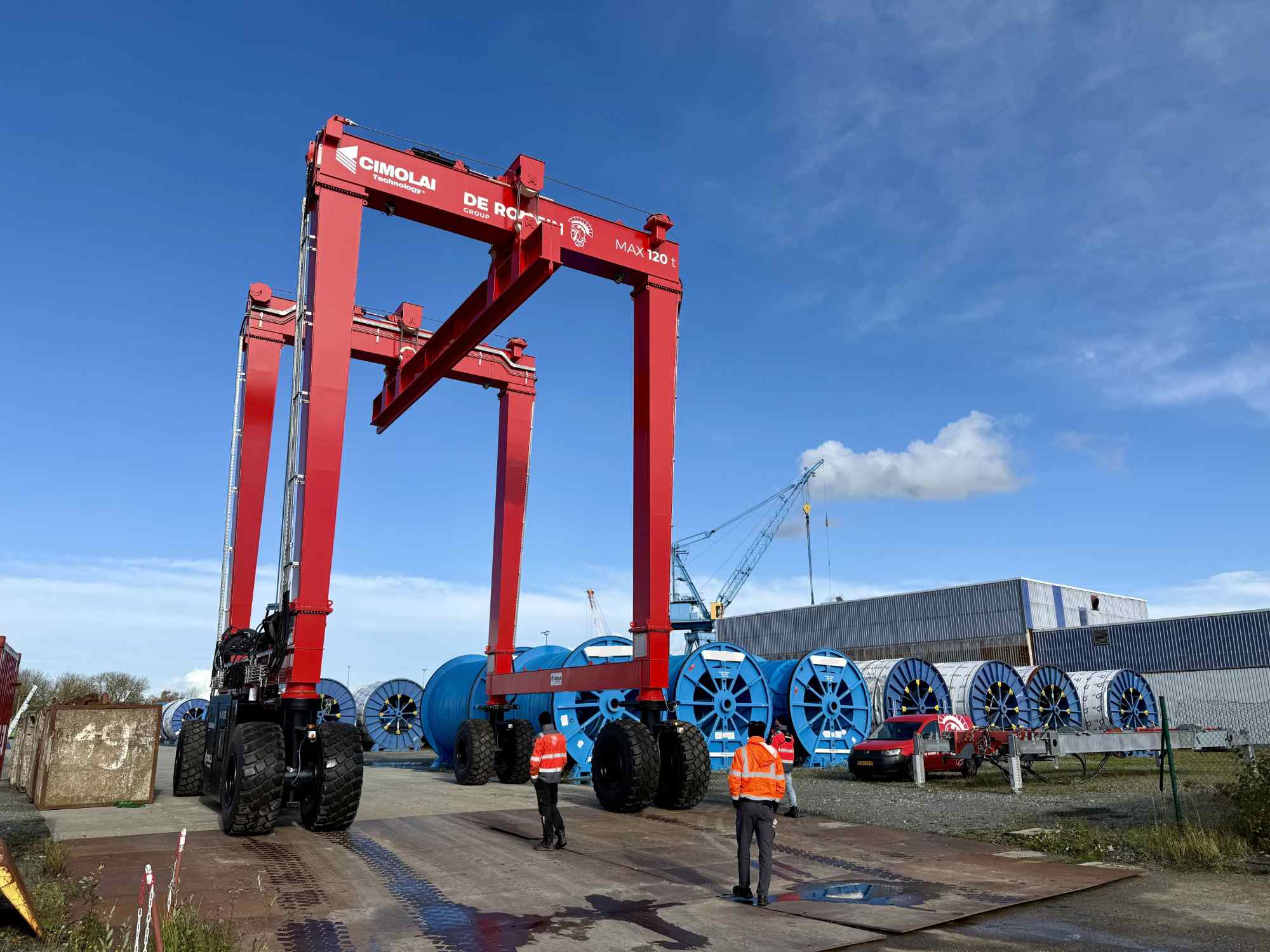
Founded in 2004, Cimolai Technology designs and delivers custom engineering solutions for lifting and handling, built around a key differentiator: a fully in-house process.
From initial concept to engineering, from manufacturing to commissioning, every phase is managed internally, supported by the production capabilities of ACCS – Armando Cimolai Centro Servizi, the group’s mechanical fabrication unit. The cycle is completed with testing, installation, training where required, and structured after-sales service and maintenance. This end-to-end model enables tight control over quality, lead times, safety and performance—especially when the application demands non-standard solutions.
Interview with Lorenzo Cimolai, Business Developer at Cimolai Technology.
What are the main areas of activity of the company?
Lorenzo Cimolai: By its nature, Cimolai Technology operates across multiple industries and operating environments. The company’s machines and systems are used in marinas and shipyards, in civil infrastructure projects, in the nuclear sector, across energy and renewables, in aerospace, and in many other industrial fields where reliability and operational continuity are essential. What these sectors have in common is the need to handle significant loads in constrained spaces, while meeting strict safety requirements, productivity targets and regulatory compliance.
What’s the news about new products/services?
L.C: Talking about “new products” at Cimolai Technology essentially means describing a method: there is no standard catalogue. Each order is developed as a prototype, engineered around the customer’s real needs and the site’s specific constraints—available footprint, environmental conditions, duty cycles, productivity goals, safety requirements, maintainability and accessibility. Every environment is different; therefore, the final machine must be different as well. Customization is not an option, but the technical foundation to ensure measurable performance in the exact context where the equipment will operate.
What are the ranges of products/services?
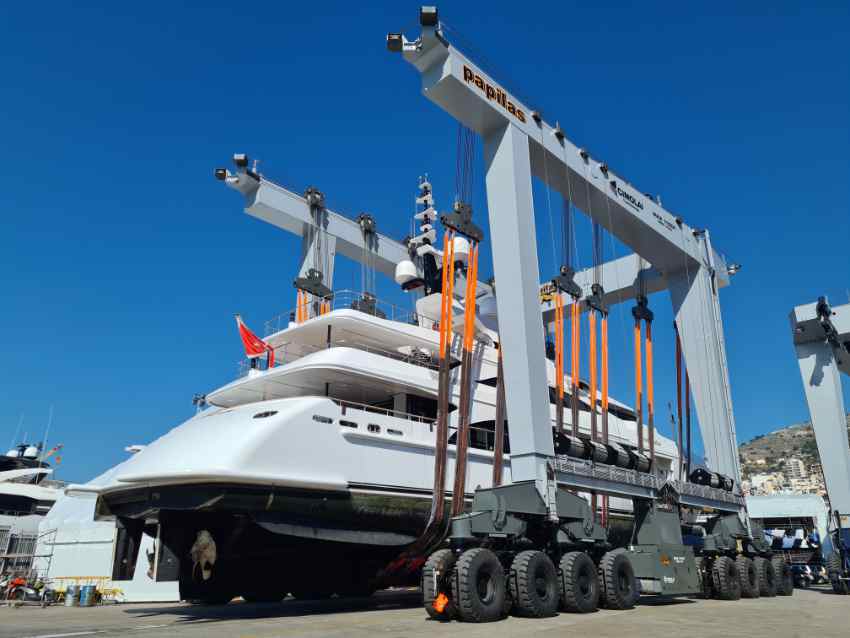
L.C: Within this tailor-made approach, solutions can be grouped into four main families. The first is boat hoists, ranging from a few tons to over 1,500 t, designed for different vessel types and marina configurations. Depending on operational needs and space limitations, telescopic versions are available, while increasing attention to environmental impact and noise reduction is strengthening interest in full-electric solutions. The second family includes straddle carriers, highly versatile machines deployed across many applications, including shipyard operations; configurations and capacities are defined case by case.
Next are shipyard cranes, offered as bridge, portal and gantry solutions, engineered to fit yard logistics and production flows while delivering the required accuracy and repeatability. Finally, special equipment: custom lifting, handling and motion systems for complex, high-profile projects where standard solutions do not fit—well captured by the guiding principle, “If you can dream it, we can build it.”
What is the state of the market where you are currently active?
L.C: The 2026 market picture is mixed. The year opened with significant uncertainty and, in some countries, a sense of stagnation: greater CAPEX caution, longer decision cycles, and increased selectivity in supplier choice. At the same time, genuinely strategic initiatives continue to move forward—marina and shipyard modernization, higher efficiency and safer operations, continuity and compliance upgrades, and the drive to reduce emissions. In this context, demand is rising for partners able to take end-to-end technical responsibility, ensure dependable delivery schedules, and provide after-sales support robust enough to sustain equipment performance throughout its life cycle.
What can you tell us about market trends?
L.C: The most visible trends reflect this evolution: electrification and lower environmental footprint; “pragmatic” automation focused on tangible to enhance safety and uptime; deep customization to operate within existing footprints and strict constraints; and a growing life-cycle perspective centered on maintainability, service strategies, spares and retrofitting. Innovation, in other words, is not pursued for its own sake, but wherever it reduces operational risk, improves availability, and makes return on investment measurable.
What are the most innovative products/services marketed?
L.C: Accordingly, some of the most innovative and requested solutions include full-electric boat hoists and telescopic configurations optimized for constrained layouts, as well as straddle carriers and shipyard cranes designed for sensor integration and condition monitoring—helping shift maintenance from reactive to planned. In special projects, innovation is expressed through the ability to combine very high lifting capacity with precise motion control and stringent safety requirements, often in challenging environments and with limited operating windows.
What estimations do you have for the second half of 2026?
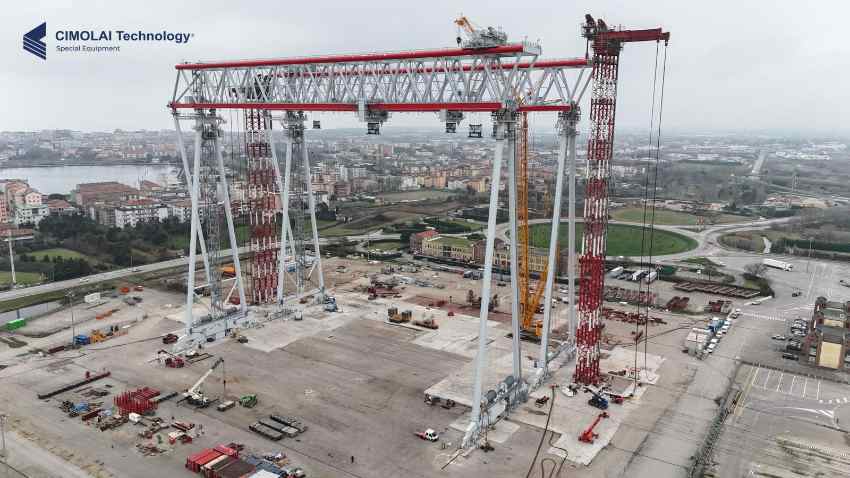
L.C: Looking at H2 2026, Cimolai Technology expects demand to remain cautious overall, yet supported by the execution of projects already in the pipeline—especially where investment is clearly linked to productivity gains, operating cost reduction, and ESG targets. At the same time, the second half of the year will see the company at the forefront with the delivery of a truly unique project: two 800-ton Goliath cranes, each reaching 100 meters in height with a 118-meter span—roughly the height of a 30-storey building.
The cranes feature an innovative design approach that revisits traditional Goliath architecture, making the structures slimmer and “lighter” not only in appearance, but in structural efficiency as well. They are engineered to support the construction of a new generation of mega cruise ships—designed for 7,500 passengers plus 2,500 crew—where throughput, precision and safety are mission-critical. For the first time, the cranes will be transported fully assembled on a barge and shipped to Monfalcone, their final destination, where they will arrive already assembled and ready for final commissioning and testing. It is a one-of-a-kind logistics operation—matching the uniqueness of the project itself—and a clear example of how customized engineering and full in-house execution can unlock new benchmarks in shipyard lifting.