
As industrial manufacturers look to transition extrusion-based 3D printing from rapid prototyping to series production, German software startup, Advanced Additive, is introducing G-code toolpath optimization to elevate material extrusion to industrial standards. Founded in Germany, as a spinoff from the Technical University of Applied Sciences Rosenheim by CEO Florian Aigner and Julia Paternoster, Advanced Additive is supported by the EXIST and FLÜGGE startup grants. The company’s flagship cloud platform, Project Path, directly optimizes toolpath planning in machine code for fused filament fabrication (FFF/MEX), covering polymers, fiber-reinforced plastics, silicone, and sinter-based metal and ceramic filaments. By dynamically adapting extrusion widths to part geometry rather than relying on fixed slicer widths, Project Path eliminates voids and over-extrusion. Tested in demanding aerospace, automotive, medical, and toolmaking applications, the machine-agnostic software has enabled printed polymer parts to achieve tensile strength on par with injection-molded references while significantly reducing leakage rates in compressed air components.
Interview with Florian Aigner, CEO of Advanced Additive.
A brief description of the company and its activities.
Florian Aigner: Advanced Additive is a 3D printing software company based in Rosenheim, Germany. It emerged from the materials science department of the Technical University of Applied Sciences Rosenheim and was founded by Florian Aigner and Julia Paternoster, supported by the EXIST and FLÜGGE start-up grants. Our mission is to bring extrusion-based 3D printing up to industrial standards. Our core product, Project Path, optimizes toolpath planning directly in the G-code so that parts are filled precisely. The result is better mechanical properties, higher reproducibility and less scrap, which makes additive manufacturing viable for demanding and safety-critical applications.
What are the main areas of activity of the company?
F.A: Our main work is in software, where we develop and license toolpath optimization algorithms for material extrusion (FFF/FDM/FLM/MEX) , for polymers as well as for metal, ceramic and silicone applications. To provide this we got a cloud-based optimization platform, where users upload their machine code and receive a ready-to-print, optimized file. Furthermore, we consult and build custom software for our customers. Our main sectors are aerospace, automotive, medical and dental technology, as well as toolmaking, special machinery and spare parts production. We work closely with partners such as Fraunhofer IAPT to expand the research into our field and convert these to findings into products for industry.
What’s the news about new products/services?
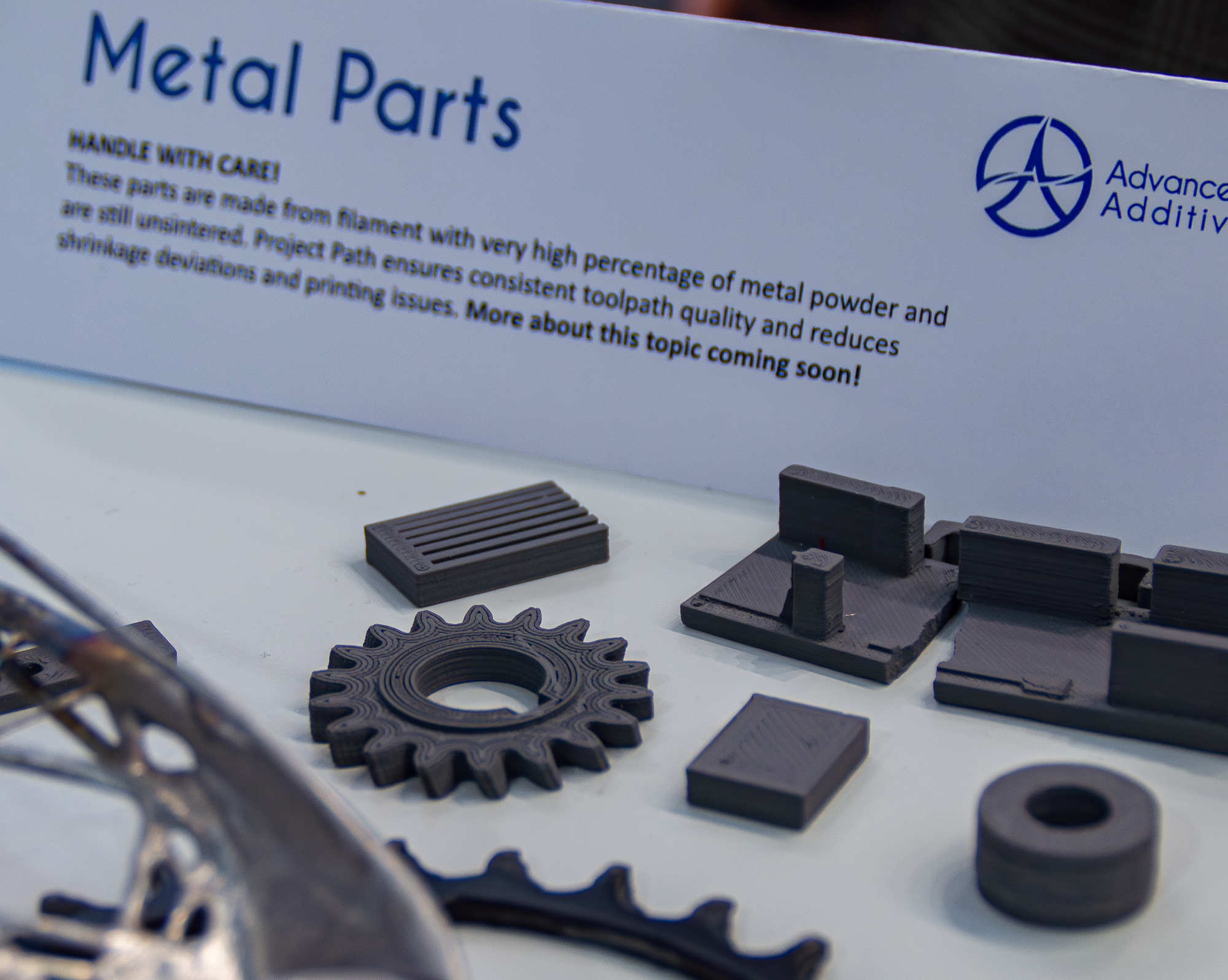
F.A: Our optimization platform for The Path is online and a new test phase is coming at the end of this year, where companies can test Project Path on their own parts without installing anything. These optimizations focus the fully filled areas of the part since there are the largest improvements to be made regarding part properties and process reliability. A growing focus for us is metal filament printing. Together with the material specialists at PT+A and printing specialists at the machine builder L.B. Bohle, we are preparing a research project on dense, gas-tight stainless steel parts made by MEX and sintering. In this project we expect to make a leap forward and be able to better control part properties as well as shrinkage and warpage achieved due to specialized toolpath planning in combination with a tailer made material for the new process.
What are the ranges of products/services?
F.A: The Path – Polymer addresses FLM parts made of standard and engineering-grade plastics, including fiber-reinforced materials. The Path – AdvancedMaterials targets sinter-based processes with metal and ceramic filaments as well as silicone. Customers can use both editions via our cloud platform, where all calculations run on our servers, or integrate them into their existing workflow. The software is machine- and material-agnostic, so it works on desktop printers as well as industrial systems, without vendor lock-in. In pilot projects, customers test the software on their real applications. Our consulting services range from short workshops to long-term project support, so that customers can print new materials and keep pushing the boundaries of additive manufacturing.
What is the state of the market where you are currently active?
F.A: Material extrusion is the most widespread 3D printing technology, with low entry costs, a huge installed base and near endless material variations. In industry, however, it is still mostly used for prototypes, jigs and fixtures, because part quality and repeatability are not yet reliable enough for functional end-use parts. The industrial AM still grows the last years, but investment decisions remain mainly in hardware but especially since the market is consolidating software solutions that boost existing manufacturing possibilities, starts to get more and more into focus. For us, this is an opportunity: companies want to get more out of the machines they already own, and software is the lever that delivers this without additional hardware investment.
What can you tell us about market trends?
F.A: We see four main trends. First, the shift from prototyping to series production, which raises the requirements for qualification and repeatability. Second, software is becoming the key differentiator, and users want hardware-independent workflows instead of a separate tool for every machine. Third, materials are getting more demanding: fiber-reinforced and high-performance polymers, but also metal and ceramic filaments that are debound and sintered. Metal FFF is particularly interesting because the process chain is considerably cheaper than laser powder bed fusion and the printers cost only a fraction. Fourth, sustainability and resilience: less scrap, local on-demand production and scalable printer farms. All of these trends depend on reliable material deposition, which is exactly what we address.
What are the most innovative products/services marketed?
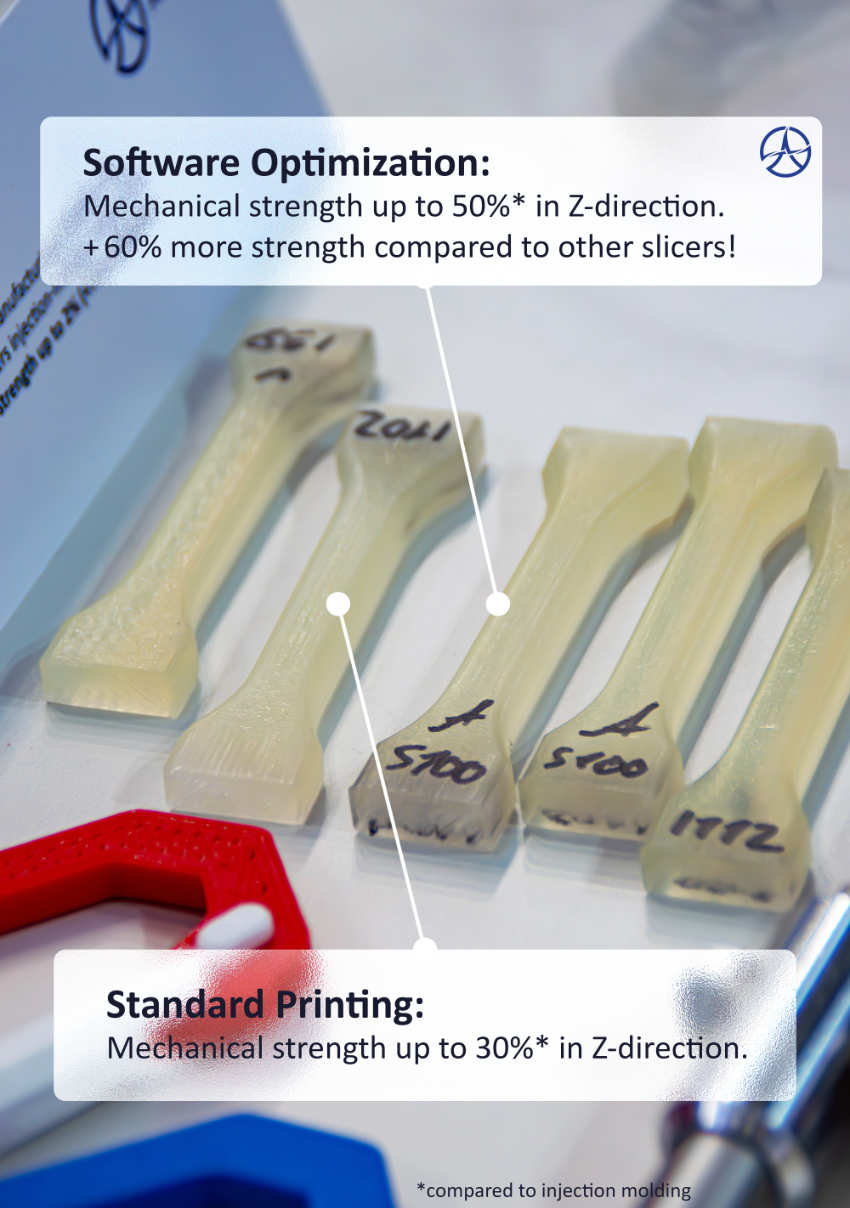
F.A: Our toolpath optimization itself. Conventional slicers work with fixed extrusion widths, which leaves gaps or causes over-extrusion, especially in thin walls and complex geometries. Project Path adapts the extrusion width to the geometry, so every part is filled completely. In tensile tests, optimized parts printed with a 0.8 mm nozzle reached 63.2 MPa, compared with 63.6 MPa for injection-molded reference parts and a deviation on par with it. For compressed air components, we reduced the leakage rate to just 0.019 bar/h, and on a sintered pipe flange for fluid transport, the optimization increased density and drastically reduced defects. Because it works directly in the G-code, the approach is independent of machine and material and can be transferred to other path-based processes such as DED, WAAM or SLS.
What estimations do you have for the end of 2026?
F.A: We expect the market to remain cautious about hardware investments for the rest of the year, but increasingly open to solutions that make existing equipment more productive and reliable. For Advanced Additive, the focus is on turning pilot projects into long-term customer relationships, extending the platform with new features, growing our AdvancedMaterials edition and deepening our partnerships. In the long run, we are convinced that software will decide how fast additive manufacturing moves into series production, and we want to help set that standard.