
Pure Global is a global regulatory technology company that makes global market access—specifically device registrations and local representation—simpler and faster for medical device manufacturers worldwide. By empowering a strong team of veteran regulatory experts with unprecedented access to AI and regulatory data, the company streamlines traditional workflows. This innovative approach passes efficiencies and simplicity directly to customers globally, helping to keep traditionally high regulatory costs at bay.
What are the main areas of activity of the company?
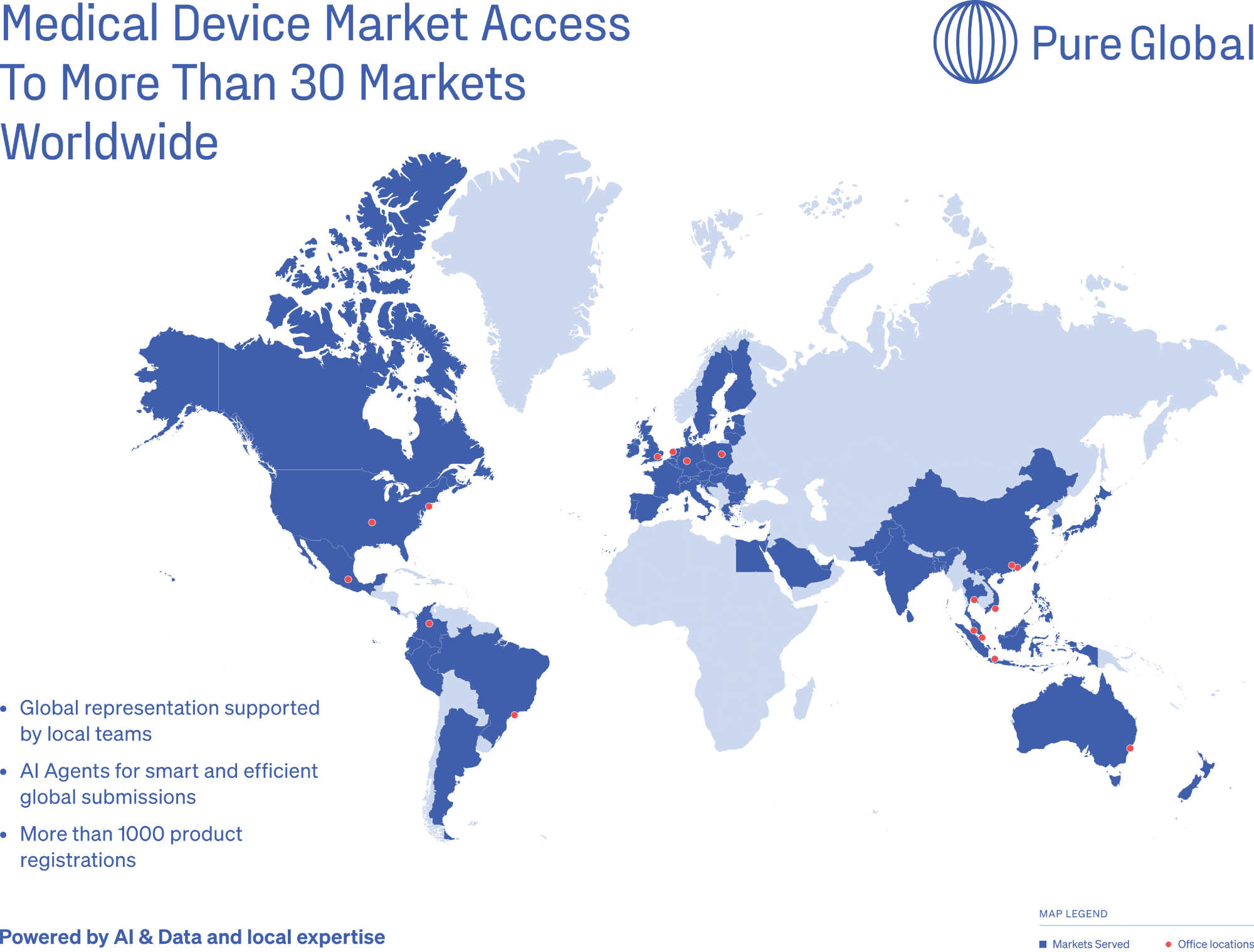
The company primarily acts as a local authorized representative and license holder for foreign manufacturers. Pure Global covers more than 15 markets directly—encompassing most major global MedTech markets—and extends this coverage to over 30 markets through an established partnership network.
What’s the news about new products/services?
In January 2026, Pure Global introduced a flat-fee pricing model for medical device market access. This new service offers all-inclusive annual fees to help clients with predictable budgeting, marking a significant departure from the traditional hourly or project-based billing models commonly used in the industry. More details can be found on their official news release.
What are the ranges of products/services?
Pure Global’s service range covers Medical Devices, IVDs, Software as a Medical Device (SaMD), and combination products, organized into three primary pillars:
Pillar 1: Market Access (Core Business)
- In-Country Representation: Covers over 30+ markets globally through direct and partner networks.
- Product Registration & Submission: Supports 30+ jurisdictions across the Americas (9), Europe (3), MENA (5), and Asia Pacific (17).
- Regulatory Consulting: Includes US (510(k), De Novo, PMA) and EU (MDR/IVDR) compliance.
- Post-Market Surveillance & Vigilance: Provided for all represented markets.
Pillar 2: Clinical Services
- Clinical Evaluation Reports (CER).
- Performance Evaluation Reports (IVD).
- CRO-related services for medical devices (managed directly through partner networks).
- Pillar 3: AI & Data Solutions
- PureGlobal.AI tracks and analyzes regulatory information across 50+ countries.
It features over 5 million product registration, listing, and trial data records, alongside 600,000+ global distribution records.
The platform is open and free for everyone to use without restrictions, serving as Pure Global’s way of supporting the entire MedTech ecosystem by ensuring public data is readily accessible to all stakeholders.
What is the state of the market where you are currently active?
Pure Global is active across 30+ markets spanning four major regions. The current state of these regions is as follows:
Americas (9 Markets): The US remains the world’s largest medical device market, with North America holding approximately 38.1% of the global market share [16] (though some reports cite >40% [17]). In 2025 alone, the FDA cleared 295 AI/ML-enabled devices [18, 22]. Latin America is experiencing accelerated device adoption and regulatory modernization; for example, Mexico updated Article 376 in January 2026 to allow 10-year registration renewals [23], and Brazil’s ANVISA continues to modernize with new SaMD regularization guidance.
Europe (3 Markets): The EU MDR/IVDR transition continues to reshape the European market. In December 2025, the EU proposed simplified MDR/IVDR rules [24, 25] and subsequently launched the EMA Breakthrough Devices Pilot Program in Q2 2026 [26, 27]. The UK MHRA is implementing new post-market surveillance regulations (effective June 2025), while Notified Body capacity remains a critical bottleneck. Additionally, Switzerland’s Swissmedic identified 22% non-compliance in 2025 device inspections.
MENA (5 Markets): The MENA medical device market is growing rapidly due to significant healthcare infrastructure investment. Saudi Arabia’s SFDA is accelerating approvals and digitalizing registration processes, and the UAE continues to attract MedTech companies by leveraging its strategic position as a regional hub.
Asia Pacific (17 Markets): This represents the fastest-growing medical device market globally, with accelerating ASEAN regulatory convergence. Malaysia’s MDA fully recognized Singapore’s HSA as a reference authority in March 2026 following a successful pilot [19, 20]. Elsewhere, Thailand introduced electronic change notification systems, Indonesia’s MOH approved an average of 1,557 new products per month in 2024, and Vietnam’s Decree 37/2026 updated device labeling requirements.
What can you tell us about market trends?
The MedTech sector is experiencing robust expansion, projected to grow at a 6.9% CAGR and reach over $1 trillion by 2034 [1]. Regional trends highlight this trajectory:
The Americas: North America remains the dominant global force, holding a 38.1% market share with a valuation of $101.98 billion in 2025 [2]. The US market drives this, projected to grow at a 6.8% CAGR to reach $199 billion by 2032 [3]. Meanwhile, Latin America shows explosive import-driven growth; Brazil’s import market surged 18.0% year-over-year to $9.33 billion in 2024 [4], and Mexico’s grew 12.6% to $11.40 billion [5].
Middle East and North Africa (MENA): The broader MEA region exhibits strong growth potential, valued at $311.43 billion in 2024 and forecast to reach $506.60 billion by 2032 (a 5.86% CAGR) [6]. Medical device contract manufacturing is a particularly high-growth segment, projected to hit $7.7 billion by 2032 at an aggressive 10.41% CAGR [7].
Europe: Representing the second-largest global market with a 26.1% share [8], Europe’s growth is mature and heavily regulated. The market is expected to expand at a steady 4.9% CAGR from 2025 to 2032 [9], supported by well-established healthcare infrastructure and demand for advanced diagnostics, though tempered slightly by strict regulatory environments.
Asia Pacific: APAC is one of the most dynamic growth centers, projected to exhibit a rapid 8.0% CAGR through 2032 [10]. Major opportunities lie in China, where domestic revenue hit $37.6 billion in 2024 [11], and India, which is expected to quadruple to $50 billion by 2030 [12]. Southeast Asia is also a critical hub, with Malaysia’s market projected to reach $4.5 billion by 2028 (9% CAGR) [13] and Indonesia forecast to reach $3.66 billion by 2029 (7.26% CAGR) [14].
What are the most innovative products/services marketed?
Pure Global continues to pioneer advancements in regulatory technology by transforming complex MedTech consulting into an accessible, predictable commodity.
Here is how their latest service offering is reshaping the industry:
Predictable, All-Inclusive Pricing: Breaking away from traditional and unpredictable hourly billing, Pure Global has introduced an industry-first flat annual fee, starting at $2,000 USD for a company’s first device. This dramatically simplifies procurement and guarantees budget predictability for manufacturers.
AI-Driven Efficiency: To make this cost-effective model viable internally, Pure Global leverages advanced technology to handle the heavy lifting. By utilizing AI Agentic Workflows, automated translations, and AI-powered classification tools, they automate the highly customized, moving parts of traditional regulatory work.
Strategic Expert Focus: By delegating laborious, repetitive tasks to AI, Pure Global ensures that their local, veteran regulatory experts can stay laser-focused on critical strategy and high-level problem-solving.
What estimations do you have for the beginning of 2026?
The start of 2026 marks a pivotal transition: generative AI agents have evolved from basic drafting assistants into the primary interface connecting manufacturers and regulatory bodies.
This shift is characterized by several major developments:
The Rise of “Reciprocal AI”: Sparked by the FDA’s first AI-assisted scientific review pilot, a new dynamic has emerged where both regulators and manufacturers actively leverage AI to prepare, interpret, and expedite scientific reviews. [32]
Accelerated Evaluation Pipelines: This mutual AI integration compresses traditional regulatory review cycles, allowing for rapid, continuous iterations during the design and documentation phases.
A Paradigm Shift in Engineering: The traditional linear workflow—building a prototype and subsequently developing the regulatory rationale—is no longer viable.
Parallel Compliance Workflows: Engineering teams must now develop requirements analyses, validation evidence, and compliance documentation concurrently with prototyping. AI agents are deployed to automate this process by instantly drafting test protocols, mapping requirements, and analyzing evidence gaps in real time.
CONSOLIDATED REFERENCES
- Fortune Business Insights: Global Medical Devices Market Size and Growth
- Fortune Business Insights: North America Medical Devices Market Size
- Pure Global: United States Medical Device Market Projections
- Pure Global: Brazil’s Medical Device and IVD Import Market Growth
- Pure Global: Research Report on Mexico’s Medical Device and IVD Import Market
- Data Bridge Market Research: Middle East and Africa Medical Devices Market Size
- Credence Research: Middle East Medical Device Contract Manufacturing Market Size 2024-2032
- MedTech Europe: Facts & Figures 2024 (European Market Share)
- Fortune Business Insights: Europe Medical Devices Market Forecast
- Fortune Business Insights: Asia Pacific Medical Devices Market Growth
- HKUST Li & Fung Supply Chain Institute: Global Supply Chain Report on Medical Devices
- EY Insights: India’s MedTech Transformation and Market Projections
- Pure Global: Research Report on Malaysia’s Medical Device and IVD Market
- Pure Global: Indonesia Medical Device Market Forecast
- Regulation (EU) 2017/746, Article 110 as amended (EU IVDR transitional deadlines)
- Fortune Business Insights — Medical Devices Market Report 2034
- Precedence Research — Medical Devices Market
- Innolitics — 2025 Year in Review: AI/ML Medical Device 510(k) Clearances (December 2025)
- HSA Press Release (March 12, 2026) — Malaysia-Singapore MDA-HSA Regulatory Reliance
- Pure Global News — Malaysia-Singapore 2025 MOU on Medical Device Regulatory Reliance
- IntuitionLabs — FDA’s AI Medical Device List (revised March 12, 2026)
- FDA.gov — Artificial Intelligence-Enabled Medical Devices
- MedDeviceGuide (April 2026) — Mexico COFEPRIS Medical Device Registration Guide
- Pure Global News — EU Proposal to Simplify MDR and IVDR Rules (2025)
- StarFish Medical — EU BtX Designation Program
- EMA Press Release (April 2026) — New pilot to support development of breakthrough medical devices
- Hogan Lovells (April 2026) — New EU Pilot Programme for Breakthrough Medical Devices and In Vitro Diagnostics
- Fortune Business Insights — AI-Enabled Medical Devices Market (April 2026)
- Towards Healthcare / Precedence Research via Yahoo Finance — AI in medical devices market projection
- FDA.gov — Quality Management System Regulation (QMSR) Official Page
- Gardner Law (February 2026) — FDA Revised QMSR Modernizes Device Quality Regulation
- FDA.gov — FDA Announces Completion of First AI-Assisted Scientific Review Pilot and Aggressive Agency-Wide AI Rollout Timeline (May 2025)