
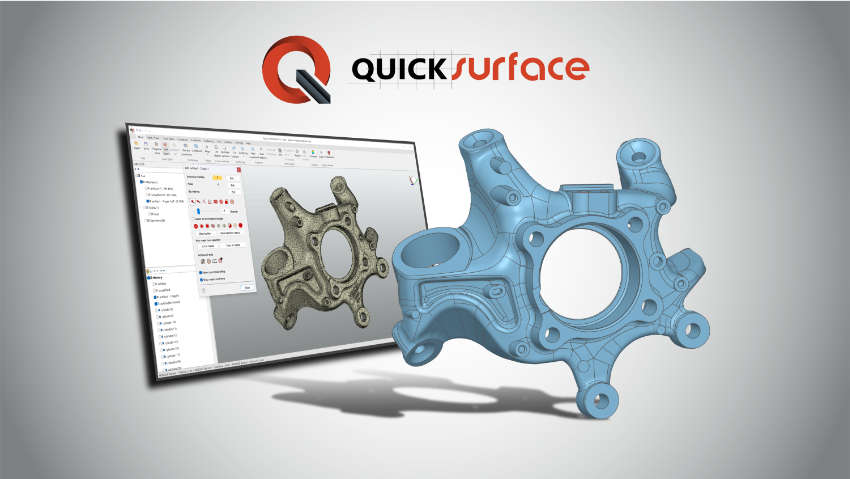
KVS Ltd, the developer of QUICKSURFACE, helps engineers transform 3D scan data into accurate, editable CAD models more efficiently. By combining practical automation with direct engineering control, QUICKSURFACE reduces repetitive modelling work while preserving accuracy, flexibility, and the original design intent of the component.
Efficiency begins after the scan
Industrial efficiency is no longer simply about completing the same task faster. It also means reducing unnecessary process steps, shortening training time, improving repeatability, and giving engineers greater control over quality.
In recent years, 3D scanning has become faster, more capable, and more accessible. As a result, the efficiency bottleneck has increasingly moved from data capture to the Scan-to-CAD stage.
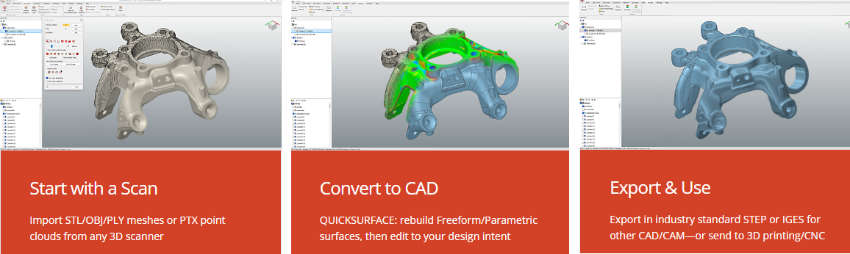
Customers now expect reverse engineering software to process scan data more quickly without compromising accuracy or engineering control. QUICKSURFACE addresses this need by simplifying the reconstruction process and helping users move efficiently from mesh data to accurate, editable CAD geometry suitable for manufacturing, redesign, inspection, or further engineering work.
A model created quickly but requiring extensive correction later is not an efficient result. True efficiency must be considered across the complete workflow, including scan preparation, reconstruction, validation, and transfer into the wider engineering process.
Practical automation and operator productivity
QUICKSURFACE was developed with operator efficiency as a core priority. Its logical interface and workflow-focused tools minimise unnecessary operations while maintaining the flexibility required for professional reverse engineering.
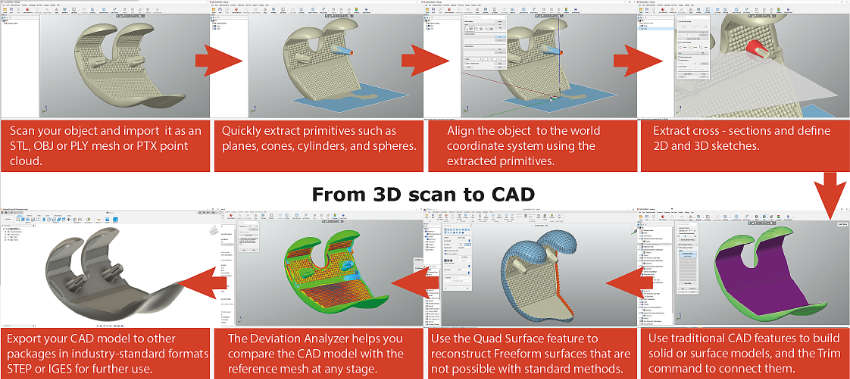
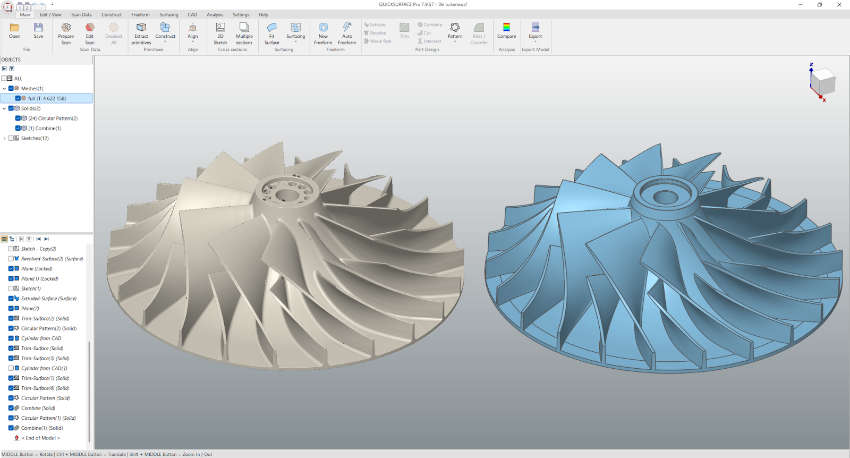
Key capabilities include automatic surfacing for organic and freeform components, primitive extraction, surface fitting, automatic sketch-entity fitting from mesh sections, and automatic fillet calculation.
These tools accelerate defined stages of the process while allowing engineers to decide how the final CAD model should be built. The objective is not to remove engineering judgement, but to reduce the repetitive work surrounding the decisions that require engineering knowledge.
Efficiency also depends on how quickly users can become productive. KVS therefore invests heavily in practical learning resources, including tutorials, workflow videos, sample projects, and online workshops. Several significant workflow improvements are also planned over the next year, with further details to be announced later.
Reducing cost without compromising quality
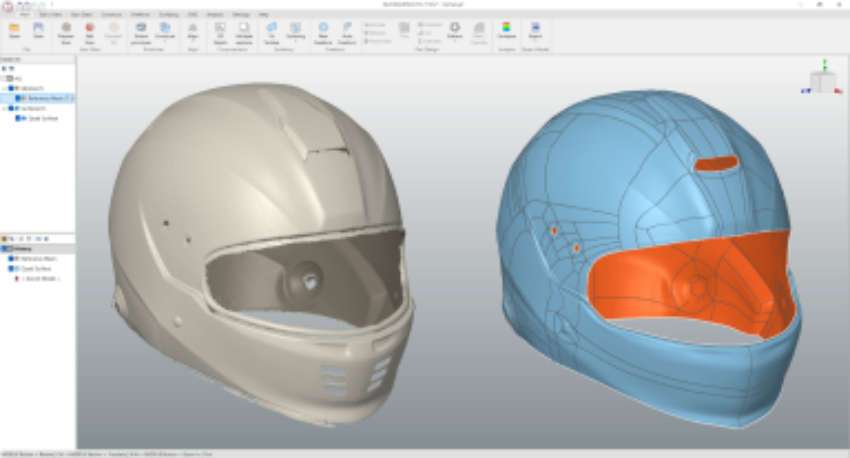
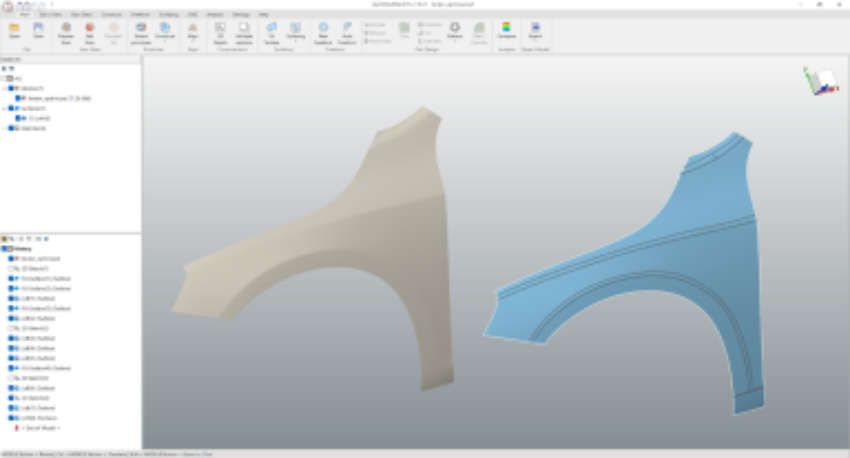
QUICKSURFACE helps customers reduce costs by shortening modelling time, reducing repetitive manual operations, limiting rework, and accelerating the transition from scan data to editable CAD.
The software also makes it possible to recreate damaged, obsolete, or unavailable components. This can help customers avoid replacing complete machines or assemblies when only one part is required.
Quality remains central to the process. Engineers can inspect deviations between the original scan and the reconstructed model, refine the geometry, and decide where the final CAD should follow the measured surface and where it should represent the intended functional design.
Digitalisation is fundamental to this process because it transforms a physical component into reusable engineering data. Automation already plays an important role, but reverse engineering cannot always be reduced to one automatic operation.
A scan records the visible condition of a component. It may include wear, deformation, damage, missing areas, manufacturing variation, or surface noise. It does not contain complete information about the original design intent, manufacturing method, or functional requirements.
The QUICKSURFACE approach is therefore pragmatic: automate repetitive and predictable operations while allowing the engineer to retain control over geometry, accuracy, and design decisions.
Practical efficiency across industrial applications
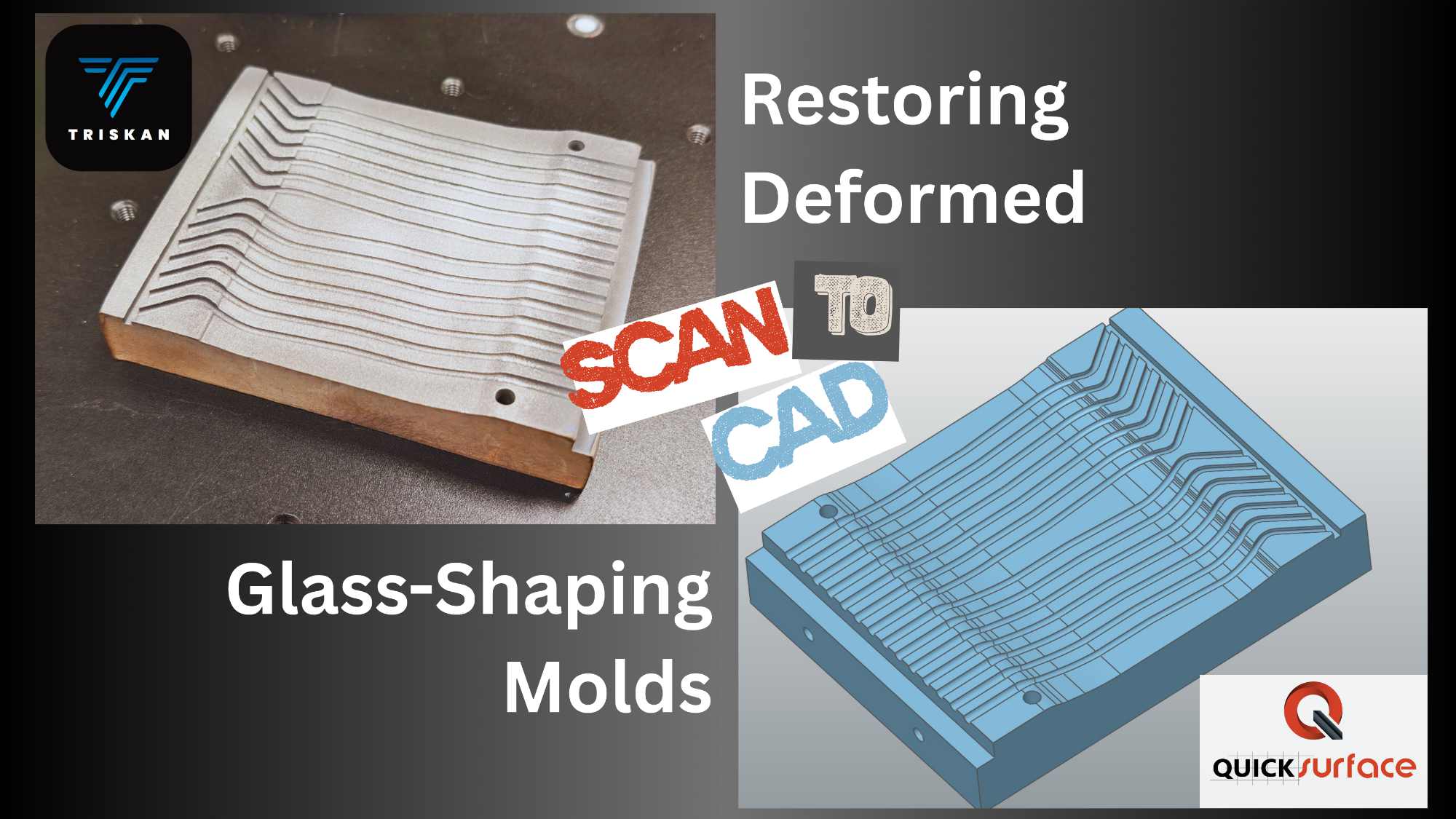
A project with TRISKAN demonstrates how reverse engineering can improve efficiency when critical production tooling becomes worn or deformed.
The project involved glass-shaping moulds whose geometry had changed through use. The moulds were 3D scanned and reconstructed in QUICKSURFACE to recover the required geometry as accurate, editable CAD data.
This allowed the existing tools to become the starting point for digital restoration, supporting remanufacturing while reducing manual reconstruction work and avoiding the need to rebuild the tooling from the beginning.
Read the full case study:
Case Study: Restoring Deformed Glass-Shaping Molds with QUICKSURFACE
Other applications demonstrate the value of efficient Scan-to-CAD workflows across different industries.
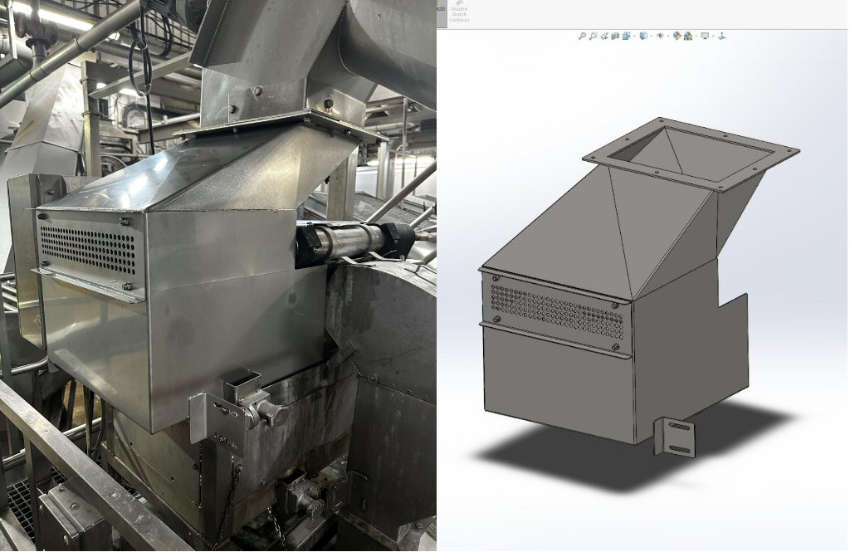
Dodman uses QUICKSURFACE for SOLIDWORKS in specialist food-processing machinery: Dodman’s Success with QUICKSURFACE for SOLIDWORKS in Food Machinery Engineering – Case Study
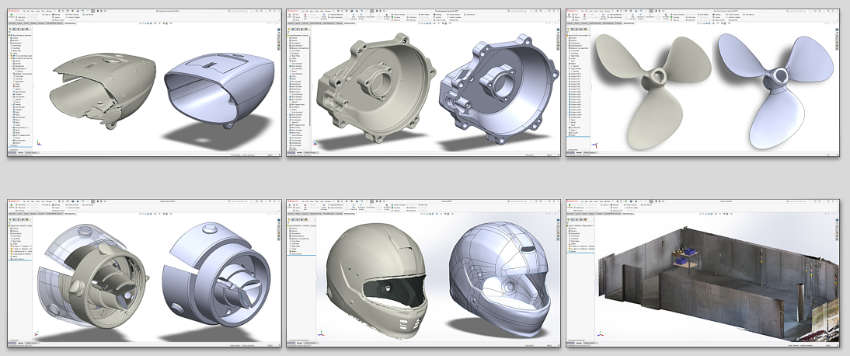
Philadelphia Racing Products uses QUICKSURFACE in the development and manufacture of specialist automotive components: From Scan to CAD, QUICKSURFACE Helps Revolutionize the Manufacturing of Automotive Parts
Although these projects involve different sectors and geometries, the objective remains the same: reduce the time between capturing a physical component and creating dependable CAD data that can be modified and reused.
Reliability, sustainability, and customer feedback
Every new QUICKSURFACE capability is evaluated against three requirements: practical workflow value, reliability, and ease of use.
Extensive testing is a standard part of the development process, and the support and development teams respond quickly when users report issues or suggest improvements. KVS does not introduce technology simply because it is new. A feature must help engineers complete real tasks more effectively without making the software less stable, less predictable, or more difficult to operate.
Customer feedback also plays an important role in product development. KVS maintains close communication with end users, resellers, and technology partners. Feedback from real projects helps identify repetitive operations, workflow obstacles, and opportunities to improve the software.
Rather than creating isolated versions for individual customers, the development team considers whether a requested improvement can provide wider engineering value. Where appropriate, it is incorporated into the main product so the broader QUICKSURFACE community can benefit.
Reverse engineering also supports sustainability by extending the operating life of existing machinery and equipment. When original CAD data, drawings, tooling, or replacement components are unavailable, scanning and reconstructing a damaged or obsolete part can allow only the required component to be remanufactured.
This supports repair, maintenance, remanufacturing, and waste reduction while helping companies minimise downtime and avoid replacing complete machines unnecessarily.
The future of Scan-to-CAD efficiency
Artificial intelligence, improved workflow automation, more capable 3D scanning systems, and stronger integration between scanning and CAD platforms will all influence industrial efficiency over the coming years.
The greatest value will come from technologies that reduce repetitive work, improve data transfer, and help engineers make decisions more quickly. However, successful adoption will depend on balancing automation with accuracy, reliability, and engineering control.
As leaders in our field, we take a pragmatic approach to emerging technologies such as artificial intelligence. We continually research how these technologies can create meaningful efficiency gains while maintaining the accuracy, reliability, and engineering control required in professional applications.
Our vision is to make professional Scan-to-CAD and reverse engineering workflows more accessible, predictable, and productive.
By combining intelligent automation, practical workflow design, responsive product development, and strong technical support, QUICKSURFACE will continue helping customers reproduce unavailable parts, extend equipment life, reduce development time, and respond more effectively to changing industrial requirements.
Subscribe for more practical Scan-to-CAD and reverse engineering workflows. https://www.youtube.com/@QUICKSURFACE
Instagram: https://www.instagram.com/quicksurface3d
Facebook: https://www.facebook.com/quicksurface
Twitter: https://twitter.com/quicksurface