
Axtra3D, Inc. specializes in developing advanced additive manufacturing solutions based on optoelectronics. Founded in 2021 around an exciting patent portfolio, the team organized around providing proof of concept. Once Hybrid PhotoSynthesis was proven on alpha machines, the company attracted investors to commercialize and bring HPS technology to market.
Axtra3D is headquartered in Charlotte, NC, USA with a subsidiary in Vicenza, Italy.
How does your company define “real impact” when it comes to industrial innovation, and how do you measure it in practice?
At Axtra3D, real impact is defined by a fundamental shift in how additive manufacturing is used within industrial environments. It is not about incremental improvements in print resolution or marginal gains in speed. Instead, it is about enabling 3D printing to move from a prototyping tool into a true production system that directly contributes to revenue generation and operational efficiency.
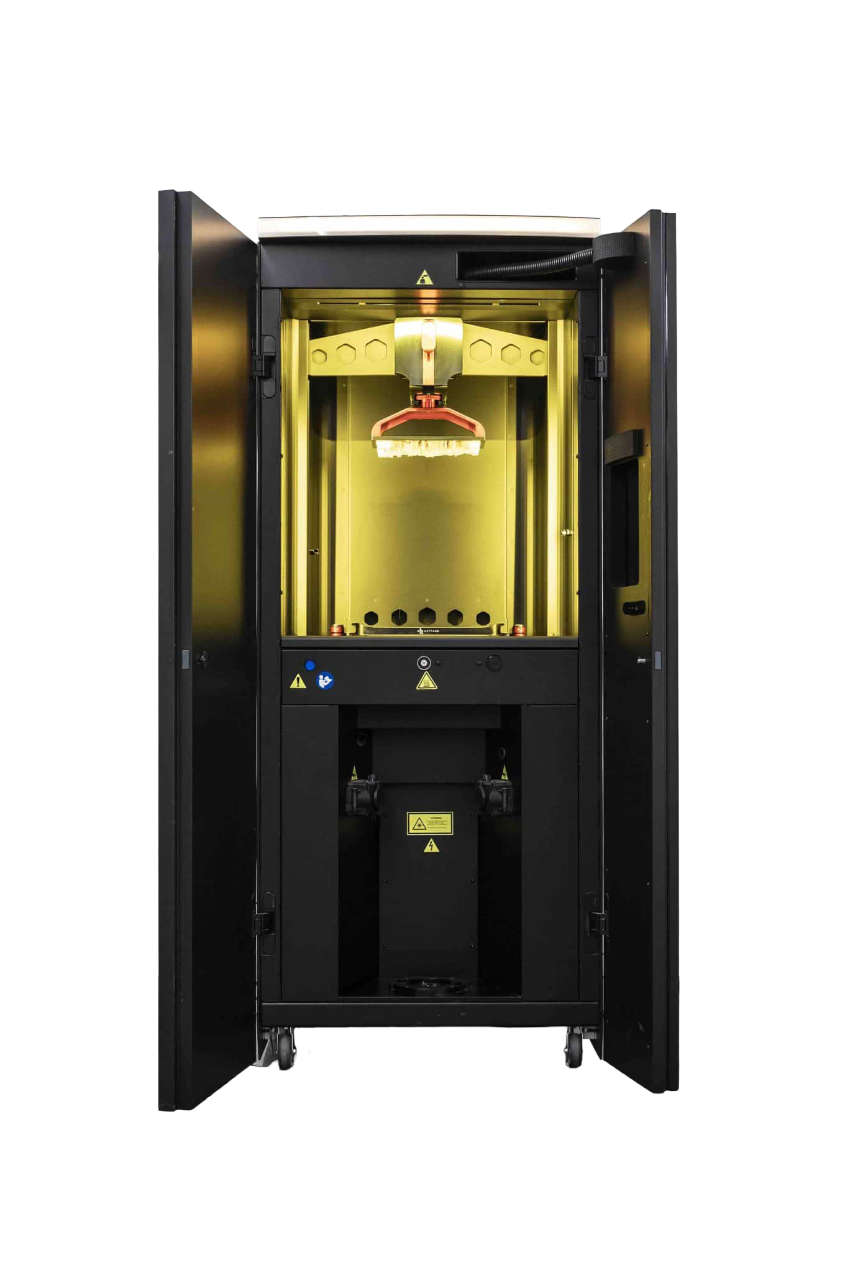
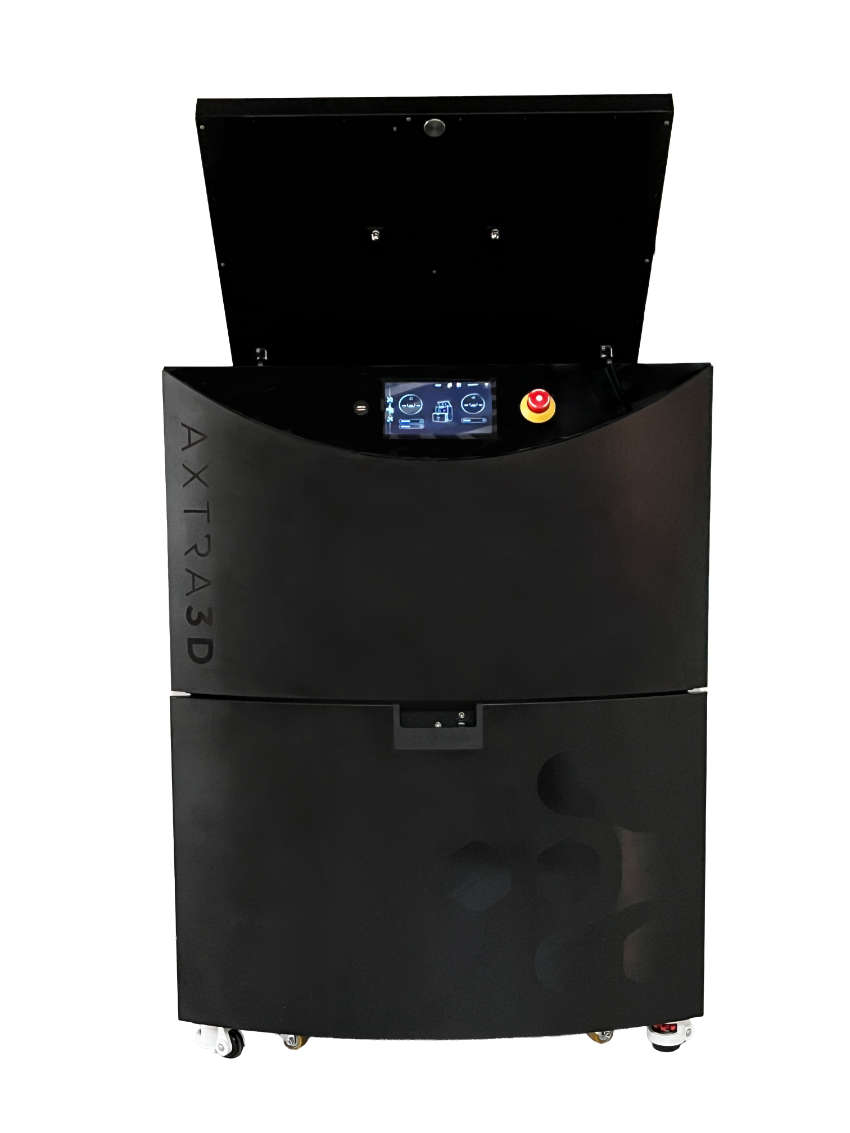
This transformation is made possible through the Lumia X1 platform, which produces production-grade parts with near-isotropic mechanical properties and micron-level precision. These characteristics allow printed components to function as end-use parts rather than simply serving as visual or form-fit prototypes.
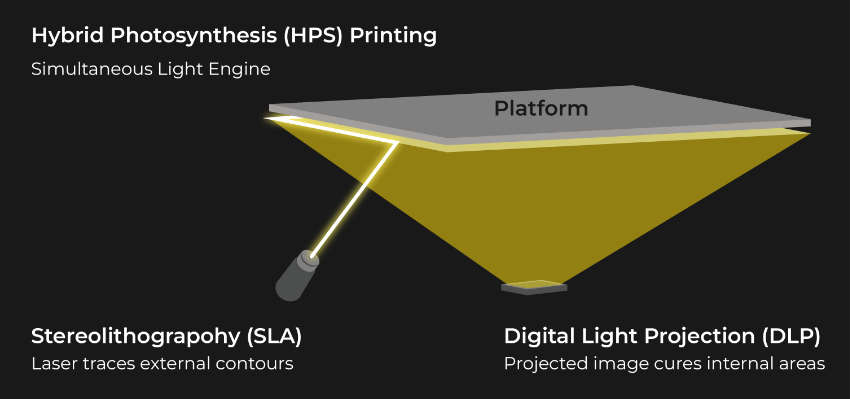
The underlying breakthrough lies in Hybrid PhotoSynthesis, which removes the long-standing trade-offs between speed, accuracy, and surface finish by combining laser precision with DLP speed into a unified process.
Impact is measured in tangible, operational terms. Throughput improvements significantly increase the number of parts produced per machine, directly improving utilization and revenue per asset. Surface quality improvements eliminate or drastically reduce post-processing, lowering labor costs and variability.
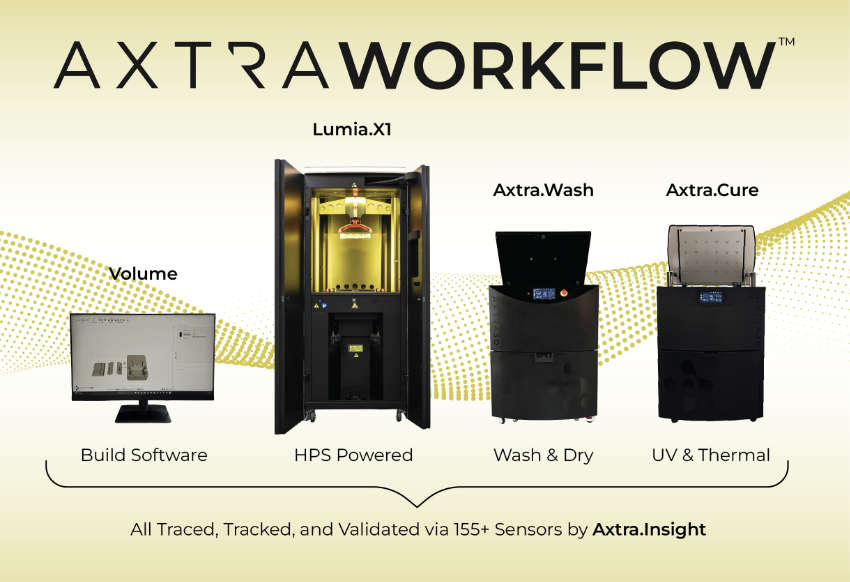
At the workflow level, Axtra.Workflow integrates printing, washing, curing, and data capture into a cohesive system, while Axtra.Insight provides full traceability through extensive process monitoring.
Ultimately, real impact is achieved when additive manufacturing is no longer an auxiliary tool but becomes a viable replacement for traditional manufacturing methods in specific applications.
What specific customer challenges or industry pain points are your solutions designed to address?
Axtra3D’s solutions are designed to overcome the fundamental limitations that have historically prevented photopolymer additive manufacturing from scaling into production.
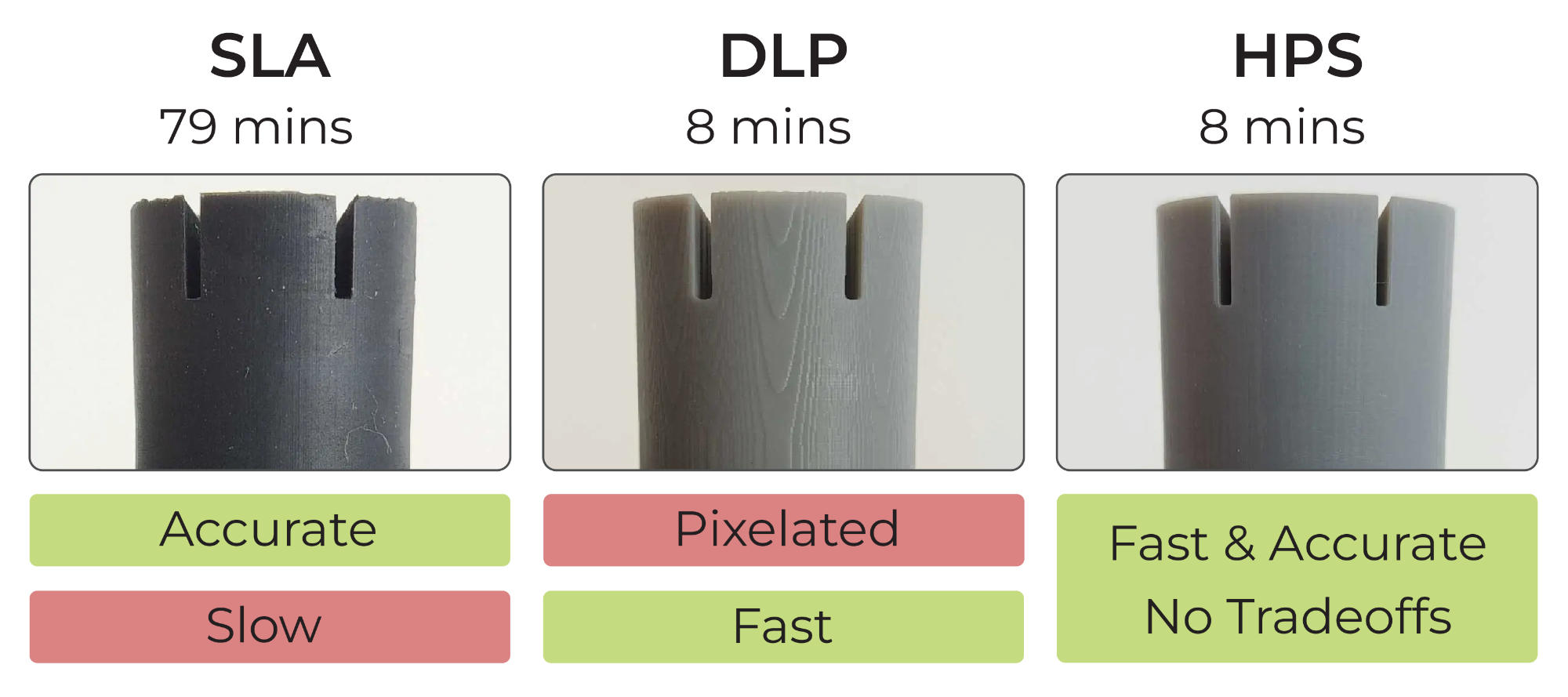
One of the most critical challenges has been the trade-off between throughput and precision. Traditional SLA systems offer high precision but are inherently slow, while DLP systems provide speed at the expense of surface quality and fine feature resolution.
Hybrid PhotoSynthesis eliminates this constraint by using both a laser and a DLP projector simultaneously, allowing large areas and intricate features to be processed in parallel without sacrificing quality.
Throughput has also been a major bottleneck. Conventional systems rely on sequential processes that limit scalability. With Hi-Speed SLA and TruLayer technology, Axtra3D removes delays between layers and enables continuous, high-speed production, significantly increasing throughput while maintaining precision.
Surface quality and post-processing represent another key pain point. Many additive technologies introduce artifacts such as pixelation or stair-stepping, which require manual finishing.
By eliminating these artifacts at the source, Axtra3D reduces the need for secondary operations, improving consistency, and lowering labor costs.
Material limitations have also constrained adoption, particularly in closed ecosystems. Lumia X1 addresses this by supporting an open material platform capable of handling a wide range of viscosities, including both filled and unfilled resins. This flexibility enables faster adoption of new materials and application-specific customization.
Finally, the lack of process validation and traceability has limited adoption in regulated industries. Axtra.Insight addresses this by capturing detailed process data at every stage, enabling repeatability, certification, and integration into quality-controlled manufacturing environments.
Can you share an example where your technology significantly improved a customer’s operations, efficiency, or sustainability?
A compelling example of Axtra3D’s impact can be seen in the production of injection molding inserts. Traditionally, tooling is manufactured through CNC machining, which involves long lead times, high costs, and limited flexibility for design iteration.
With Lumia X1, this process is fundamentally transformed. The system leverages Hybrid PhotoSynthesis to simultaneously process large internal geometries using DLP while refining fine features with laser precision. This allows both speed and accuracy to be achieved within a single build. TruLayer technology further enhances the process by enabling rapid and stable layer separation, removing constraints related to geometry size and complexity.
The operational impact is significant. Tooling that once required weeks to produce can now be manufactured within hours. This enables same-day design iterations and significantly accelerates product development cycles.
From a business perspective, this shift enables on-demand tooling and reduces reliance on traditional machining. It lowers inventory requirements and supports distributed manufacturing models. Tooling transitions from being a fixed capital expense to a flexible, digital asset that can be produced as needed.
How do you ensure that your innovations remain relevant and adaptable to rapidly changing industrial environments?
Axtra3D ensures long-term relevance by designing its solutions as adaptable platforms rather than fixed-function machines.
The Lumia X1 supports multiple build modes, allowing users to optimize extreme precision, balanced performance, or maximum throughput depending on the application. This flexibility enables the same system to support a wide range of use cases, from prototyping to full-scale production.
Material compatibility is another critical factor. The system is designed to process both current and emerging materials, including high-viscosity and filled resins. This ensures that customers can take advantage of new material innovations without requiring new hardware investments.
Software plays a central role in adaptability. Axtra.Workflow creates a connected ecosystem where improvements in process control, analytics, and automation can be implemented through software updates. This allows the system to evolve continuously in response to changing requirements without disrupting operations.
By combining hardware flexibility, material openness, and software-driven evolution, Axtra3D ensures that its technology remains relevant in dynamic industrial environments.
In what ways do you collaborate with customers to co-create solutions that deliver tangible value?
Axtra3D engages customers through a highly collaborative, application-driven approach. Rather than positioning its technology as a standalone product, the company works closely with customers to identify specific applications where additive manufacturing can deliver a meaningful advantage.
This collaboration involves joint validation of materials, geometries, and process parameters. Customers and Axtra3D teams work together to develop optimized print profiles and post-processing workflows tailored to the requirements of each application.
The result is not just a validated part, but a complete production-ready process. These co-developed solutions are then documented and standardized into application-specific playbooks that can be deployed at scale. Such developments have been completed with several customers like BD, Protolabs, and many others.
This approach reduces adoption risk, accelerates time to value, and ensures that customers can transition from evaluation to production with confidence.
How do digitalization and emerging technologies enhance the impact of your offerings?
Digitalization is a foundational element of Axtra3D’s strategy via Axtra.Insight.
It serves as the data backbone of the manufacturing process, capturing real-time information across every stage of production. This includes machine performance, layer-by-layer process parameters, thermal conditions, and energy inputs.
This level of data visibility enables a shift from manual process control to data-driven optimization.
Manufacturers can monitor performance, identify inefficiencies, and continuously improve output quality and consistency. Integration with enterprise systems such as MES and quality management platforms allows additive manufacturing to be fully embedded into broader production workflows.
Looking ahead, this data infrastructure enables advanced capabilities such as predictive maintenance, closed-loop process control, and AI-driven optimization. The result is a transition toward intelligent manufacturing systems that are increasingly autonomous and self-optimizing.
What role does sustainability play in your innovation strategy?
Sustainability is embedded within Axtra3D’s innovation strategy as a direct outcome of efficiency and process optimization. Additive manufacturing inherently reduces material waste compared to subtractive processes, and the precision of Hybrid PhotoSynthesis further minimizes the need for post-processing, reducing both energy consumption and labor.
The ability to produce parts on demand eliminates the need for large inventories, reducing waste, and improving supply chain efficiency. Localized production enabled by digital workflows reduces transportation requirements and associated emissions.
Importantly, sustainability is not treated as a separate initiative or compliance requirement. It is integrated into the economic value proposition.
By aligning environmental benefits with cost savings and operational efficiency, Axtra3D ensures that sustainability delivers measurable and practical value for customers.
How do you balance cutting-edge innovation with reliability, safety, and ease of integration?
Axtra3D balances innovation with industrial reliability by designing its systems to meet the demands of production environments rather than experimental settings.
The Lumia X1 incorporates high-end optoelectronics and precision mechatronics to ensure a stable and repeatable curing process, delivering consistent results across builds.
TruLayer technology enhances reliability by enabling rapid and stable layer separation, eliminating common failure modes and ensuring consistent performance even for large or complex geometries.
Ease of integration is achieved through the Axtra.Workflow ecosystem, which connects all stages of the process into a unified system. Pre-validated materials and workflows reduce the need for extensive calibration and simplify deployment.
Axtra.Insight adds an additional layer of reliability by providing full traceability and process validation, ensuring that every part meets quality and regulatory requirements.
This combination of advanced technology and industrial robustness allows customers to adopt innovation without compromising reliability.
What feedback mechanisms do you use to understand customer needs and continuously improve your solutions?
Axtra3D employs a comprehensive feedback system that integrates machine-level data, workflow analytics, and direct customer engagement. At the machine level, Axtra.Insight captures detailed process data across every build, providing continuous visibility into performance and enabling data-driven improvements.
At the workflow level, the system tracks performance across printing, washing, and curing, allowing for end-to-end optimization. Fleet-level analytics enable customers to benchmark performance across multiple machines and identify opportunities for improvement.
Customer feedback is incorporated through ongoing collaboration, where insights from real-world applications are used to refine materials, print profiles, and workflows. This creates a continuous improvement loop where each deployment contributes to the overall advancement of the platform.
Over time, this approach builds a compounding data advantage, improving performance, reliability, and application coverage.
Looking ahead, what key trends will shape industrial innovation, and how is your company preparing to deliver meaningful impact in this evolving landscape?
The future of industrial innovation will be shaped by the convergence of production-grade additive manufacturing, digital workflows, and advanced materials. One of the most significant trends is the shift from prototyping to production, driven by improvements in throughput, repeatability, and process validation.
Digital manufacturing ecosystems will become increasingly important, integrating hardware, software, materials, and data into unified platforms. Axtra.Workflow is already positioned to support this transformation by connecting every stage of the manufacturing process.
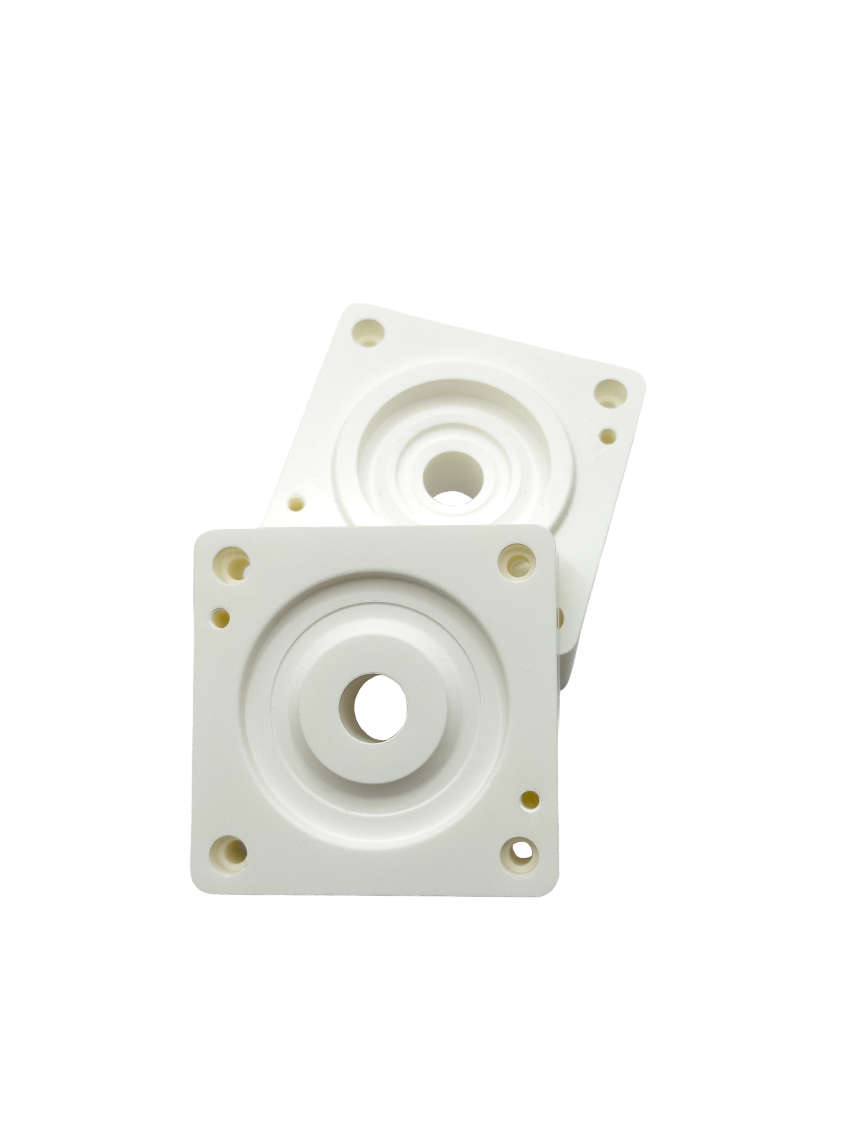
Tooling is another area undergoing disruption, with 3D printed tooling increasingly replacing traditional machining for low-volume and bridge production. Lumia X1’s ability to produce high-quality parts at scale makes it well suited for this shift.
Material innovation will continue to accelerate, enabling new applications through functional and filled resins. Axtra3D’s open material platform ensures compatibility with these developments.
Finally, data-driven manufacturing will become a requirement, particularly in regulated industries. With built-in traceability and process validation, Axtra3D is already aligned with this direction.
Overall, the company is not only preparing for these trends but actively shaping them by delivering a manufacturing platform that integrates performance, scalability, and intelligence into a single, cohesive system.