
Cognitive Design by CDS is an AI-powered concurrent engineering platform created to enable engineers accelerate the development of high-performance, manufacturable, and sustainable products.
Interview with Rhushik Matroja, CEO of Cognitive Design Systems.
How does your company define “real impact” when it comes to industrial innovation, and how do you measure it in practice?
Rhushik Matroja: At Cognitive Design Systems, real impact means equipping the concept phase, the least equipped yet most consequential phase in any engineering program, with a real exploration capability. The earliest design decisions lock in the majority of a program’s total cost. Yet traditional tools force engineers to commit to a direction after evaluating only a handful of variants, simply because no tool was built to do more within the available time window.
We measure impact through concrete engineering outcomes: how many qualified concepts were explored before entering detail design, how much lead time was saved in the concept phase, and whether the selected geometry was chosen with data rather than by default. Our customers report concept lead time reductions of up to 85%, with 50 to 100+ variants evaluated per program, each within 95% of the final part in terms of mass, cost, and structural performance.
What specific customer challenges or industry pain points are your solutions designed to address?
R.M: Our platform targets a well-documented bottleneck in the product development cycle: conceptual design. Engineers in aerospace, space, defense, and automotive face three structural problems that traditional tooling cannot solve.
First, the CAD process is deeply siloed, concept design phase included. Structural engineers, CAE specialists, manufacturing experts, and cost analysts work in sequence, each handing off to the next. By the time all constraints are on the table, the design window has closed and the team is already firefighting downstream. There is no agility at the stage where agility matters most.
Second, current CAD tools are built for modeling, not exploration. They are precision instruments for capturing a design that is already mostly defined, not for generating and comparing fundamentally different concepts under engineering constraints. When the time allocated to the exploratory phase is limited, as it always is, engineers cannot realistically evaluate more than a small handful of directions before the program moves on. The best possible design for a given part very often never gets considered.
Third, generative design tools address part of this problem but introduce new ones. They can produce more geometric candidates than a manual CAD process, but they sit on top of existing workflows as an additional layer. They accelerate one step without resolving the underlying sequential, siloed structure. The process becomes more complex without becoming more integrated.
Cognitive Design was built to address all three simultaneously. It brings structural, thermal, manufacturing, cost, and carbon footprint analysis into a single unified workflow at the concept stage, replacing the sequence with a parallel, exploration-first process.
Can you share an example where your technology or service significantly improved a customer’s operations, efficiency, or sustainability?
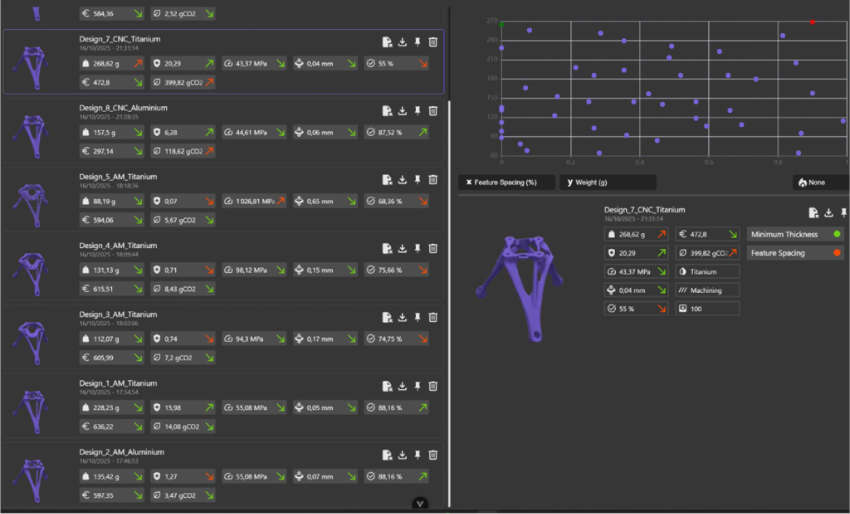
R.M: One concrete example involves Thales Alenia Space, who used Cognitive Design to tackle one of their most repetitive yet critical engineering challenges: the design and optimization of antenna reflector tripods for satellite payloads. Although each tripod in a family faces identical load cases and environmental conditions, slight geometric differences across 80+ variants forced engineers to redesign every unit independently from scratch, running a full CAD-simulation-manufacturability cycle each time.
Using Cognitive Design, TAS and CDS ran a two-phase approach. First, a broad generative exploration identified the best-performing tripod configuration integrating structural, manufacturing, cost, and carbon footprint criteria simultaneously. That optimal workflow was then converted into a reusable parametric process, allowing every subsequent variant to be generated automatically by simply updating input parameters.
The results were substantial. The first optimized tripod was built in 2 weeks. Every variant after that was completed in 2 days, seven times faster per part. Across the full family of 80+ components, total engineering lead time was reduced by 83%. Average mass reduction per bracket reached 45% compared to legacy designs, all while meeting stiffness requirements and full manufacturability constraints for both additive and CNC manufacturing routes.
How do you ensure that your innovations remain relevant and adaptable to rapidly changing industrial environments?
R.M: We work very closely with customers who are themselves at the frontier of innovation, organizations running advanced programs in space, defense, and high-performance automotive where the engineering constraints change faster than any product roadmap can anticipate.
That proximity is deliberate. When your customers are pushing the boundaries of what is structurally and thermally possible, you learn what the next real problem looks like before it becomes a market trend. Our development cycles are shaped by live engineering programs, not by industry surveys. This keeps our platform calibrated to challenges that matter, and it ensures that every new capability we release has already been stress-tested against real parts, real loads, and real deadlines.
In what ways do you collaborate with customers to co-create solutions that deliver tangible value?
R.M: Our collaboration model is built around genuine engineering proximity. When a customer starts using Cognitive Design, we do not hand over a license and step back. We engage directly in their early design cycles, understand their specific constraint sets, and track outcomes across the program.
In practice, this means our product team regularly works side by side with customer engineers on real use cases. That closeness surfaces friction points and capability gaps that no structured feedback form would ever capture. Several of our most significant platform improvements came directly from watching engineers work through a problem and identifying exactly where the tool needed to do more. Co-creation, for us, happens at the engineering level, not just the commercial one.
How do digitalization and emerging technologies (such as AI, IoT, or automation) enhance the impact of your offerings?
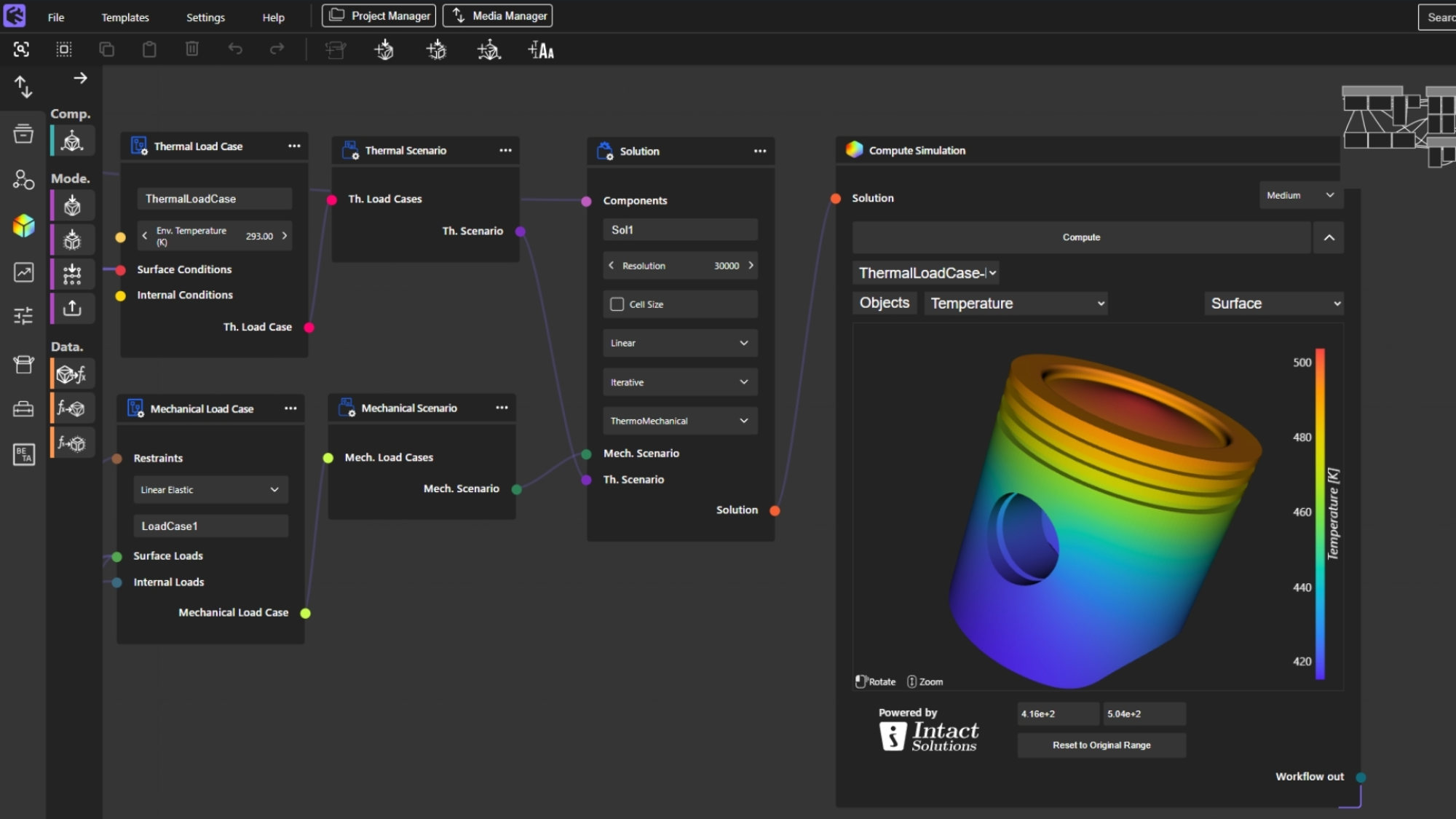
R.M: Cognitive Design integrates AI as part of a broader computational engine that combines physics-based simulation, topology optimization, and manufacturability analysis. What makes this combination trustworthy in regulated industries is that every result is deterministic: same inputs, same output, always. No black box, no result you cannot explain in a design review or a certification audit. Because every KPI is computed and logged automatically, AI adoption in Cognitive Design produces a return on investment you can calculate, not estimate.
What we are currently developing pushes this further. We are building an MCP server integration that connects a large language model directly to Cognitive Design’s core engine. This allows an engineer to describe a design problem in plain language, specifying loads, materials, thermal environment, and manufacturing constraints in just a few prompts, and have the platform generate a validated, manufacturable concept in a fraction of the time traditionally required. Speed added, certainty preserved.
What role does sustainability play in your innovation strategy, and how does it translate into measurable benefits for your clients?
R.M: Sustainability is embedded in the platform at multiple levels. Most directly, Cognitive Design includes a dedicated module that estimates the carbon footprint of manufacturing each generated part, calculated per design candidate based on material, geometry, and selected production process. Engineers can compare the environmental cost of each option alongside its structural and thermal performance, making sustainability a quantifiable design variable rather than an afterthought.
Beyond that, the underlying topology optimization systematically reduces part mass while maintaining or improving performance. A 10% mass reduction on a aircraft structural component carries cascading benefits across a platform’s operational lifetime, including lower fuel consumption, reduced emissions, and lighter overall system weight. Faster concept exploration also cuts the physical prototyping cycles that consume energy and raw material during development.
How do you balance cutting-edge innovation with reliability, safety, and ease of integration for industrial customers?
R.M: This tension is central to everything we build. Our customers operate in regulated industries where a tool that generates exciting geometry but cannot interface with existing qualification workflows is simply unusable.
Our answer has three parts. First, every result in Cognitive Design is computed by deterministic solvers. Same inputs, same output, always. No stochastic variability, no unexplainable results. Every design decision is logged with its full parameter history, making outputs auditable for certification and explainable in any design review. Second, Cognitive Design operates upstream of the existing CAD chain and exchanges via standard STEP and IGES, with no ecosystem migration and no retraining of the CAD team. Third, every new capability is validated on real customer programs before general release. Our thermo-mechanical simulation module was tested extensively with customer engineering teams on actual aerospace parts before becoming a standard platform feature. Innovation at concept stage, zero disruption downstream.
What feedback mechanisms do you use to understand customer needs and continuously improve your solutions?
R.M: Our primary mechanism is direct engineering engagement. Our customer success team maintains close, regular contact with every active account, and the conversations go well beyond software usage. We track whether the platform is actually helping engineers hit their program milestones and where the workflow creates friction.
We also run structured retrospectives with key accounts after major program milestones, specifically to capture what the tool did well, where it fell short, and what capability would have changed the outcome. Those retrospectives feed directly into our quarterly product roadmap reviews. The goal is a short loop between what an engineer experiences in a real design cycle and what we ship next.
Looking ahead, what key trends do you believe will shape industrial innovation, and how is your company preparing to deliver meaningful impact in this evolving landscape?
R.M: Three trends are converging to reshape how complex parts are designed. First, the push for lighter, more thermally efficient structures, driven by electrification in automotive and decarbonization in aerospace, is creating demand for multi-physics optimization at the concept stage. Second, accelerating program cycles across defense and space are squeezing the time available for exploration precisely when the decisions made are most consequential. Third, additive manufacturing and advanced machining are expanding what is geometrically possible, but only if design tools can reliably generate geometries that those processes can actually produce.
Cognitive Design is built at the intersection of all three. Our roadmap focuses on deepening multi-physics simulation, broadening supported manufacturing processes, and shortening the path from functional requirement to validated, producible concept.