

2025 was marked by economic, geopolitical and technological shift that are permanently transforming industry, infrastructure and critical sectors. Global tensions, fragile supply chains and intensifying technological competition highlight how vulnerable Europe’s critical infrastructures have become. At the same time, digital transformation, cyber threats and new technological paradigms such as artificial intelligence (AI) and modern communication standards like 5G and FRMCS are accelerating change across industrial processes and communication. According to forecasts, more than 60% of all organizations will be using AI strategically by 2026, while the demand for secure, highly available networks continues to rise.
This development requires more than technical excellence alone. Issues such as technological sovereignty, resilience, security and data sovereignty are increasingly becoming the focus of business decisions. In this dynamic environment, the ability to design IT and OT infrastructures that are secure, robust, connected and adaptable is becoming a key competitive factor.
Cyber Resilience Act & Cybersecurity: Security Becomes a Strategic Imperative
Cybersecurity is increasingly evolving from an isolated IT discipline into an integral part of industrial value creation. With regulations such as the Cyber Resilience Act (CRA), NIS-2 and RED, the EU is responding to a threat situation that has intensified significantly in recent years. Attacks on industrial infrastructures, critical networks and connected devices are not only increasing in quantity, but also becoming more sophisticated due to automation and AI.
The economic impact is considerable: analyses now estimate the annual economic damage caused by cyber-attacks in Europe at over €200 billion. At the same time, regulatory requirements are driving demand for secure digital products designed with compliance and security in mind.

The new EU requirements provide a clear framework for the development, operation and security of digital products throughout their entire product lifecycle – from integrity protection and encrypted data communication to continuous updates and threat monitoring. Kontron supports manufacturers with a range of CRA-ready components such as KontronOS (a hardened, CRA-compliant operating system), KontronGrid (central compliance monitoring), KontronAIShield (AI-based threat detection) and suitable edge hardware platforms. These solutions meet the requirements of upcoming EU regulations while creating a robust foundation for connected systems – from embedded devices to edge platforms.
AI at the Edge & 5G: Intelligence where Data is Created
Looking ahead to 2026, the role of AI and 5G will continue to shift away from pure cloud approaches towards intelligent, secure edge architectures. Data is generated in machines, vehicles, production facilities and critical infrastructures. It must be processed where latency, availability and security are decisive. Private 5G networks are becoming key enablers for industrial real-time applications and highly available communication.
AI functionalities are becoming increasingly integrated with embedded systems, edge platforms and secure operating systems. Solutions such as AI-supported anomaly detection, predictive maintenance and autonomous decision support only deliver added value if they can be operated in a stable, explainable and cyber-resilient manner. Technologies that work in one area can increasingly be transferred to other industries, accelerating innovation and efficiency gains.
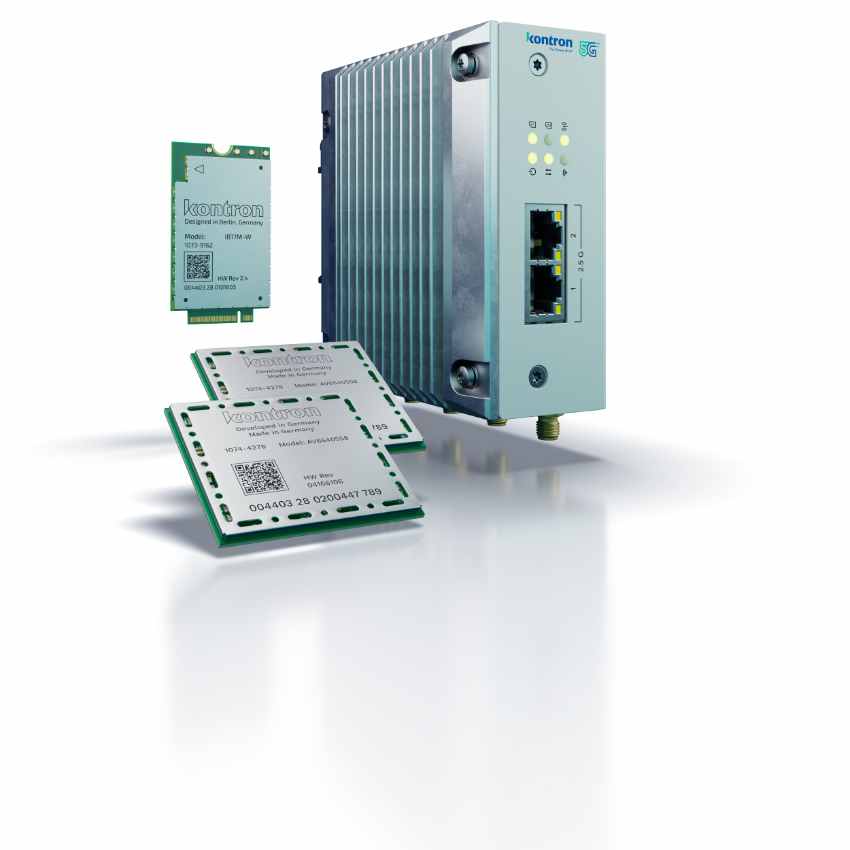
One example – and a strategically important market for Kontron – is the railway sector. FRMCS (Future Railway Mobile Communication System) is creating a new 5G-based communication infrastructure for safety-critical applications. It is emblematic of highly regulated environments, long life cycles and maximum requirements for safety and availability. End-to-end solutions developed for the secure transition from GSM-R to FRMCS, such as MCx, private 5G core networks and cloud-native management tools, can also be transferred to other industries and give providers such as Kontron an early competitive advantage.
Defense and Security-Related Applications: Technology as a Protective Factor
The geopolitical situation and the increasing interconnectedness of critical infrastructures are leading to rising investment in defense and security projects worldwide, and in Europe in particular. Countries are focusing on long-term resilient, secure and networked systems that meet extreme requirements for reliability, real-time capability and availability. There is demand for modular architectures, open standards and robust embedded computing systems that combine high computing power with stability and cyber resilience. Security at the hardware level, controlled supply chains, local manufacturing and compliance with international regulations are gaining strategic importance.
Technologies proven in industries such as manufacturing, railways, and energy are increasingly being used in safety-critical environments. There is a demand for modular architectures, open standards, and robust embedded computing systems that combine high computing power, stability, and cyber resilience. These systems must function reliably in extreme environments, such as high heat, extreme cold, vibration, and dust, and they must work together stably in complex network structures. With many years of experience in the embedded computing sector, Kontron relies on global development locations, a closely networked engineering team, and local manufacturing in strategically relevant regions. Kontron offers ITAR compliance, ensuring that sensitive technologies are only supplied to approved partners.
Bureaucracy in Transition: First Signs of Relief
Despite growing regulatory and security-related demands, there is at least one ray of hope: even at EU level, there is a growing awareness that excessive bureaucratic complexity can inhibit innovation and efficiency. Initiatives to simplify reporting requirements, digital compliance processes and the harmonization of standards show that economic competitiveness and regulation do not have to be contradictory. For companies, the direction is clear: those who integrate regulation strategically at an early stage can gain efficiency, predictability and competitive advantages.
Outlook
2026 will not be a year of restraint, but one of deliberate decisions. Cybersecurity, AI, 5G and secure embedded systems will continue to converge. Resilience will become the new currency – technologically, economically and strategically. Companies that invest in secure, software-driven and connected solutions today are laying the foundation for sustainable growth in an increasingly complex environment.
Interdisciplinary collaboration and the integration of security, real-time capability and AI into industrial platforms will determine who remains successful. Kontron is also living up to its responsibility and aims to support customers in designing systems that are robust, flexible and future-proof.

Author: Hannes Niederhauser, CEO of Kontron AG
Hannes Niederhauser, a graduate of Graz University of Technology in electrical engineering, has had a long career managing microchip and embedded computing companies. Prior to joining S&T, the Austrian-born Niederhauser was a major shareholder and CEO of the former Kontron AG from 1999 to 2007. During his tenure, Kontron has developed into a leading global provider of embedded computing. He is continuing to drive Kontron’s transformation from an IT service company to a leading provider of IoT solutions.