

Thinex is the printed electronics division of Rotimpres, an industrial company with more than 40 years of experience in high-precision printing and manufacturing. Rather than being a separate startup, Thinex emerges as an internal transformation of an established industrial player that has progressively evolved from traditional printing into advanced functional technologies.
Built on decades of expertise in industrial printing, materials and scalable production processes, the company represents a strategic shift: from printing communication to printing functionality. They develop printed electronic systems that transform conventional products into intelligent, data-generating assets, integrating sensing, connectivity and interaction directly into surfaces and materials.
This evolution is rooted in a broader industrial reinvention, where long-term know-how in printing is leveraged together with R&D capabilities to address the growing demand for smart, connected and efficient industrial products.
Interview with Marc Vizern, Business Unit Manager at Thinex.
What are the main areas of activity of the company?
Marc Vizern: Thinex focuses on the development of printed electronics solutions designed for direct integration into industrial products and environments. Its main areas of activity include printed sensors (such as temperature, strain and pressure sensing), flexible heating systems, capacitive touch interfaces (printed capacitive keys), RFID and NFC-based identification technologies, and emerging biosensor solutions.
These technologies enable both functional and interactive capabilities to be embedded directly into products and surfaces, allowing them to sense, react and communicate. Applications span across industrial manufacturing, robotics, mobility, logistics, packaging and healthcare. In all cases, the objective is to integrate intelligence at the product level, reducing reliance on external electronics and enabling new levels of functionality, efficiency and data generation.
What’s the news about new products/services?
M.V: Thinex is currently working on the development of customised printed sensors for specific use cases, in close collaboration with partners and companies from different sectors. Rather than offering only standard components, the company focuses on adapting its printed electronics capabilities to solve concrete industrial challenges.
This approach allows Thinex to co-develop tailored sensing solutions according to the technical requirements of each application, including parameters such as geometry, substrate, integration method, sensitivity, durability and scalability. Current developments are mainly focused on sensors for monitoring, traceability, interaction and data generation in real operating environments.
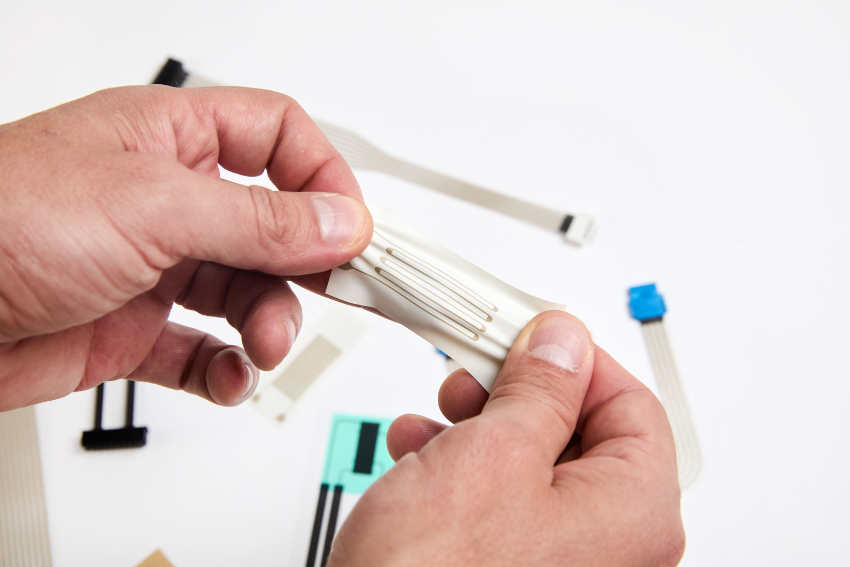
By working directly with sector-specific collaborators, Thinex aims to accelerate the transition from proof-of-concept to functional and scalable solutions, ensuring that each development responds to a real market need and can be integrated into existing products or industrial processes.
What are the ranges of products/services?
M.V: Thinex’s portfolio is structured around modular functional capabilities rather than fixed products. It includes printed sensing technologies for measuring physical parameters such as temperature, strain and pressure; flexible heating systems designed for localized thermal control; RFID and NFC solutions for identification, traceability and connectivity; and custom printed electronic systems developed for specific industrial applications.
All solutions share a common principle: they are designed to be fully integrated into the product itself, adapting to its geometry, material and manufacturing constraints. This enables electronics to become an intrinsic part of the product rather than an external add-on.
What is the state of the market where you are currently active?
M.V: The printed electronics and smart systems market is currently in a strong growth phase, driven by the acceleration of Industry 4.0, industrial digitalisation and the increasing need for real-time data at the product level.
Industries are moving away from externally connected systems towards embedded intelligence, where products themselves become data-generating elements. This shift is supported by broader trends in automation, IoT and advanced manufacturing, particularly in Europe, where industrial ecosystems and innovation programs are actively promoting the integration of next-generation technologies.
At the same time, companies are under increasing pressure to improve efficiency, traceability and sustainability, which further accelerates the adoption of lightweight, scalable and material-efficient electronic solutions.

What can you tell us about market trends?
M.V: The printed electronics market is entering a strong acceleration phase, driven by the convergence of Industry 4.0, IoT expansion and the growing need to generate real-time data directly at the product level. Increasingly, industrial competitiveness depends on the ability to automate processes, optimize performance and make data-driven decisions, which is reshaping how products and systems are designed from the ground up.
A major trend is the transition from externally instrumented products to embedded sensing architectures. Instead of adding sensors or electronic modules after design, industries are moving towards solutions that can be integrated directly into materials and manufacturing processes, enabling intelligence to be generated at the source and reducing system complexity.
In parallel, electronics are evolving from rigid components into functional materials. This shift enables sensing, connectivity and interaction to be printed and embedded into surfaces, creating scalable pathways for integration into existing industrial products without requiring complete redesigns or disruptive changes in production.
Overall, this creates a significant market opportunity. Demand is increasing for systems that enhance operational efficiency, enable predictive intelligence and reduce resource consumption. Printed electronics is therefore moving from an enabling technology to a foundational layer of industrial competitiveness, where intelligence is no longer added to products, but embedded into them from the beginning.
What are the most innovative products/services marketed?
M.V: One of the most advanced developments involving Thinex is our collaboration in an aerospace-related project linked to parachute system testing, in collaboration with industrial partners working on NASA-related engineering challenges.
Parachutes are among the most critical and demanding components in spacecraft landing systems. Their fabrics must endure extreme aerodynamic loads while deploying in a perfectly controlled way within fractions of a second. At the same time, testing these systems on Earth is highly complex, as the behaviour of the material under real deployment conditions is extremely difficult to replicate or measure accurately.
In this context, the key challenge was to understand whether deformation and stress could be measured directly on the parachute fabric without affecting its mechanical behaviour. This required a sensing technology that was not only extremely precise, but also ultra-thin, flexible and fully compatible with delicate technical textiles.
Thinex contributed by developing printed strain sensors designed specifically for this purpose. These sensors were engineered to integrate directly onto ripstop nylon, adapting to its surface without interfering with its performance. This allowed for in-situ measurement of deformation and load during testing, providing engineers with real mechanical data from the material itself rather than external approximations.
This project is particularly significant because it validates the use of printed electronics in extreme and highly sensitive environments. It demonstrates that this technology can move beyond traditional industrial applications and operate in aerospace-grade conditions where reliability, accuracy and non-intrusiveness are absolutely critical.
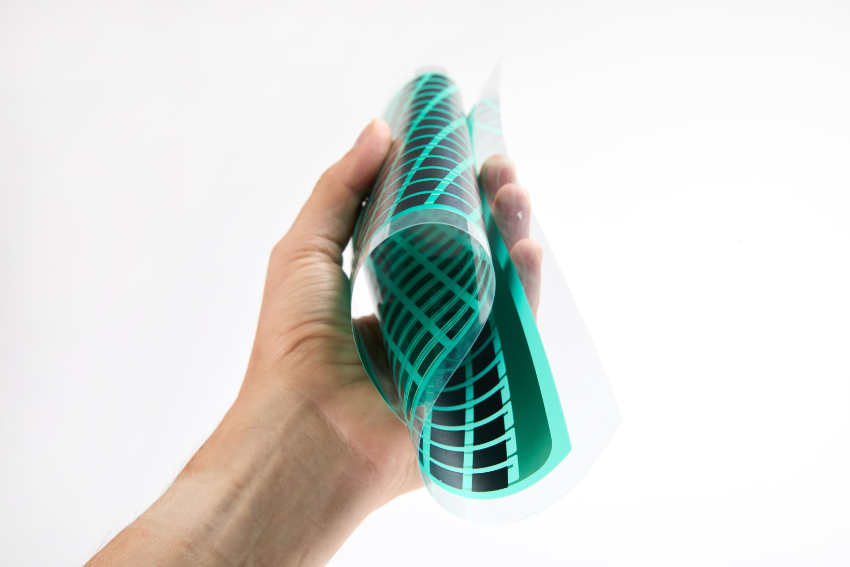
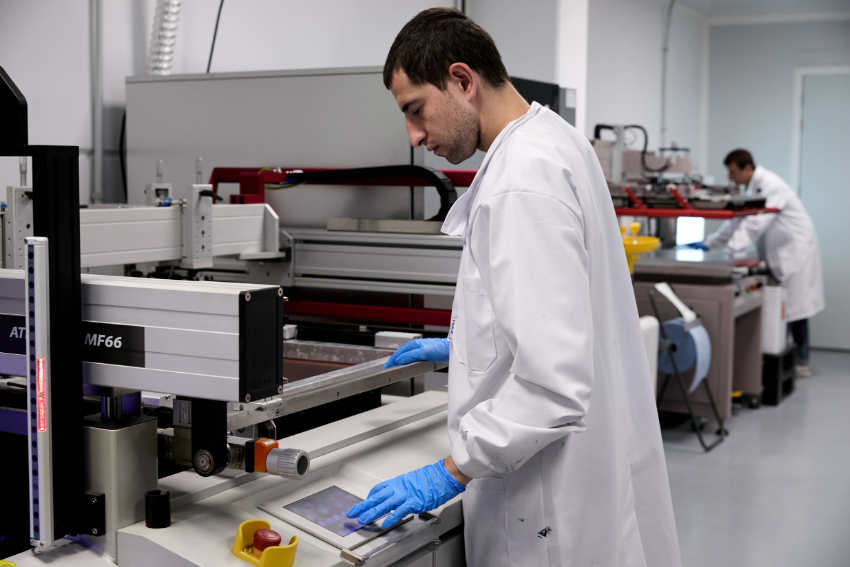
Beyond the specific application, it reinforces a broader point: printed electronics is not just about adding sensing capability, but about enabling measurement directly at the material level, even in the most demanding engineering contexts.
What estimations do you have for the second half of 2026?
M.V: For the second half of 2026, Thinex expects to consolidate the transition from technology development to market-driven industrial applications. The company anticipates growing demand for printed electronics solutions linked to traceability, smart packaging, industrial monitoring, connected products and sustainable alternatives to conventional electronic assemblies.
A major priority will be to convert ongoing pilots and co-development projects into more mature industrial opportunities, especially in sectors such as mobility, healthcare, logistics, packaging, smart textiles and industrial IoT. Thinex also expects to continue strengthening its production and industrialisation capabilities, with a focus on scalable manufacturing, repeatability and cost-efficient integration into customer products.
Overall, the outlook for the second half of 2026 is positive. The company expects increased commercial activity, more application-specific developments and a stronger positioning as an industrial partner capable of bringing printed electronics from concept to production. This forecast is consistent with Thinex’s current portfolio and its focus on integrated, sustainable and connected printed electronics solutions.