
Artificial intelligence dominates the conversation in manufacturing. Conferences, vendor briefings, and industry strategies all position AI as the next major leap in industrial productivity. But the reality inside factories is often very different.
“AI does not fix poorly understood production systems,” says Niels Erik Wøhlk, Chief Revenue Officer at Wirtek. “It improves factories that already understand their machines, their data, and their processes.”
When that foundation is missing, AI initiatives often become pilots that never scale beyond experimentation. The uncomfortable truth is that the biggest barrier to industrial AI is rarely the technology itself. It is operational clarity.
The gap between AI ambition and factory reality
Manufacturers widely recognise the potential of AI. Predictive maintenance, automated quality inspection, and production optimisation are among the most discussed applications. Yet many organisations struggle to identify where AI should actually be applied.
“Before you start talking about algorithms, you need to understand the production problem you are trying to solve,” Wøhlk explains. “Otherwise, AI becomes a technology search looking for a problem.”
In practice, many companies cannot clearly answer a few fundamental questions:
- Which operational problem should AI solve first
- Whether machine data is accessible and reliable
- How production systems connect with enterprise systems
- Who owns operational improvements across the organisation
Without these answers, AI remains an interesting experiment rather than a production capability.
The real work behind industrial AI
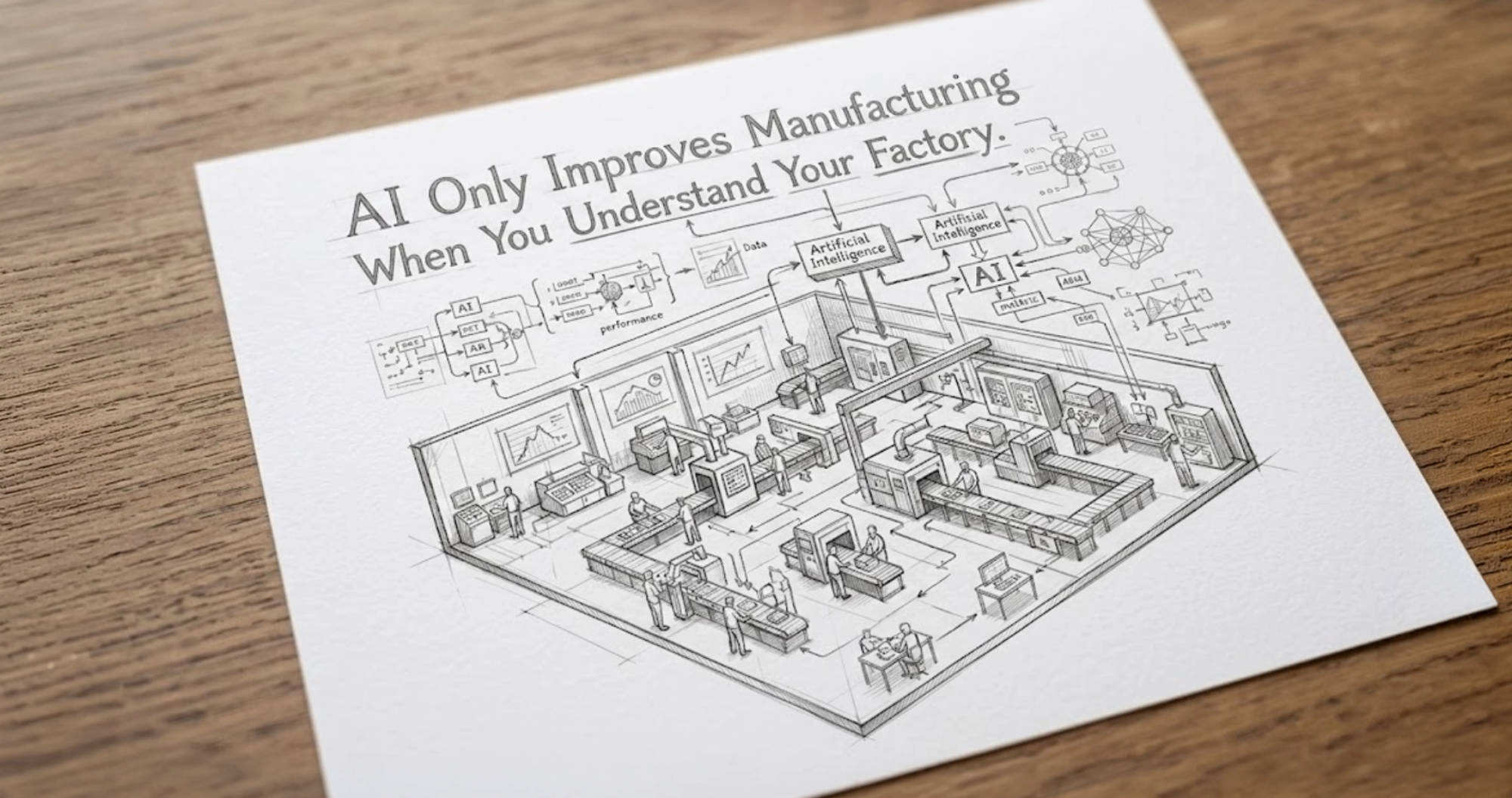
Manufacturing environments already generate enormous amounts of data. The challenge is not the absence of information, but the way it is fragmented across different industrial systems.
Operational data typically lives across several layers of technology:
- Machine controllers and PLC systems
- SCADA environments
- MES platforms
- ERP systems
- Industrial IoT devices
Connecting these layers is often the most complex part of industrial AI projects. “In most industrial AI projects, the algorithm is the easy part,” says Wøhlk. “The real work is connecting industrial systems, structuring machine data, and building reliable software around production environments.”
Only when those foundations are in place does AI start to deliver measurable operational improvements.
Where AI actually creates value
The most successful industrial AI deployments tend to focus on specific operational challenges rather than broad transformation programmes.
Examples include predictive maintenance, automated quality inspection, production scheduling optimisation, and identifying energy inefficiencies across production lines.
“These initiatives succeed because they solve clearly defined operational bottlenecks,” Wøhlk notes. “AI works best when it is applied to a problem engineers already understand.”
The same principle increasingly applies beyond the production line. Logistics and warehouse operations are becoming data rich environments where software can improve both efficiency and sustainability.
Solutions such as warehouse and logistics ESG optimisation by Wirtek demonstrate how operational data can be used to optimise energy usage, improve reporting, and support ESG goals across complex facilities.
Production knowledge still matters more than algorithms
Successful industrial AI initiatives combine strong software engineering capabilities with deep production knowledge. AI specialists can build models and analytics platforms. Production engineers understand machine behaviour, operational constraints, and quality requirements.
“When production engineers and software specialists work together, that is where real industrial innovation happens,” says Wøhlk. “AI alone does not create better factories. Insight into operations does.”
Projects driven purely by technology often struggle to move beyond experimentation.
Start with the factory, not the algorithm
Manufacturers that achieve measurable results with AI usually take a pragmatic approach. They start with the factory. That means identifying operational bottlenecks, ensuring production data is reliable and accessible, integrating legacy systems with modern software platforms, and applying AI where the operational environment actually supports it.
“Factories do not become smarter simply because AI tools are deployed,” Wøhlk concludes. “They become smarter when organisations understand their operations well enough to know where intelligence actually belongs.”
AI will undoubtedly influence the future of manufacturing. But smarter factories will be built by organisations that understand their production systems first.
Wirtek | EU-based Tech Partner for Energy, IoT and Digital Engineering