
SINID International Logistics has developed MOVEO – its proprietary digital logistics platform built around the realities of everyday transport operations. Managing Director Šimon Krasnický explains why the company decided to develop its own technology, how automation is changing the way logistics work is performed, and why the next stage of development is moving towards increasingly close digital integration with customers and their systems.
Why did SINID decide to develop its own logistics platform?
Šimon Krasnický: The idea did not start with software. It started with everyday logistics.
International transport creates a constant flow of information between customers, carriers, drivers and our own team. Schedules change, documents arrive, new situations develop, and decisions often need to be made very quickly.
Over time, we realised that even when individual systems work well, people still spend a great deal of time connecting information between them or repeating tasks that technology could perform.
So, we asked ourselves a simple question: why should we continuously adapt our operations to the capabilities of different systems when we can develop technology around the way our logistics actually works?
That is how MOVEO was created.
As Managing Director, I personally lead its development together with our team. One of the major advantages for us is that there is no long chain between a real problem in daily operations and its technological solution involving users, company management and development.
When we identify a process that unnecessarily slows us down, is repeatedly performed, or creates room for error, we can immediately look at how it could be improved.
MOVEO is therefore not developed separately from our logistics operations. It evolves directly alongside them.
What is MOVEO today?
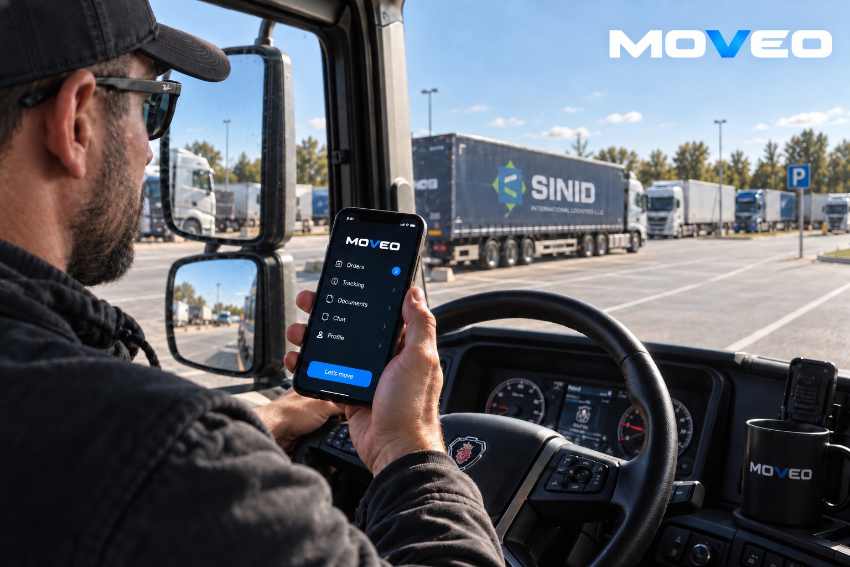
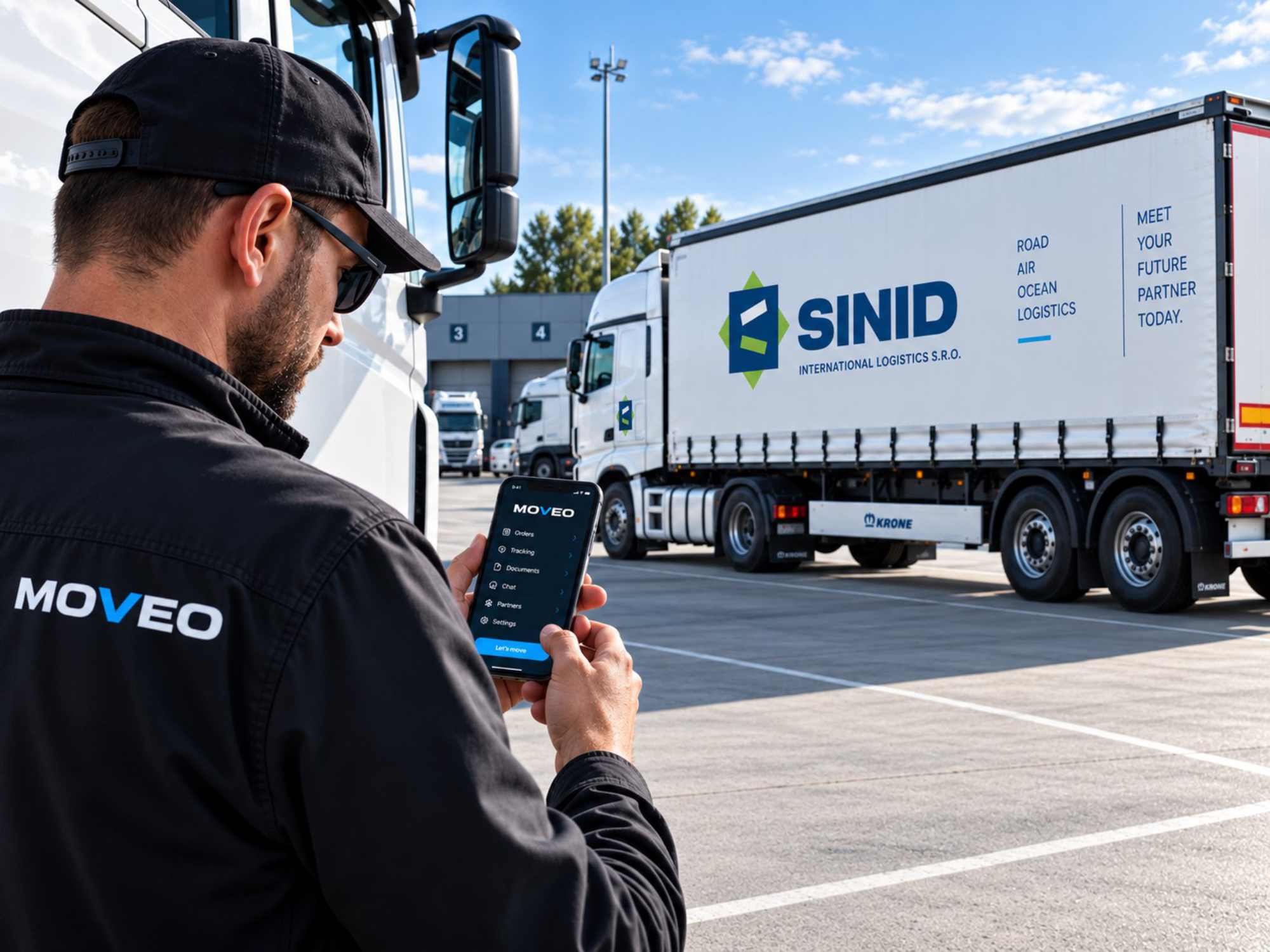
Š.K: MOVEO is our proprietary digital environment that now supports a significant part of SINID’s daily logistics operations.
It connects transport operations, drivers, customers, shipment tracking, communication and documentation within one operational context.
A shipment is much more than an order number. It consists of information, decisions, responsibilities, documents and numerous changes that can occur during its execution.
MOVEO connects these elements so that information does not have to be repeatedly transferred manually from one place to another, and so that the system can move the process forward based on what is happening.
Today, 100% of transports managed by SINID are digitally tracked through MOVEO.
Tracking, however, is only one part of what MOVEO represents today.
Automation is becoming an important part of MOVEO. How far do you want to take it?
Š.K: Automation is currently one of the most important areas of MOVEO’s further development.
We are not interested only in automating individual, simple tasks. We look at the entire process and ask which steps genuinely require people’s attention and which can be performed reliably by the system itself.
There are many activities in logistics that are essential for a transport to run correctly, but carrying them out does not necessarily require manual work every time. Processing information, assigning it to the correct shipment, updating a status, passing information to another party or triggering the next step in a process – these are all areas where technology can gradually take over an increasing share of the work.
Our direction is therefore simple:
The system should perform what it can reliably perform on its own. People should focus on control, decision-making and situations where their experience creates real value.
Developing our own platform allows us to explore automation in areas where standard TMS environments still depend heavily on manual steps and the transfer of information between people.
We deliberately do not disclose the detailed logic behind these processes because it forms part of our internal know-how. What matters is the result – less repetitive work, faster information flow and greater control over the entire process.
How is automation changing the role of people in everyday logistics?
Š.K: We do not see this as a question of technology on one side and people on the other. We see the greatest potential in combining the two.
Many activities that used to slow us down were nevertheless essential. They had to be performed correctly and at the right time, but carrying them out did not necessarily require experience or individual judgement.
If MOVEO can now perform these activities automatically, people no longer need to execute every individual step themselves. They can focus more on controlling the outcome, handling exceptions, communicating with customers and making decisions where the system should not decide on its own.
The result should be an operation in which the combination of people and technology allows us to work faster, more accurately and with less room for error.
That is where we believe automation creates the greatest value in logistics.
You personally lead the development of MOVEO. Does this influence how the platform evolves?
Š.K: Definitely. I do not see MOVEO as a separate IT project. It is part of how SINID operates and how we want the company to develop.
On one side, I understand the company’s commercial and operational requirements. On the other, I am directly involved, together with our team, in translating those requirements into the system.
As a result, the path from a problem to a solution can be very short.
Sometimes everything begins with a very simple question: Why are we still doing this manually?
If we find that a particular activity is repetitive, slows people down or creates room for error, we look at whether it can be simplified, connected with another process or fully automated.
Many MOVEO capabilities were therefore not created because we decided the application needed another module. They were created because we encountered a specific problem in real operations and looked for a way to eliminate it.
I consider this direct connection between development, company management and daily operations to be one of MOVEO’s greatest advantages.
What does the customer gain from this approach?
Š.K: Ideally, customers should experience the result without having to understand the complexity of the system working behind it.
They should not need to know which colleague; email inbox or system currently contains the answer to their question. From their perspective, SINID should operate as one coordinated service.
MOVEO helps us connect the physical execution of a transport with its current status, communication and documentation. Information that has already been created can be used further by the system without having to be manually processed or forwarded every time.
For the customer, this should primarily mean faster information flow, better visibility and simpler cooperation.
The objective is not to expose our internal processes to customers. The objective is to provide them with relevant information more easily and at the right time.
What makes MOVEO different from a standard TMS?
Š.K: We did not begin developing MOVEO from a checklist of functions that a TMS is supposed to contain.
New capabilities usually emerge from specific situations in real operations.
We ask ourselves: Where are we repeatedly doing the same work? Where is information still being transferred manually? Where is somebody waiting unnecessarily? Where is there room for error? And where could the system recognise on its own what should happen next?
This approach has gradually led us to develop our own operational, commercial, decision-support and automation processes that go beyond what we would normally expect from a standard TMS environment.
The difference is that we do not want the standard functionality of an existing system to define the limits of how far our operations can develop.
Where is MOVEO heading next?
Š.K: Towards deeper automation, better use of information and closer digital cooperation with customers.
One of the next areas of development is making it as simple as possible to connect MOVEO with our customers’ internal systems.
If certain information already exists in one system, our vision is that it should not have to be manually entered, checked or forwarded again in another system.
Secure system integration can allow the necessary information to move automatically between platforms and individual processes to connect more seamlessly. This can accelerate the entire process, from the initial request through transport execution to documentation and subsequent processing.
The less often our customers or our team have to manually process the same information multiple times, the faster and more accurate the entire logistics process can become.
Logistics already generates enormous amounts of data. We believe the next challenge is not simply to collect even more of it. It is more important to recognise what matters right now, what the system can perform automatically and where people’s attention is required.
MOVEO was originally developed for SINID’s internal operations. As it continues to evolve, however, we see increasing potential for direct digital integration between our operations, our customers and the systems they already use.
We want to develop this gradually, with a strong focus on security, appropriate separation of information and, above all, genuine practical value for the customer.
Our principle remains the same:
We do not want to simply move existing work into a digital environment. We want to improve the way that work is done.
ABOUT SINID INTERNATIONAL LOGISTICS
SINID International Logistics s.r.o. provides international road, air and ocean freight, warehousing and comprehensive logistics solutions across Europe and beyond.
The company also develops its proprietary digital logistics platform MOVEO, focused on connected operations, shipment visibility, automation and decision support.