
MKey Solution is a German technology company specializing in industrial machine vision, AI-based image processing, digital worker assistance systems, and customized automation solutions for manufacturing and logistics environments. With more than 35 years of experience in machine vision – primarily with Keyence technologies – and over 500 successfully implemented national and international projects, the company transforms deep expertise and practical know-how into tailored solutions that precisely address our customers’ specific requirements.
Interview with Michael Kunze, CEO of MKey Solution GmbH.
A brief description of the company and its activities.
Michael Kunze: Our approach goes beyond technology delivery: we focus on creating sustainable, application-oriented solutions that generate measurable value in real industrial environments. We combine industrial imaging technologies, artificial intelligence, robotics, and software engineering into integrated systems tailored to customer-specific production requirements. MKey Solution primarily serves customers in automotive, electronics, medical, life science, food, technology, logistics, and general industrial manufacturing.
What are the main areas of activity of the company?
M.K: Our core business is concentrated in four main areas: industrial machine vision and AI-based inspection systems, digital worker assistance and augmented reality solutions, customized automation for robotics integration, and lightfield technology for robust handling of high-glossy parts.
We are also actively involved in research and innovation projects as a research partner of OTH Amberg-Weiden, focusing on advanced machine vision, AI-supported automation, and next-generation industrial assistance systems. Additionally, we provide consulting, feasibility studies, system integration, commissioning, and long-term technical support, and are regularly invited as keynote speakers at industry events and conferences.
What’s the news about new products/services?
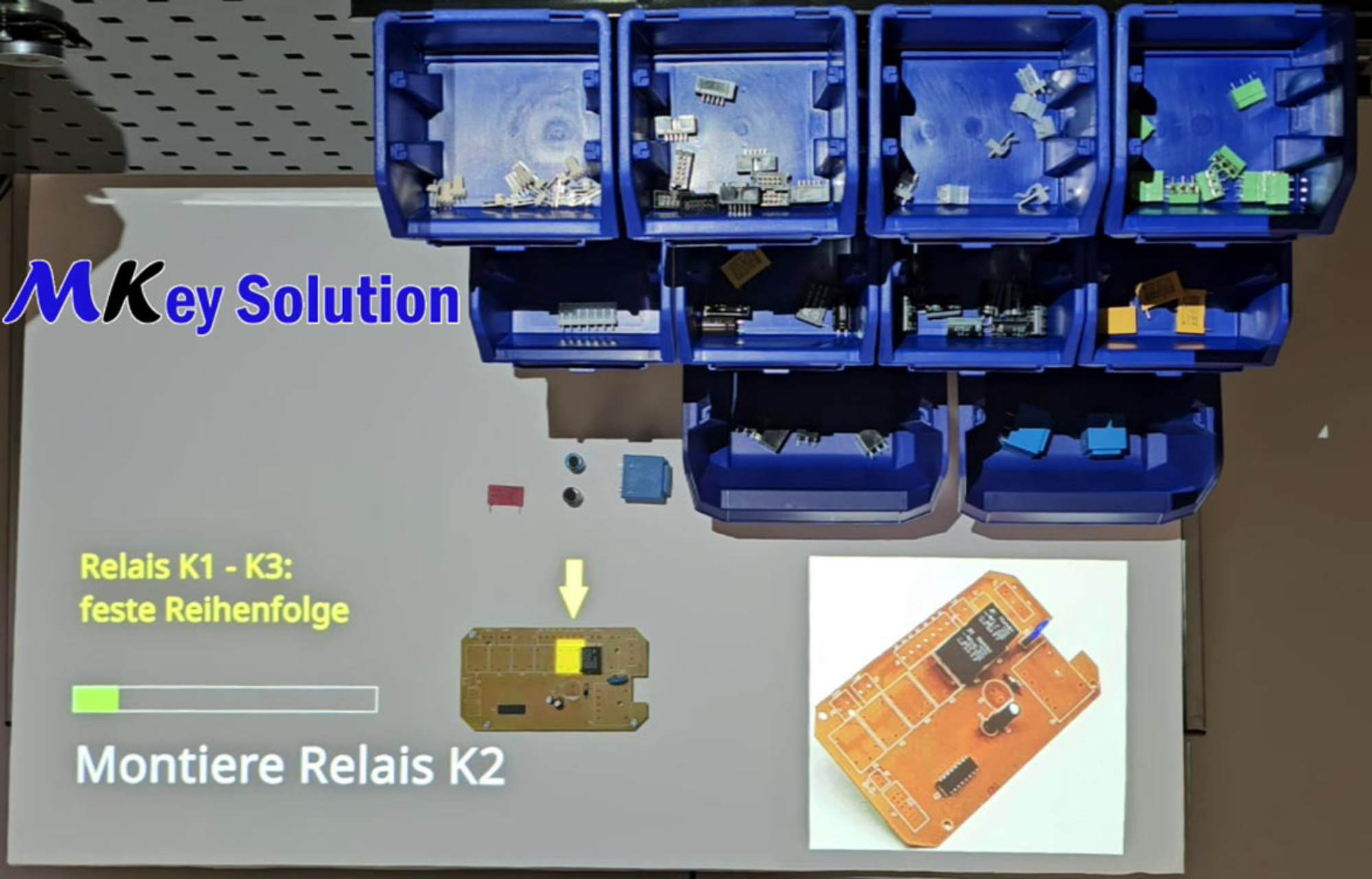
M.K: One of our current strategic priorities is the expansion of AI-supported AR-guided worker assistance systems for production, manual assembly, and intralogistics applications. We are developing intelligent assistance platforms that combine spatial Augmented Reality – requiring neither headsets nor displays -, machine vision, AI-driven process guidance, and real-time data for business intelligence. These systems support operators in highly variable manual processes such as assembly, quality inspection, order picking, or sterile goods logistics, and integrate smart tools like torque sensors, code readers, and industrial scales.
We are also involved in a flagship innovation project together with Siemens focusing on AI-driven industrial light field technology. For the first time, this makes it possible to reliably detect components with highly reflective and glossy surfaces in industrial environments for robotic bin-picking and other machine vision applications – a significant technological milestone, as reflective metallic parts have traditionally been among the most difficult challenges in automated optical detection.

What are the ranges of products/services?
M.K: Our portfolio ranges from standalone vision sensors to fully integrated turnkey inspection and assistance systems. Typical solutions include optical inspection systems, 2D and 3D vision applications, PCB inspection (SMT and THT), AI-based defect detection, robot-guided vision systems, bin-picking solutions, OCR/OCV and code reading, dimensional measurement systems, hands-free AR worker guidance platforms, data analysis and traceability platforms, light field imaging systems for reflective surface inspection, as well as on-site and remote service and maintenance. We also offer complete project management, consulting, engineering, commissioning, training, and lifecycle support.
What is the state of the market where you are currently active?
M.K: The market environment remains highly dynamic. Manufacturing companies are under significant pressure to increase productivity, improve quality, reduce costs, and address the growing shortage of skilled labor. Demand for intelligent automation and AI-driven assistance systems continues to grow strongly – particularly in Europe, where many industrial companies are accelerating investments in digitalization and machine vision.
Customers are increasingly looking for flexible and scalable solutions instead of rigid automation concepts, strongly supporting AI-based and adaptive software architectures. We also observe growing interest in advanced imaging technologies capable of solving applications previously considered technically unstable or unviable – especially for reflective, transparent, or highly variable components.
What can you tell us about market trends?
M.K: Several trends currently dominate: increasing adoption of AI in industrial quality inspection, growing importance of human-machine collaboration, strong demand for flexible automation, expansion of worker guidance and assistance systems, higher demand for traceability and process transparency, real-time process data integration, and the convergence of machine vision with robotics and AR technologies.
Due to the growing shortage of skilled labor, companies must digitally preserve operational knowledge and ensure consistent quality across all shifts. In many facilities, employees with limited local language proficiency are already a daily reality – making fast, reliable, and individualized onboarding increasingly critical. Digital worker assistance systems and intuitive human-machine interfaces will play a decisive role here. We also see a significant shift from isolated automation cells toward interconnected, data-driven production ecosystems, and growing acceptance of AI in safety-critical and quality-relevant processes.
What are the most innovative products/services marketed?
M.K: We see the combination of AI-driven machine vision, spatial augmented reality, and advanced optical imaging as one of the most innovative developments entering industrial markets. Our AI-supported spatial AR assistance systems guide workers interactively through complex processes, adapt to individual experience, skill level, and language, automatically verify process quality in real time, dynamically adjust workflows based on live production data, and reduce dependency on highly specialized personnel.
Another highly innovative development is our industrial light field technology for reflective surface detection. Together with Siemens, we are demonstrating that even highly reflective metallic components can be reliably detected and localized for robotic bin-picking. This breakthrough has led to our nomination for the Bavarian Innovation Award 2026 in the category of Industrial Innovation. Conventional camera systems regularly fail on glossy surfaces due to uncontrolled reflections – industrial light field imaging overcomes this challenge fundamentally, opening entirely new possibilities for robotic automation and intelligent manufacturing.
What estimations do you have for the second half of 2026?
M.K: We expect continued growth in demand for AI-supported industrial solutions during the second half of 2026 – particularly in AI-based quality inspection, AR assistance systems, robotics-supported production, smart intralogistics, and advanced machine vision for difficult surfaces and materials. Economic uncertainties remain a factor across many industries; nevertheless, companies continue to invest in technologies that enhance resilience, efficiency, and workforce productivity.
From our perspective, the market is moving beyond experimental AI projects toward productive, large-scale industrial deployment. We also expect strong growth in demand for intelligent optical systems capable of handling complex materials and reflective surfaces – particularly in robotics, autonomous handling systems, and high-end manufacturing automation.