
As industrial operators face increasingly stringent discharge standards and zero-liquid-discharge mandates, French water treatment innovator BIOHAP is introducing a patented generation of apatite-based mineral media designed for industrial wastewater polishing. Founded in 2021 in Brittany, France, and led by Co-founder and CEO Maxence Seillery, BIOHAP manufactures technical apatites that immobilise dissolved heavy metals – including copper, zinc, cadmium, lead, nickel, and chromium – into stable mineral phases. Inspired by natural geological structures, BIOHAP offers its calcium-phosphate technology in two complementary formats: granular media for autonomous fixed-bed filtration operating continuously for 12 to 18 months, and newly introduced technical apatite powders for direct dosing into existing physicochemical batch systems. Operating out of the Vitré Communauté Innovation Campus, BIOHAP provides laboratory feasibility studies, pilot testing, and system sizing for surface treatment, metalworking, pulp and paper, electronics, and environmental remediation facilities across Europe.
Interview with Maxence Seillery, Co-founder & CEO of BIOHAP.
A brief description of the company and its activities
Maxence Seillery: Since 2021, BIOHAP have been developing a new generation of patented apatite-based media for removing residual metals from industrial wastewater.
Based in Brittany, France, BIOHAP develops and manufactures mineral solutions designed primarily as a polishing treatment. They help industrial facilities improve the performance of their existing wastewater-treatment processes and comply with increasingly stringent discharge requirements.
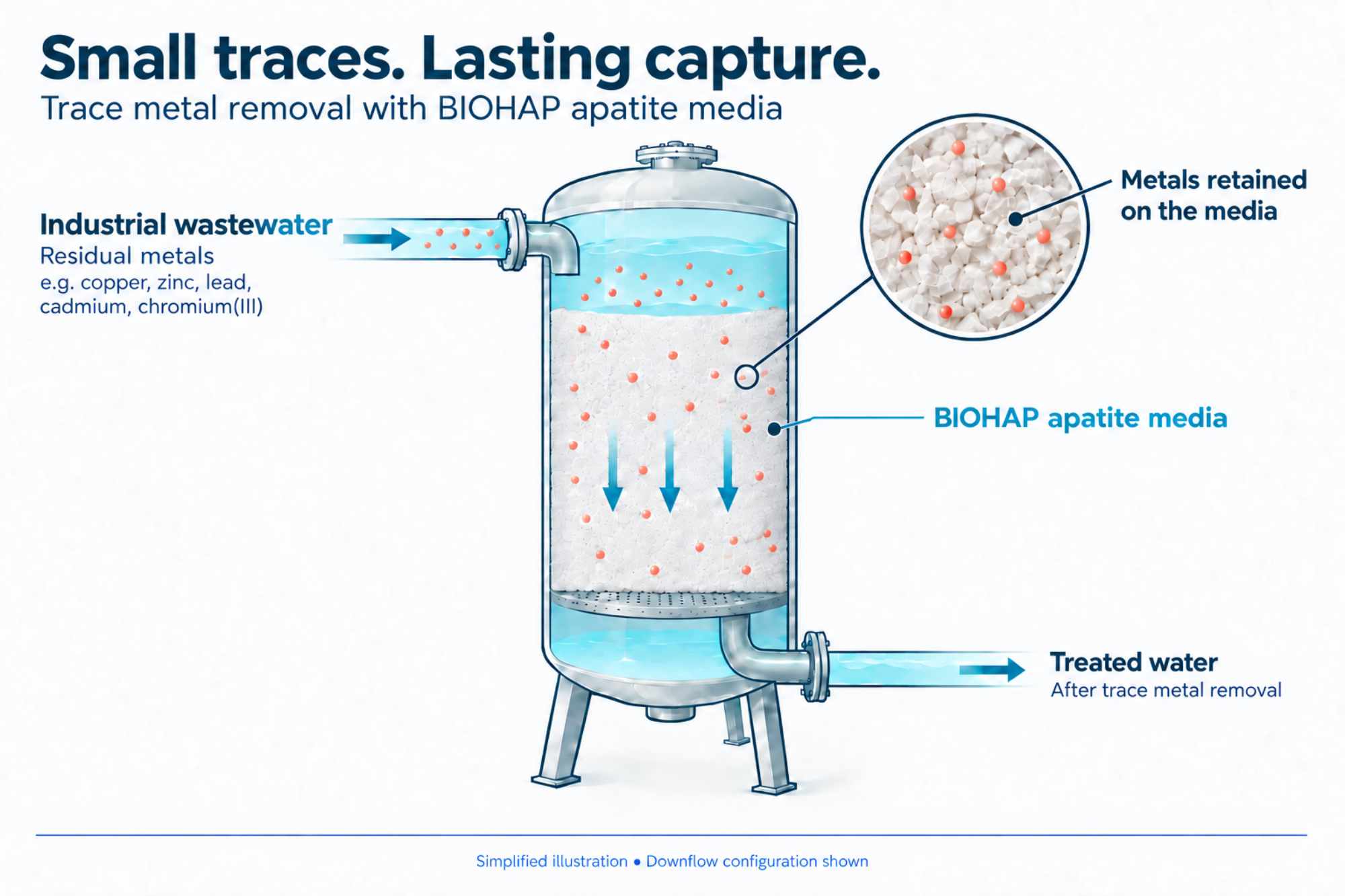
The technology can simultaneously target metals such as copper, zinc, cadmium, lead, nickel and chromium by immobilising them within stable mineral phases.
What are the main areas of activity of the company?
M.S: BIOHAP specialises in treating residual metals in industrial wastewater, particularly when conventional treatment processes alone can no longer consistently achieve the required discharge levels.
Our solutions are intended for a wide range of industries, including metalworking, pulp and paper manufacturing, industrial laundries, surface treatment, waste incineration, electronics, chemicals, food and beverage production, cement manufacturing, mining and quarrying. They can also be used for environmental remediation and industrial water-reuse projects.
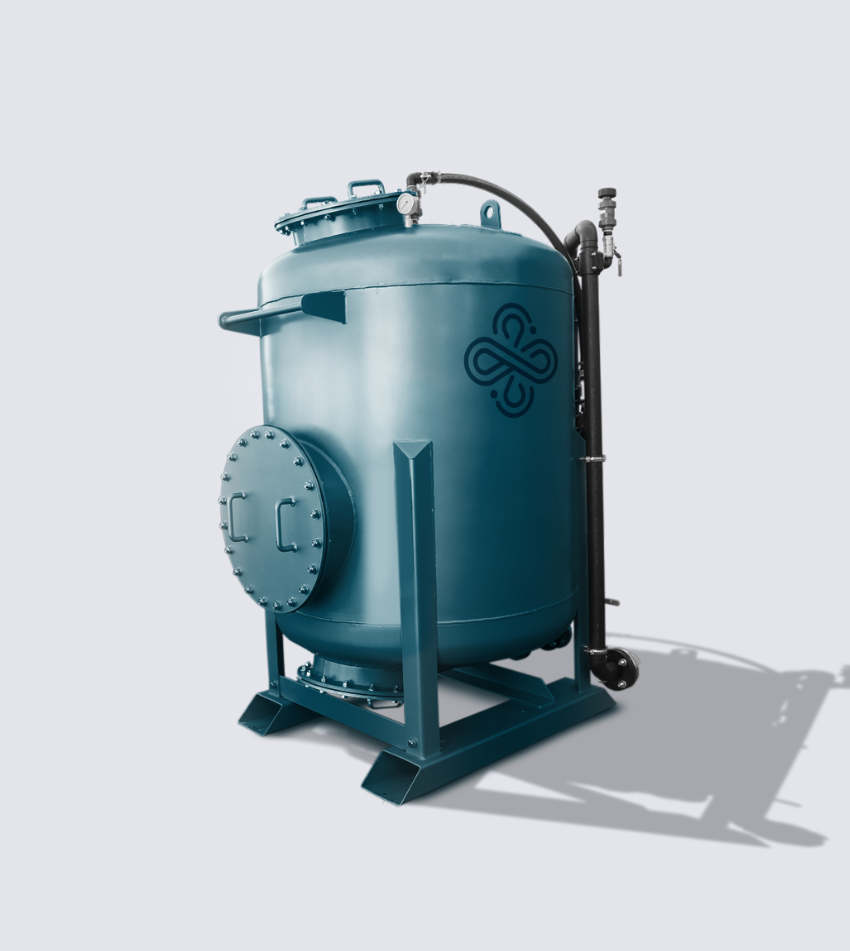
BIOHAP works closely with industrial operators, water-treatment companies, engineering firms and solution integrators. Our support ranges from laboratory feasibility studies using real wastewater to pilot testing, process integration and full-scale system sizing.
What’s the news about new products/services?
M.S: BIOHAP’s latest development is its new range of apatite powders, designed for direct dosing into existing physicochemical and batch treatment processes.
Technical apatites represent a new approach to water treatment. They are inspired by the natural ability of geological apatites to capture and stabilise metals, but their composition and properties are specifically optimised for industrial water-treatment applications.
BIOHAP has developed several technical apatite formulations to address different contaminants and wastewater compositions. These formulations can be produced as either granules or powders, depending on how the treatment process operates.
The powder format provides greater operational flexibility. It can be incorporated directly into an existing treatment tank, with a dosage adapted to variations in metal concentrations and treatment objectives. This makes it possible to introduce the technology without necessarily installing an additional filtration unit.
What are the ranges of products/services?
M.S: BIOHAP offers two complementary product ranges based on the same mineral metal-immobilisation technology.
Granular apatite is used as a fixed-bed filter medium for continuous polishing treatment. As wastewater passes through the filter, the media immobilises residual metals. The process operates continuously and autonomously, with minimal operator intervention and without the daily handling of chemical reagents. Depending on the application, the filter media can remain in operation for 12 to 18 months before replacement.
Apatite powder is added directly to treatment tanks or existing physicochemical processes. Its dosage can be adjusted according to the wastewater composition, variations in metal concentrations and the required treatment performance. It is particularly suitable for batch processes and installations requiring greater operational flexibility.
BIOHAP also provides laboratory feasibility studies, on-site pilot trials, technical support and treatment-system sizing. These services make it possible to select the most suitable formulation and format for each industrial application.
What is the state of the market where you are currently active?
M.S: The European industrial wastewater-treatment market is evolving rapidly. Many industrial facilities already have effective conventional systems for removing the main pollutant load, but they may still encounter difficulties in consistently achieving very low residual metal concentrations.
This creates growing demand for polishing technologies that can be integrated downstream of existing treatment processes without requiring a complete redesign of the wastewater-treatment plant.
However, every industrial wastewater stream is different. Its composition, pH, competing ions, flow-rate variations and discharge objectives can significantly influence treatment performance. For these reasons, our customers particularly appreciate preliminary laboratory studies and pilot trials, which provide practical performance data on their own wastewater before full-scale deployment.
What can you tell us about market trends?
M.S: Several major trends are currently shaping the market. Discharge requirements are becoming increasingly stringent, while industrial companies are paying greater attention to water reuse, chemical consumption, sludge production and the environmental footprint of their treatment processes.
There is growing interest in passive, modular and easy-to-operate technologies. Mobile treatment units are also becoming more widely used for temporary industrial projects, contaminated sites and environmental-remediation operations.
Another important trend is the shift from technologies designed mainly to remove large pollutant loads towards more selective solutions capable of treating low residual concentrations. Industrial operators are looking for robust processes that can manage variations in wastewater quality while reducing daily chemical handling and operator workload.
What are the most innovative products/services marketed?
M.S: BIOHAP’s core innovation lies in its patented technical apatites and in the way their natural properties have been optimised for industrial water treatment.
Apatite is a calcium-phosphate mineral found in geological environments. Its structure can interact with metallic contaminants and immobilise them through several complementary mineral mechanisms. BIOHAP reproduces and optimises this natural phenomenon through controlled formulations specifically designed for treating polluted water.
The innovation therefore goes beyond the use of BIOHAP technical apatites in water treatment. It lies in the diversity of available formulations and product formats, the precise control of their physicochemical properties, and their adaptation to different wastewater compositions and industrial treatment processes.
This mineral approach provides high retention capacity, stable metal immobilisation and compatibility with a broad range of operating conditions. It offers industrial operators a robust and easy-to-integrate solution for achieving the final level of treatment required for regulatory compliance.
What estimations do you have for the second half of 2026?
M.S: The second half of 2026 marks a new industrial phase for BIOHAP. The company is strengthening its manufacturing, packaging and logistics capabilities, notably through its installation at the Vitré Communauté Innovation Campus in Brittany.
We expect to increase the number of feasibility studies, field trials and full-scale applications carried out with industrial companies and water-treatment partners. Several projects are also being developed with integrators, mobile water-treatment specialists and environmental-remediation companies in France and other European countries.
Our objective is to convert the results obtained through laboratory and pilot trials into recurring industrial applications, while increasing production capacity and making BIOHAP’s technical apatites more widely available to water-treatment professionals.