
As embedded systems become the backbone of modern industry, from automotive platforms to robotics and industrial automation, the challenge is no longer just building software. Companies must manage growing complexity, ensure safety and reliability, and bring innovation into production at a scale.
eSOL positions itself at this intersection, offering not only a real-time operating system, but a full-stack engineering approach designed to deliver measurable, real-world impact for its customers.
From Technology to Tangible Value
At the heart of eSOL’s strategy lies a clear definition of “real impact”: enabling customers to transform prototypes into reliable, certified, and scalable production systems. Rather than focusing solely on software performance, eSOL measures success through concrete outcomes such as reduced integration effort, improved system reliability, and faster time-to-market.
This philosophy reflects a broader shift in the embedded world. With software complexity reaching hundreds of millions of lines of code and hardware architectures evolving rapidly, companies increasingly need solutions that span the entire development lifecycle. [esol.com]
Tackling Industry Pain Points
Modern embedded development faces several persistent challenges. Systems often combine multiple processor types, including microcontrollers, real-time cores, and application processors, each traditionally running different operating systems. This fragmentation leads to duplicated effort, higher maintenance costs, and integration risks.
eSOL addresses this through its eMCOS platform, a scalable real-time operating system designed to run consistently across heterogeneous hardware environments. By supporting architectures ranging from Cortex-M microcontrollers to high-performance multicore processors and RISC-V platforms, eMCOS reduces the need for multiple software stacks and toolchains. [esol.com]
Another major challenge lies in bridging the gap between innovation and production. Many systems begin as prototypes built with open ecosystems such as ROS, but struggle to meet the determinism, safety, and certification requirements of industrial deployment. eSOL’s approach allows these systems to evolve without requiring a full redesign.
Bridging Prototype and Production
One of the most compelling examples of eSOL’s impact is its ability to support the transition from experimental robotics software to industrial-grade systems. Developers can run ROS 2 directly on eMCOS POSIX, maintaining familiar development workflows while gaining deterministic behavior and tighter resource control.
Through interoperability with industrial runtime environments such as RTMaps, these systems can then move toward production-ready architectures that meet safety requirements, including ISO 26262 certification up to ASIL-D. [esol.com]
The result is a smoother path from concept to deployment, reducing engineering effort, minimizing risk, and accelerating time-to-market.
A Platform Designed for Change
Adaptability is built into eSOL’s core technology. The multikernel architecture of eMCOS enables efficient scaling across multicore and manycore systems, avoiding the bottlenecks associated with traditional operating systems. Each core runs an independent kernel, allowing high performance and strong isolation, both key factors for mission-critical systems.
At the same time, POSIX compatibility ensures that existing software assets, including Linux- and ROS-based applications, can be reused. This combination of scalability and compatibility allows customers to evolve their systems without starting from scratch.
Co-Creation as a Business Model
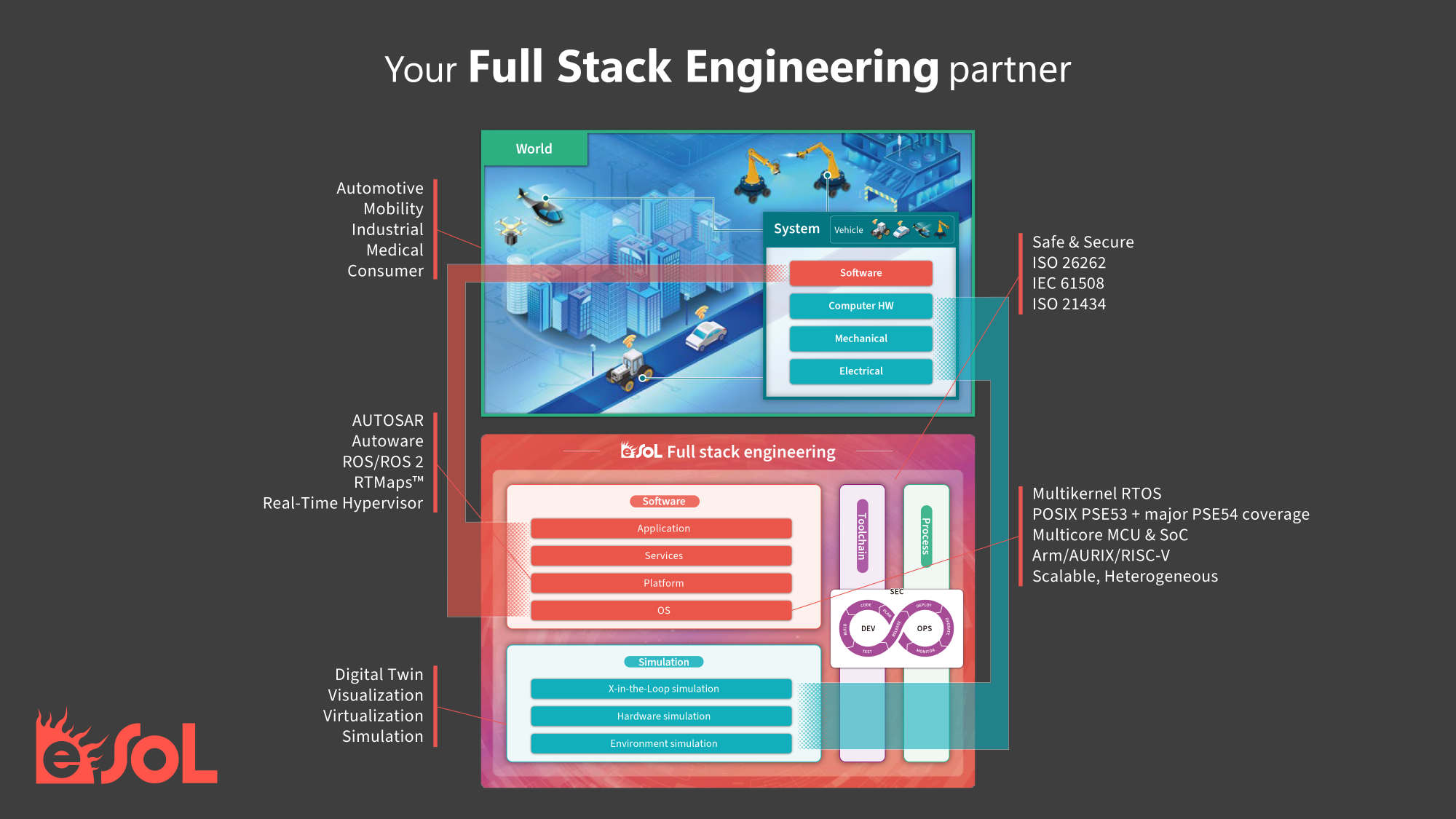
eSOL’s impact is not delivered through software alone. The company emphasizes long-term collaboration with customers, providing engineering expertise across the entire stack, from OS and middleware to application design and certification processes.
This co-creation model addresses a common industry issue: vendor fragmentation. Instead of coordinating multiple suppliers, customers can rely on a single partner that understands the full system architecture and remains accountable throughout the project lifecycle.
Enabling Digital Transformation
Digitalization technologies such as AI, IoT, and advanced automation further amplify eSOL’s value. The platform supports data-intensive workloads, sensor fusion pipelines, and distributed systems, enabling real-time processing in applications such as autonomous systems and industrial automation.
By combining modern software ecosystems with hard real-time guarantees, eSOL enables companies to adopt cutting-edge technologies without compromising determinism or safety.
Sustainability Through Efficiency
While sustainability is often discussed in terms of energy or emissions, eSOL approaches it from a system efficiency perspective. A unified platform reduces redundant development work, lowers hardware dependency, and extends product lifecycles. Deterministic execution ensures optimal use of computing resources, contributing indirectly to more sustainable system design.
Balancing Innovation and Reliability
A defining characteristic of eSOL’s offering is its ability to balance advanced innovation with industrial-grade reliability. The eMCOS platform is certified to ISO 26262 ASIL-D, one of the highest safety standards in the automotive industry, while still supporting modern development paradigms and scalable architectures. [esol.com], [esol.com]
This dual focus on innovation and safety enables customers to push technological boundaries without compromising on quality or compliance.
Preparing for the Future of Embedded Systems
Looking ahead, several trends are shaping the future of industrial innovation: the rise of software-defined systems, increasing hardware heterogeneity, and the growing importance of safety-critical software beyond automotive into robotics and industrial applications.
eSOL is preparing for this landscape with its Full Stack Engineering approach, integrating operating systems, middleware, tools, and services into a unified offering. By supporting both emerging ecosystems and strict industrial requirements, the company positions itself as a key enabler of next-generation embedded systems.
A Clear Value Proposition
Ultimately, eSOL’s message is straightforward: industrial innovation only creates value when it reaches production. By providing a single, scalable platform and the engineering expertise to support it, eSOL helps customers turn complexity into competitive advantage, delivering real impact where it matters most.