
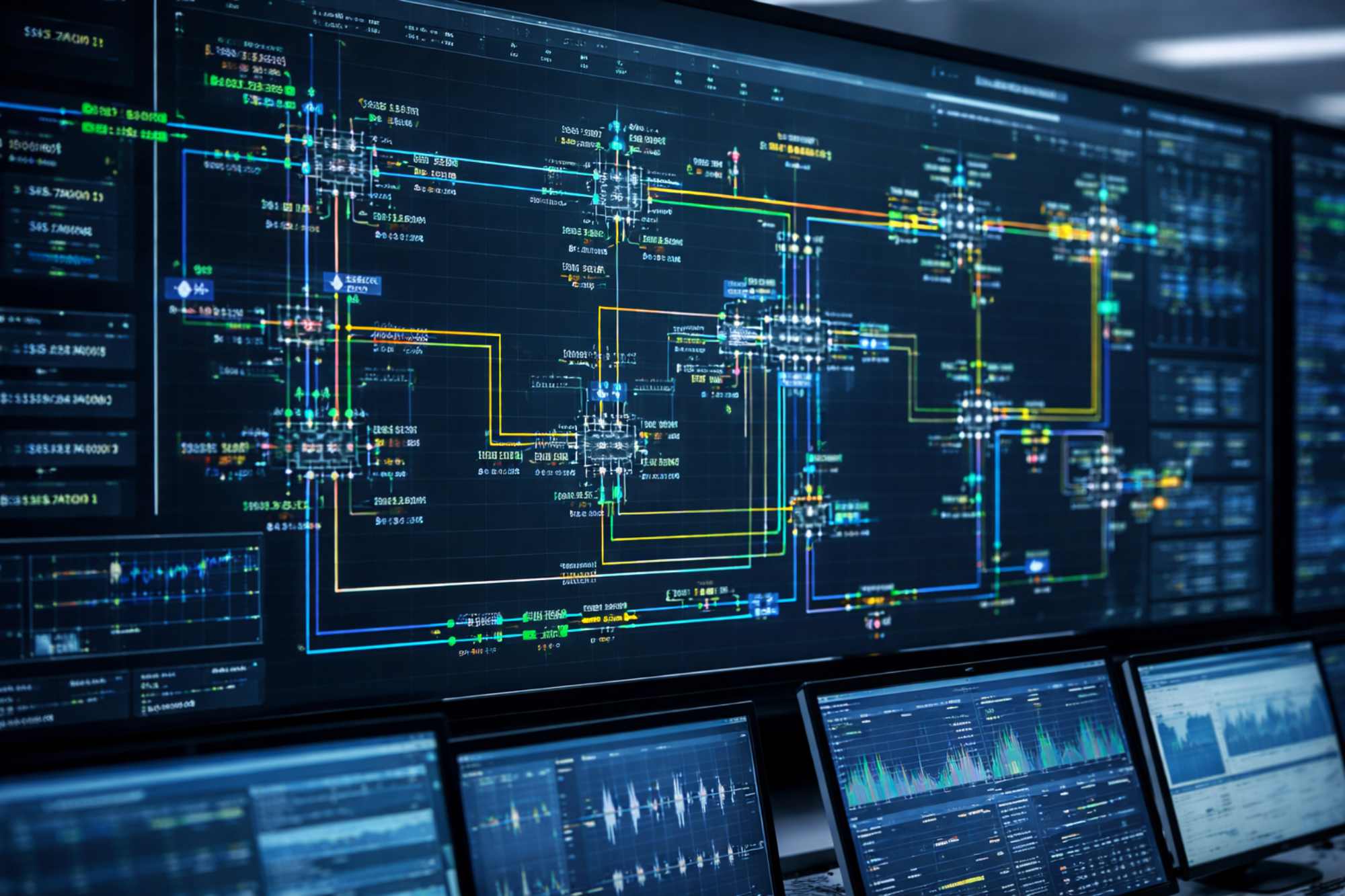
As power grids become more connected, the pressure on companies to secure industrial communication protocols is intensifying. Standards such as IEC 62351 are raising the cybersecurity bar, but in practice many engineering teams face a less visible problem. They do not have the right tools to properly test what they build.
This is particularly true for IEC 60870 5 104, widely known as IEC 104, a core telecontrol protocol used in electrical power systems. It enables SCADA systems to exchange real time data between substations, remote terminal units and control centres over TCP IP networks. IEC 62351 5 extends this protocol with authentication and security mechanisms designed to protect against spoofing, replay attacks and unauthorised access.
On paper, the path is clear. Implement the security extensions and validate them. In reality, many companies discover that suitable test environments simply do not exist.
When the testing environment does not exist
Engineering teams working with niche industrial protocols often rely on physical devices or specialised simulators to validate behaviour. But for newer combinations of legacy protocols and modern security extensions, commercial simulators may not support the full feature set. Hardware can also be scarce, expensive or unavailable during development.
That was the situation in a recent project at EU-based technology company Wirtek, involving IEC 104 secured with IEC 62351 5. Wirtek develops software and IoT solutions for companies in energy, connectivity and industrial automation, with a strong focus on modernising critical systems without increasing operational risk. In this case, the team had no access to a physical RTU and no off the shelf simulator capable of emulating both the protocol behaviour and the required security layer. Without a realistic communication partner, validating correctness becomes theoretical rather than practical.

As Filipe Fernandes, one of the lead engineers involved in the project, explained, “We quickly realised that the real bottleneck was not the implementation itself, it was the lack of a proper environment to prove that everything behaved as expected.”
For companies operating in critical infrastructure, that gap represents risk. Security mechanisms cannot be considered robust unless they are tested against realistic peer behaviour, including edge cases and unexpected message sequences.
Building the missing piece
Instead of postponing validation or limiting the scope of testing, the team decided to build their own virtual RTU. The goal was straightforward. Create a software based communication partner capable of speaking IEC 104, implementing the relevant IEC 62351 5 mechanisms, and interacting with the gateway under development as if it were a real field device.
AI tools were used to accelerate parts of the development process. Large language models supported exploration of protocol flows, edge cases and message structures. They did not replace engineering judgement, but they helped speed up iterations and clarify ambiguities in the standard.
According to Filipe, “AI did not write a finished solution for us. It helped us reason faster. We could challenge assumptions, simulate scenarios and refine our approach in a much shorter cycle.”
The result was a controlled, repeatable test environment that enabled full validation of authentication flows, session handling and error conditions. More importantly, it allowed the team to move from document level compliance to behaviour level verification.
A broader shift in industrial engineering
This example reflects a wider trend. As industrial systems modernise, companies are increasingly forced to build parts of their own tooling ecosystem. Standards evolve faster than commercial simulation products. Security requirements expand faster than legacy environments can adapt.
AI is emerging as a practical support tool in this context, not as an autonomous system making safety critical decisions, but as an accelerator for engineers who need to navigate complex specifications and interactions.
For companies working in energy, utilities and other critical sectors, the lesson is clear. Implementing a standard is only half the job. The ability to test it under realistic conditions is just as important. When the tooling market does not yet provide what is needed, building internally, supported by AI where appropriate, can be a pragmatic and effective response.
With more than two decades of experience in embedded systems, IoT and energy software, Wirtek has increasingly focused on supporting the energy transition, helping utilities and technology providers modernise infrastructure, improve resilience and meet evolving regulatory demands. Projects like this illustrate how deep protocol expertise combined with practical engineering innovation can reduce risk in some of the most critical digital environments.